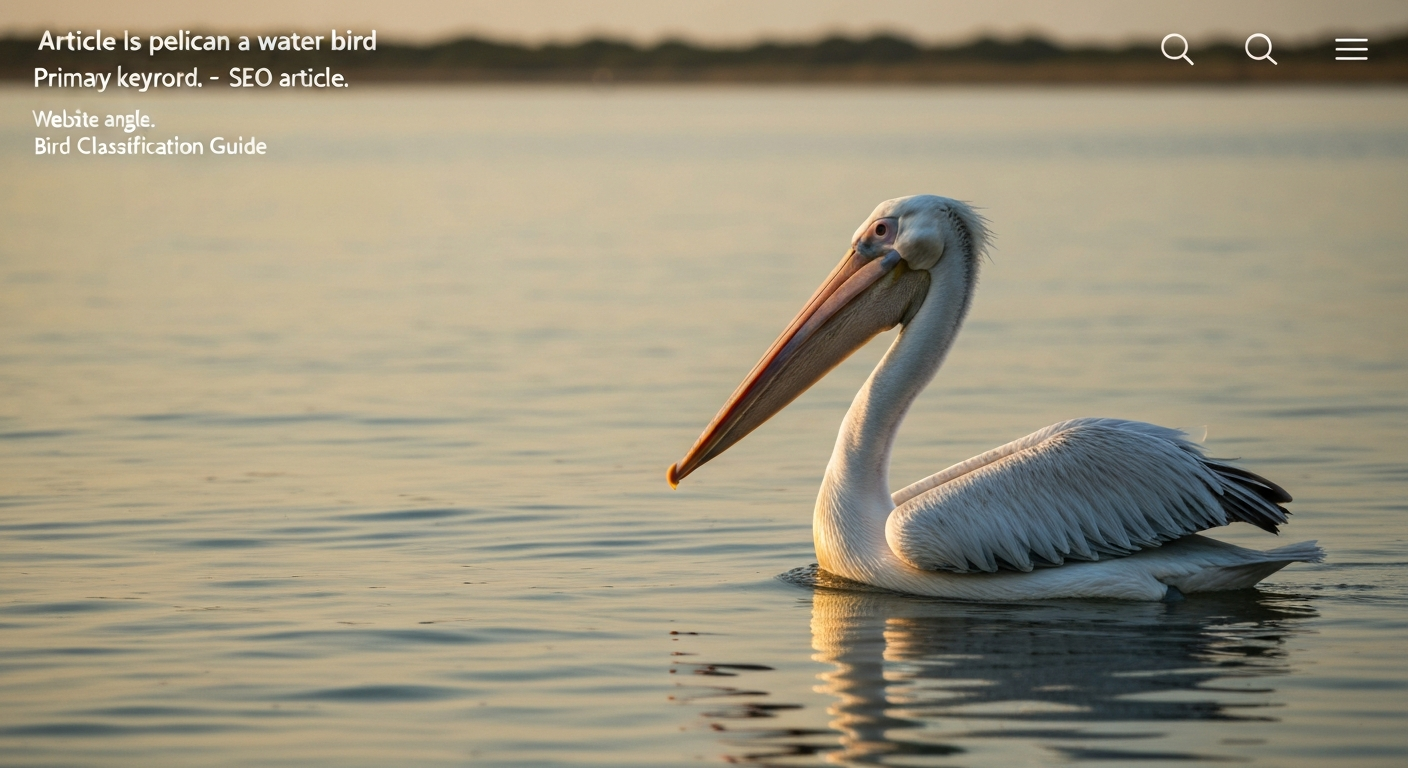
Yes, pelicans are water birds. They belong to the family Pelecanidae within the order Pelecaniformes, and every species in the genus Pelecanus is ecologically dependent on aquatic habitats for feeding, nesting, and survival. Their anatomy, diet, and behavior all meet the biological criteria that ornithologists and wetland scientists use to classify a species as a water bird.
Is Pelican a Water Bird? Quick Answer, Traits & ID Tips

Sarah Chen
13 Jul 2026
Is a pelican a bird at all? Taxonomy first
Before we get into the water-bird question, it is worth grounding the answer in classification, because that is where a lot of confusion starts. Pelicans are unambiguously birds. They belong to the class Aves, which means they have feathers, lay eggs, are warm-blooded, and have a skeleton with hollow bones adapted for flight. No reptile, mammal, or fish shares that combination of traits.
More specifically, pelicans sit in family Pelecanidae, which contains a single genus, Pelecanus, with eight living species. Major taxonomic authorities, including the IOC World Bird List, the Clements Checklist used by eBird, and ITIS (Integrated Taxonomic Information System), all place Pelecanidae within the order Pelecaniformes. That order also includes herons, ibises, spoonbills, and the hamerkop, all of which share a broadly aquatic lifestyle.
People sometimes wonder whether a pelican could be a fish or a reptile simply because it lives near water and has an unusual, almost prehistoric-looking bill. The answer is no. The presence of feathers alone is enough to settle the question: feathers are a defining trait of birds and appear in no other living animal group. If you are working through similar questions, the same logic applies to penguins and ostriches, both of which are also birds despite common misconceptions.
What biologists actually mean by 'water bird'
The term 'water bird' (also written 'waterbird' in scientific literature) is not a formal taxonomic rank. It is an ecological category used by ornithologists and wetland conservationists to group species that depend on aquatic or wetland environments to complete their life cycle. Wetlands International and the Ramsar Convention, the international treaty framework for wetland protection, both use this definition when identifying globally important wetlands under what is called Criterion 6, the 1 percent rule: if a wetland regularly supports at least 1 percent of the global population of any waterbird species, it qualifies as internationally significant. Wetlands International, What are Waterbirds? (Waterbird Population Portal background) defines 'waterbird' as species ecologically dependent on wetlands and notes this usage is applied when identifying Important Waterbird Areas and implementing Ramsar Criterion 6 (the 1% rule) Wetlands International — What are Waterbirds? (Waterbird Population Portal background).
In practice, biologists assess water-bird status using four overlapping criteria: habitat (does the species breed, feed, or roost on or near water?), diet (does it rely on aquatic prey such as fish, crustaceans, or invertebrates?), anatomy (does it have physical adaptations for aquatic life, such as webbed feet, waterproof plumage, or a bill shaped for catching fish?), and behavior (does it swim, dive, or wade as part of its normal foraging routine?). A species does not need to meet all four perfectly, but pelicans satisfy every single one.
How pelicans check every water-bird box
Let me walk through the evidence concisely. Pelicans feed almost exclusively on fish, which they catch directly from the water's surface or by diving into it. Their feet are totipalmate, meaning all four toes are joined by webbing, a trait shared by few bird groups and directly tied to strong aquatic locomotion. Common morphological traits indicating aquatic adaptation in pelicans include a very long bill with a distensible gular pouch, totipalmate feet, long broad wings, and preen‑oil waterproofing (American White Pelican, All About Birds (morphology & adaptations)) American White Pelican — All About Birds (morphology & adaptations). Their plumage is waterproofed through preen-gland oiling, which lets them float and sit on water without becoming waterlogged. They nest on islands, lake shores, and coastal cliffs, almost always adjacent to productive fishing water. And the vast majority of their foraging time is spent on or directly above water. By any reasonable definition, they qualify.
The bill, the pouch, and how pelicans catch fish
The most recognizable feature of any pelican is its bill, specifically the large, expandable gular pouch (from the Latin gula, meaning throat) that hangs beneath the lower mandible. This pouch is a featherless, distensible sac of skin that can stretch enormously, functioning essentially as a dip-net. When a pelican scoops or plunges, the pouch expands to engulf both water and fish, then the bird tilts its head to drain the water before swallowing its catch.
The pouch does double duty beyond catching food. In hot weather, pelicans flutter it rapidly, a behavior called gular flutter, to cool themselves through evaporation. Parent birds also regurgitate fish directly into the pouch for chicks to feed from, making it a multi-purpose soft-tissue tool unique among birds.
Feeding strategies differ by species. Brown Pelicans (Pelecanus occidentalis), which reach about 100 to 137 cm in length with a wingspan up to 2 meters and a weight of 2 to 5 kg, are aerial plunge-divers. They spot fish from heights of up to 20 meters, then tuck their wings and crash into the water head-first. American White Pelicans (Pelecanus erythrorhynchos), which are considerably larger at 140 to 183 cm with a wingspan up to 3 meters and a weight of 4 to 8 kg, rarely plunge-dive at all. Instead, they forage cooperatively on the surface, working in groups to herd fish into shallow water before scooping them up. Studies at sites like Pyramid Lake have documented White Pelicans targeting species such as carp, minnows, and crayfish. Brown Pelicans rely heavily on schooling pelagic fish including anchovies and sardines.
Webbed feet, swimming, and how pelicans move
Pelican feet are totipalmate, a term worth defining because it is more specific than simply 'webbed.' Most swimming birds, such as ducks, have palmate feet with webbing connecting three forward-facing toes. Totipalmate means all four toes, including the small hind toe, are connected by a continuous web. This configuration produces a larger paddle surface and is considered a stronger aquatic adaptation. Cormorants, gannets, and frigatebirds share this trait, and all are closely tied to water.
Despite their bulk, pelicans are accomplished fliers. They use thermal columns of rising warm air to soar at considerable height, often flying in V-formations or lines to conserve energy during long-distance travel. Their long, broad wings are efficient at soaring rather than rapid flapping, which suits a bird that needs to cover large distances between nesting colonies and fishing grounds. On the water, they sit buoyantly, kept afloat partly by their hollow bones and partly by air sacs in the body and beneath the skin that act as natural life jackets.
Where pelicans live and how they behave in the wild
Pelicans occupy a wide range of aquatic environments: saltwater coasts, estuaries, large inland lakes, rivers, and wetlands. They are found on every continent except Antarctica, making them among the most geographically widespread water birds on earth. They are absent from polar regions and the open ocean but thrive wherever large bodies of shallow, productive water exist close to suitable nesting sites.
Nesting is colonial, meaning large groups breed together in the same location, often on islands that offer protection from ground predators. American White Pelicans migrate long distances, moving from inland breeding lakes in the northern United States and Canada to coastal wintering grounds in the southern U.S., Mexico, and Central America. Brown Pelicans tend to be more sedentary along coastlines but still undertake seasonal dispersal movements. Great White Pelicans (Pelecanus onocrotalus) in Europe and Africa similarly move between breeding wetlands and coastal or estuarine wintering areas.
Pelican species at a glance
| Species | Scientific Name | Primary Habitat | Feeding Method | IUCN Status |
|---|---|---|---|---|
| Brown Pelican | Pelecanus occidentalis | Coastal saltwater, estuaries | Plunge-diving | Least Concern |
| American White Pelican | Pelecanus erythrorhynchos | Inland lakes, coastal wetlands | Cooperative surface scooping | Least Concern |
| Great White Pelican | Pelecanus onocrotalus | Large lakes, deltas (Africa/Europe/Asia) | Surface scooping, cooperative | Least Concern |
| Dalmatian Pelican | Pelecanus crispus | Lakes, rivers, deltas (Europe/Asia) | Surface scooping | Vulnerable |
| Australian Pelican | Pelecanus conspicillatus | Coastal and inland waters (Australia) | Surface scooping | Least Concern |
| Pink-backed Pelican | Pelecanus rufescens | Inland waters, coasts (Africa/Arabia) | Surface scooping | Least Concern |
| Spot-billed Pelican | Pelecanus philippensis | Inland lakes and coasts (South/SE Asia) | Surface scooping | Near Threatened |
| Peruvian Pelican | Pelecanus thagus | Coastal (Pacific, South America) | Plunge-diving | Least Concern |
Pelicans compared to other birds people commonly confuse
Because this site focuses on clearing up classification confusion, it is useful to briefly compare pelicans to animals that appear in related questions. For a similar classification question, see Is an impala a mammal, bird, insect, or fish. The most common mix-up involves penguins. Both pelicans and penguins are birds, but they sit in entirely different orders and have very different lifestyles. A penguin is a bird; a penguin is a bird i know this because it explains that being flightless does not make an animal anything other than a bird. For more on penguins' classification, see the article are penguins bird. Penguins (order Sphenisciformes) are flightless, use their wings as flippers for underwater swimming, and live in the Southern Hemisphere. Pelicans are strong fliers that catch fish from above or at the surface. The question of whether penguins are birds or mammals trips people up because penguins do not fly, but flight is not a requirement for being a bird. For more detail on whether a penguin is a bird or an animal, see the penguin is bird or animal guide. Ostriches, emus, and kiwis are all flightless birds too. For a focused explanation of why penguins are classified as birds, see why is a penguin a bird (internal link).
Bats are another common point of confusion for readers new to bird classification. Bats are mammals: they give birth to live young, nurse with milk, and have wings made of skin stretched over elongated finger bones. No feathers, no beak, no eggs. Pterosaurs, the flying reptiles of the Mesozoic era, are also frequently mistaken for early birds, but they were reptiles, not birds, and all went extinct roughly 66 million years ago. True birds evolved from theropod dinosaurs and are the only living descendants of that lineage.
Key traits that make pelicans water birds: a quick summary
- Classified in family Pelecanidae, order Pelecaniformes, class Aves: unmistakably a bird
- Diet dominated by fish caught directly from water through diving or surface scooping
- Totipalmate webbed feet on all four toes, enabling strong swimming
- Large, distensible gular pouch for catching and draining water from prey
- Preen-gland waterproofing that keeps plumage dry and maintains buoyancy
- Breeding and foraging habitats are exclusively aquatic: coasts, lakes, rivers, and wetlands
- Colonial nesting on islands or lake shores adjacent to productive fishing water
- Long-distance migration patterns that follow water bodies and seasonal fish availability
Conservation status and human impact
Most pelican species are listed as Least Concern by the IUCN, meaning their global populations are not currently at risk of extinction. The major exception is the Dalmatian Pelican (Pelecanus crispus), classified as Vulnerable, with populations concentrated in fragmented wetlands across central Europe and Asia facing habitat loss and human disturbance.
The Brown Pelican offers one of the more striking conservation recovery stories in North American ornithology. Populations crashed dramatically in the mid-20th century, largely because the pesticide DDT and its breakdown product DDE caused eggshell thinning so severe that nesting adults crushed their own eggs. After DDT was banned in the United States in 1972 and targeted recovery actions were implemented, Brown Pelican numbers rebounded sufficiently for the U.S. Fish and Wildlife Service to delist the species. It now serves as a textbook example of how removing a specific chemical threat can allow a wildlife population to recover, provided enough suitable habitat remains.
Pelicans remain sensitive to water quality, fish stock health, and wetland availability. Because they sit at the top of aquatic food chains and feed exclusively on fish, they act as useful indicators of ecosystem health. A thriving pelican colony on a lake or estuary is generally a sign that the underlying fish community is productive and the water is in reasonable condition.
FAQ
Short answer: Is a pelican a water bird?
Yes. Pelicans (genus Pelecanus) are birds in the family Pelecanidae and are classed as waterbirds because they are ecologically and anatomically adapted to aquatic life—they feed mainly on fish, live and nest at coasts, lakes and wetlands, have webbed feet and a specialized gular (throat) pouch for scooping fish.
Pelican taxonomy — where do pelicans fit in bird classification?
Pelicans belong to the order Pelecaniformes (per major taxonomies such as IOC, Clements, ITIS) and to the single genus Pelecanus in the family Pelecanidae. There are eight living Pelecanus species recognized by standard checklists (sources: ITIS; IOC World Bird List; Cornell Lab All About Birds).
What biological criteria define a “water bird”?
In ecology and conservation a “waterbird” is a bird species largely dependent on aquatic habitats and resources. Key criteria: primary habitat use (wetlands, coasts, lakes, rivers, seas), diet mainly from aquatic sources (fish, invertebrates), anatomical/behavioral aquatic adaptations (webbed feet, waterproof plumage, specialized bills, diving/swimming or surface‑scooping foraging), and life‑history ties to water for breeding or roosting (Ramsar/Wetlands International usage).
What evidence shows pelicans meet those waterbird criteria?
Pelicans meet each criterion: habitat—coasts, estuaries, lakes, rivers and wetlands; diet—primarily piscivorous (fish) documented in diet studies; anatomy—totipalmate feet (all four toes webbed), large waterproofed plumage from preen‑oil, very long bill with a distensible gular pouch used to scoop fish; behavior—surface‑scooping, plunge‑diving (Brown Pelican), cooperative herding and scooping (White Pelicans), and nesting colonies at water margins (Cornell All About Birds; National Geographic; Wetlands International).
How do pelicans differ from penguins, ostriches and other “borderline” animals?
- Pelicans vs penguins: Both are birds. Pelicans fly (most species) and have totipalmate feet and a gular pouch; penguins are flightless, wing‑propelled divers with flipper‑like wings and lobed toes—penguins are not mammals or fish. - Pelicans vs ostriches: Ostriches are flightless terrestrial birds with reduced wing flight bones and only two toes; pelicans are aquatic, fly well, and have fully webbed feet. - Pelicans vs bats/pterosaurs: Bats are mammals with skin wings and are not birds; pterosaurs are extinct flying reptiles (not birds). In short: pelicans are true birds and true waterbirds; penguins are birds adapted to aquatic life but flightless; other examples (ostrich) are birds but not waterbirds.
Common question: “Is a pelican a bird?”
Yes — pelicans are birds (class Aves). They have feathers, lay eggs, possess beaks (bills), and are placed in modern avian taxonomies as family Pelecanidae (order Pelecaniformes). Major ornithological authorities and field guides list pelicans as birds (Cornell Lab, IOC, ITIS).