If you spotted a flying animal and are not sure what you saw, here is the fast answer: bats are mammals, not birds. A bat belongs to the order Chiroptera within class Mammalia, the same biological class as dogs, whales, and humans. A bird belongs to class Aves. The two animals look superficially similar in flight, but they are separated by an enormous evolutionary distance and by several traits you can check on the spot, including feathers, wing structure, and how they reproduce.
Is It a Bat or Bird? Clear ID Guide for Field Observers

Sarah Chen
19 Jul 2026
Is it a bat or a bird? The quick answer
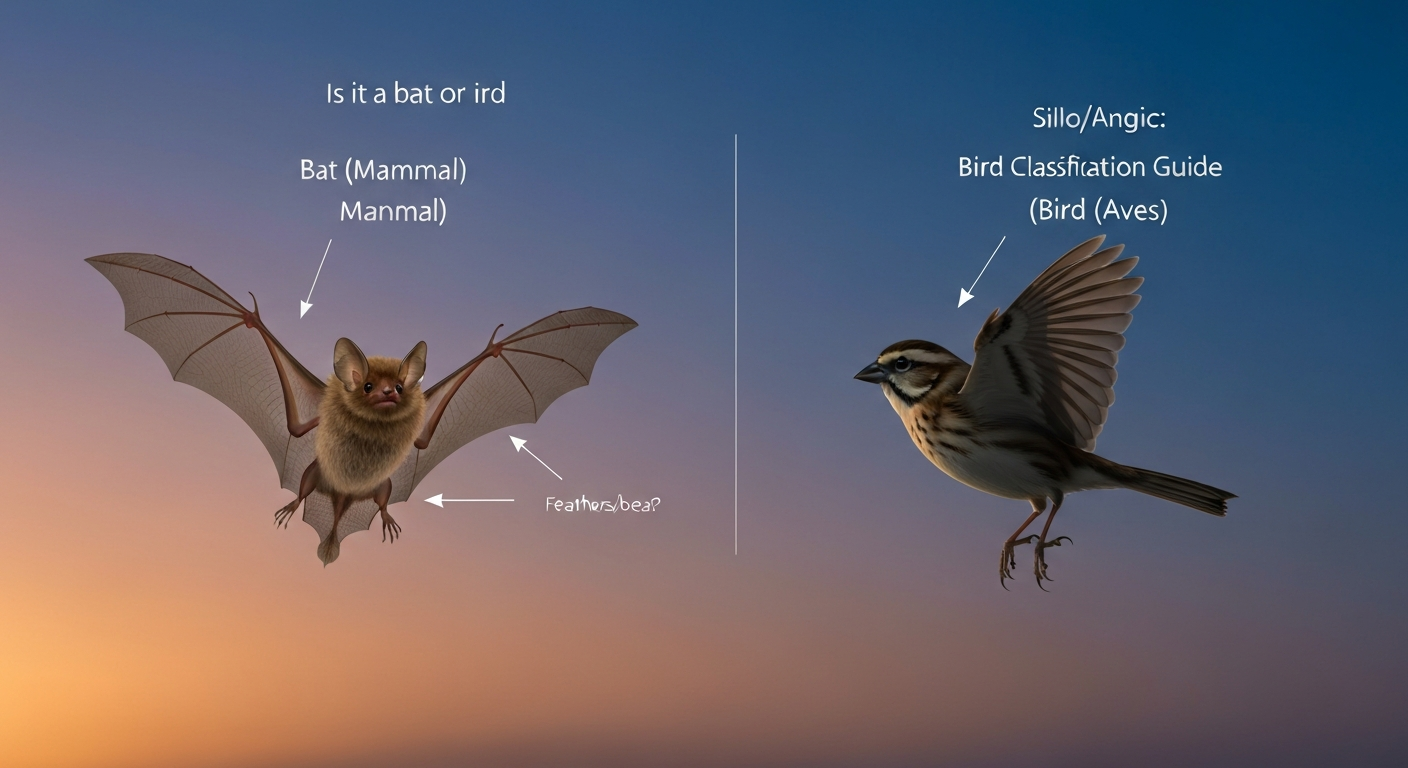
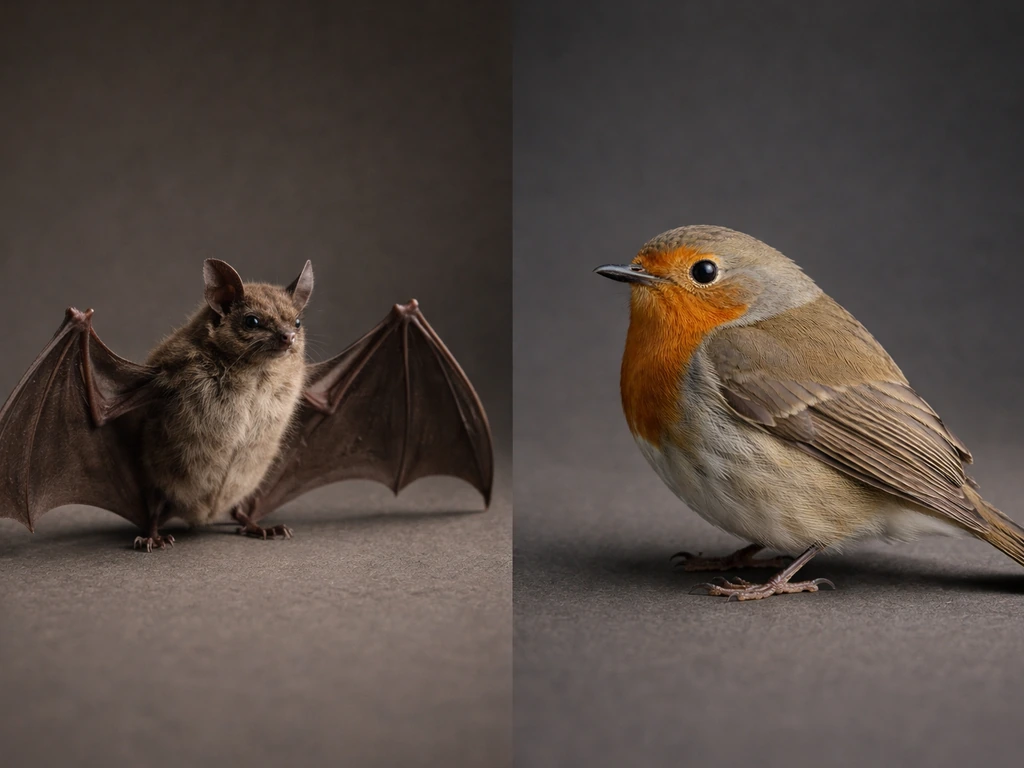
Every bat is a mammal. Every bird is an Aves. No species sits in both categories, and no bat is reclassified as a bird under any modern taxonomic system. The confusion is completely understandable because both animals fly using wings, both can be active at dusk, and from a distance the silhouettes can look alike. But the biological differences are deep: bats give birth to live young and nurse them with milk, while birds lay hard-shelled eggs. Bats have fur and a paper-thin wing membrane stretched over elongated finger bones; birds have feathers and a compact forelimb skeleton. Once you know what to look for, telling them apart takes seconds.
Field ID checklist: what to look for in the moment
You rarely need a microscope or a taxonomy textbook to tell a bat from a bird. The following cues are visible to the naked eye or with basic binoculars, and any one of them is usually enough to make the call. See Bat Conservation International’s 'Bats vs. Birds - Bat Conservation International (practical ID comparison)' for a practical field-identification checklist covering feathers vs fur, membrane vs feathered wings, tail/uropatagium presence, beak vs teeth, flight time, and roosting posture.
- Feathers or fur: birds have feathers covering their body and wings; bats have fur on the body and a bare, leathery wing membrane called the patagium
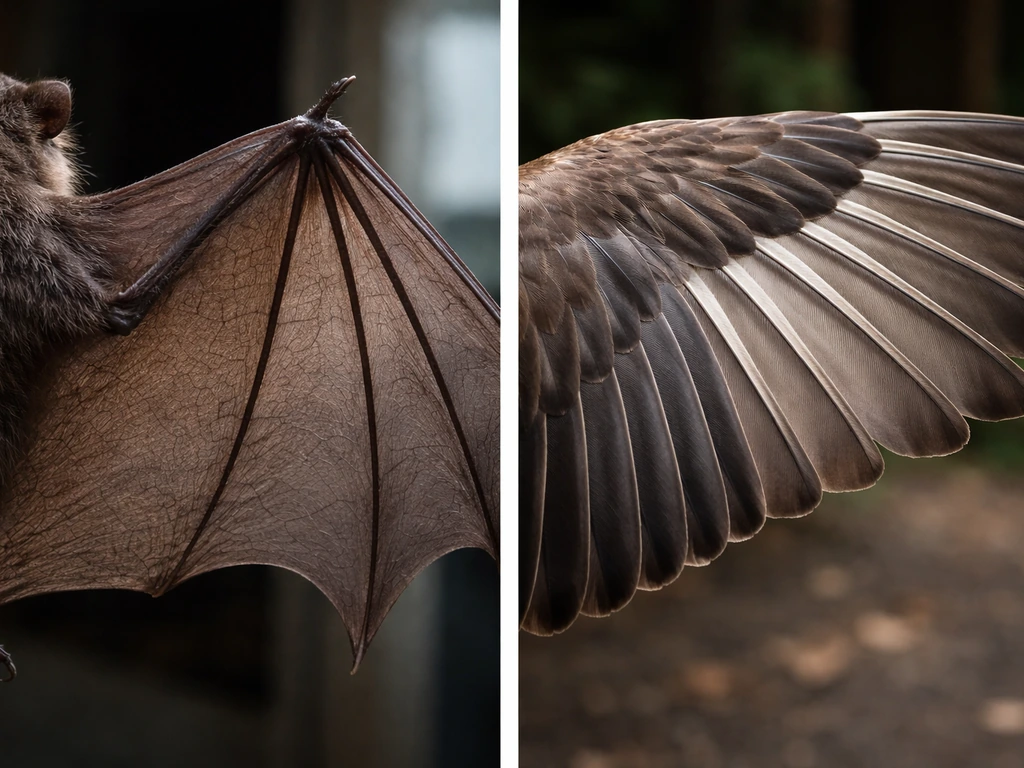
- Wing outline: a bird's wing has a smooth, rounded edge formed by overlapping feathers; a bat's wing shows a thin, translucent membrane and you can often see the finger bones stretching it out
- Tail shape: birds have a fan of tail feathers; many bats have a uropatagium (a membrane stretched between the hind legs and tail) with little or no visible tail feather structure
- Beak vs teeth: birds have a hard, keratinous beak with no true teeth; bats have visible mammalian teeth, including canines and molars, though these are easiest to see up close
- Flight time: most bats are nocturnal and emerge after sunset; most birds fly during daylight, though a few (owls, nightjars) are also active at night
- Flight style: bat flight tends to be highly erratic and maneuverable with rapid direction changes, controlled by reshaping the wing membrane with their fingers; bird wingbeats are generally more regular and predictable
- Roosting posture: bats hang upside down from their feet; birds perch upright on their feet
Side-by-side biological traits: bat vs bird
The differences between bats and birds go well beyond what you see in the field. Every major biological system, from skin covering to reproduction to skeleton, places them in separate categories.
| Trait | Bat (Mammalia: Chiroptera) | Bird (Aves) |
|---|---|---|
| Body covering | Fur (keratin-based hair shafts) | Feathers (complex keratinous structures with rachis, barbs, and barbules) |
| Wing surface | Patagium: thin elastic skin stretched over elongated digits (fingers 2–5) | Feathered aerofoil attached to a fused, shortened forelimb skeleton (carpometacarpus) |
| Reproduction | Viviparous: live birth after internal gestation; young fed with milk | Oviparous: hard-shelled eggs laid, incubated externally |
| Skeleton | Greatly elongated metacarpals and finger bones support the wing membrane | Fused wrist-hand bones (carpometacarpus); flight feathers anchor to forearm and hand |
| Teeth | True mammalian teeth: incisors, canines, molars (diet-adapted) | No teeth: hard keratinous beak in all living species |
| Metabolism & thermoregulation | Endothermic; many temperate species enter torpor or hibernate seasonally | Endothermic; maintain high constant body temperature; no true hibernation in most species |
| Flight mechanics | High wing-shape morphing via digit control; erratic, maneuverable flight | Wingbeat kinematics driven by pectoralis muscles; more rigid wing stroke pattern |
Taxonomy at a glance: where each animal sits
Taxonomy is the formal system biologists use to group living things by shared ancestry. Understanding where bats and birds fall in that system makes it instantly clear why they are not even close relatives.
| Level | Bat | Bird |
|---|---|---|
| Domain | Eukaryota | Eukaryota |
| Kingdom | Animalia | Animalia |
| Phylum | Chordata | Chordata |
| Class | Mammalia | Aves |
| Order | Chiroptera | Varies (e.g., Passeriformes, Strigiformes) |
| Common examples | Little brown bat, fruit bat, vampire bat | Robin, eagle, penguin, ostrich |
Both bats and birds are chordates (they have a backbone), but their last common ancestor lived more than 300 million years ago and was neither a bat nor a bird. From that point, the lineages diverged completely: birds evolved from theropod dinosaurs, while bats evolved from small, insect-eating land mammals. The ITIS (Integrated Taxonomic Information System) and the NCBI Taxonomy Browser both list Chiroptera as an order within Mammalia and Aves as its own separate class, with no overlap.
Why bats are not birds: ancestry, convergent evolution, and the real differences
The core reason bats are not birds is ancestry. Birds descended from theropod dinosaurs (the same lineage that includes Velociraptor and T. rex) and carry the biological hallmarks of that heritage, most importantly feathers, which are unique to birds and their closest extinct relatives. Bats descended from a completely separate branch of vertebrate life: early placental mammals. Bats evolved powered flight roughly 50 million years ago, tens of millions of years after birds were already well-established.
What makes the confusion understandable is a phenomenon called convergent evolution: two unrelated lineages independently arriving at a similar solution to the same problem. Both bats and birds needed to get airborne, so both evolved powered wings built from modified forelimbs. The result looks broadly similar from a distance, but the engineering is entirely different. A bird's wing is a feathered aerofoil supported by fused, compact hand bones. A bat's wing is a flexible membrane stretched across dramatically elongated finger bones, giving bats remarkable mid-flight agility that most birds cannot match. Same function, completely different structure, completely different ancestry.
Beyond wings, the biological checklists do not overlap. Bats nurse their young with milk (a defining mammalian trait), have hair, possess mammalian teeth adapted to their diet, and many temperate bats enter torpor or hibernate in winter, a physiological state driven by mammalian metabolic systems. Birds lay eggs, have beaks instead of teeth, and maintain a high, constant body temperature without hibernating. No amount of superficial visual similarity changes these fundamental biological facts.
Confusion with other flyers: pterosaurs and common misidentifications
Bats and birds are not the only flying vertebrates people mix up. Pterosaurs, the flying reptiles that lived from roughly 228 million to 66 million years ago, are a classic source of confusion, especially for children and anyone who has seen them in popular media. Pterosaurs were neither birds nor bats. They were archosaurs (reptiles more closely related to crocodilians and dinosaurs than to modern lizards), and they evolved flight completely independently of both birds and bats. Powered flight in vertebrates evolved at least three separate times: once in the pterosaur lineage, once in the theropod dinosaur lineage leading to birds, and once in the mammal lineage leading to bats. All three are examples of convergent evolution.
If you see a silhouette in the sky and it looks enormous, leathery, and vaguely reptilian, you are not looking at a pterosaur (all pterosaur species went extinct at the end of the Cretaceous period, 66 million years ago). A large bat, like the flying foxes of the genus Pteropus with wingspans reaching up to 1.5 meters, can look dramatic at dusk and is occasionally reported as something prehistoric. It is still just a bat. Similarly, large birds like herons in slow flight, with their long necks folded and broad wings, are sometimes mistaken for bats or even pterosaurs. The presence of feathers and a beak settles the question every time.
Case study: is a brown bat a bird?
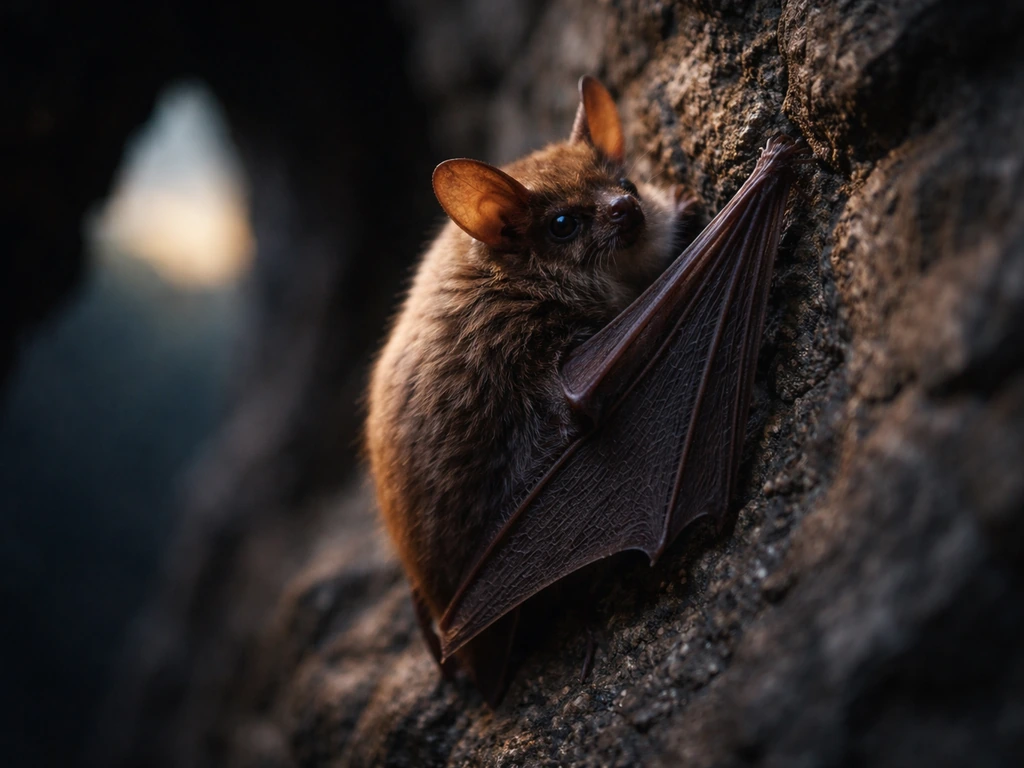
The little brown bat (Myotis lucifugus) is one of the most common bat species in North America and is frequently spotted around homes, streetlights, and bodies of water at dusk. It has a wingspan of roughly 22 to 27 centimeters, brown fur, and the characteristic erratic flight pattern that makes many people do a double-take when they first see it. To answer directly: no, a brown bat is not a bird. It is a mammal, a member of genus Myotis within the order Chiroptera.
Up close, a little brown bat shows every mammalian trait clearly: its body is covered in dense brown fur, its wings are bare membranous skin, and it has small pointed mammalian teeth suited for catching insects in flight. It gives birth to a single pup per year and nurses it with milk. When it roosts, it hangs upside down from cave ceilings, attic rafters, or tree bark, gripping with its hind feet, something no bird does. The big brown bat (Eptesicus fuscus), another commonly seen North American species, follows the same pattern. Both are mammals. Neither is a bird, considered a bird, or in the bird family under any classification system.
Short answers to common variations of this question
Is a bat considered a bird?
No. In biology, a bat is formally classified as a mammal (class Mammalia), not a bird (class Aves). No current taxonomic system considers a bat a bird. The confusion comes from shared flight, not shared biology.
Are bats a type of bird?
No. Bats are a type of mammal. They are the only mammals capable of sustained powered flight, which puts them in a unique position among mammals, but it does not make them birds. See the short answer to 'are bats a type of bird' in the FAQ above for a concise explanation. Being able to fly does not define what class an animal belongs to; ancestry, anatomy, and reproduction do.
Why is a bat not a bird?
A bat is not a bird because it lacks every defining bird trait: it has no feathers, no beak, no bird-type skeleton, and it does not lay eggs. Field guides and ID keys (e.g., blank" rel="noopener noreferrer">Feathers - Biology (All About Birds, Cornell Lab of Ornithology)) list feathers as a primary diagnostic character distinguishing birds from mammals. Instead, it has fur, mammalian teeth, a membrane wing built from elongated finger bones, and it gives birth to live young. Its evolutionary ancestry traces back to early placental mammals, not theropod dinosaurs, which is where birds come from.
Is a bat in the bird family?
No. In taxonomy, 'family' is a specific rank (below order, above genus). Bats belong to families within the order Chiroptera, such as Vespertilionidae (the vesper bats, which include the little brown bat) and Pteropodidae (Old World fruit bats). Birds belong to families within class Aves, such as Accipitridae (hawks and eagles) or Passeridae (sparrows). These two family trees have no overlap whatsoever. For more detail, see the page titled "Is a bat in the bird family" which explains why bats and birds occupy entirely separate families and higher taxa.
How to tell them apart every time: a practical summary
If you are still uncertain after a sighting, run through these three checks in order. They have never failed me in the field.
- Look at the wing surface: if you see individual feathers or a smooth feathered edge, it is a bird; if you see a thin membrane with visible finger-bone stretchers and no feathers, it is a bat
- Check the body: a furry body with no visible feathers means bat; a feathered body means bird
- Note the time and behavior: erratic swooping flight after sunset near water or lights is almost certainly a bat; regular wingbeats in daylight are almost certainly a bird
Those three checks cover the vast majority of real-world sightings. The taxonomy, the evolutionary history, and the full biological comparison all reinforce the same conclusion: bats and birds are fundamentally different animals that evolved flight independently, from entirely different starting points. A bat is a mammal. A bird is a bird. The wings are where the resemblance ends.
Want to go deeper?
If this question got you thinking about what actually defines a bird, it is worth exploring the full definition of class Aves and why some surprising animals like penguins and ostriches qualify as birds even though one cannot fly and the other swims. For a direct classification summary, see the short answer 'Is a bat considered a bird?'. Pterosaurs, the extinct flying reptiles, are covered in more detail elsewhere on this site and are a fascinating case study in convergent flight evolution. Each of those animals, like bats, tests the question 'what is a bird?' in a slightly different way, and the answer always comes back to the same set of biological markers: feathers, a beak, egg-laying, and an ancestry that traces back through the dinosaurs.
FAQ
Is it a bat or bird? (Concise direct answer)
Direct answer: A bat is a mammal (order Chiroptera) and not a bird (class Aves). If the flying animal has feathers and a beak it’s a bird; if it has fur, a thin membranous wing (patagium) stretched over long fingers, and gives live birth, it’s a bat.
Field ID checklist — quick observable cues to tell bat vs bird
Checklist: 1) Feathers vs fur — feathers = bird, fur and exposed skin membrane = bat. 2) Wing structure — feathered vane and solid wing outline = bird; thin membrane between long digits = bat. 3) Beak vs teeth — a hard beak/no visible teeth = bird; visible teeth or mammal-like snout = bat. 4) Flight pattern — flapping with steady wingbeats or soaring (birds) vs rapid, maneuverable, fluttering wingbeats and erratic turns (many bats). 5) Day/night activity — many birds are diurnal; many bats are nocturnal (not universal). 6) Roosting posture — birds perch on feet upright; many bats hang upside down. 7) Tail and uropatagium — bats often have a membrane between legs/tail; birds have feathered tails.
Biological comparison: feathers vs fur, reproduction, skeleton, metabolism, dentition, wing structure and flight mechanics
Feathers vs fur: Birds have feathers (complex keratin structures) forming flight surfaces; bats have hair (fur) and skin membranes. Reproduction: Birds are oviparous (lay eggs); bats are viviparous placental mammals (give live birth). Skeleton: Bird forelimbs have shortened/fused hand bones (carpometacarpus) with feathers attached; bat wings are supported by greatly elongated digits that stretch the patagium. Metabolism/temperature: Both are endothermic, but bats use torpor/hibernation more commonly; physiological patterns differ. Dentition/feeding: Modern birds have bills (no true teeth); bats have mammalian teeth adapted to diet (insectivores, frugivores, nectarivores, sanguinivores). Wing/flight mechanics: Bird wings use feathers and fixed aerofoil shapes with varying wingbeat strategies; bat wings are highly morphing, digit-controlled membranes enabling agile, maneuverable flight.
Taxonomy: where bats and birds sit in classification
Taxonomic placement: Bats — Class Mammalia, Order Chiroptera. Birds — Class Aves. They are placed in separate classes in standard taxonomic databases (e.g., ITIS, NCBI) and are not in the same family or order.
Why bats are not birds (evolutionary explanation)
Bats are not birds because flight evolved independently in mammals and in the dinosaur lineage that produced birds (convergent evolution). Bats descend from mammalian ancestors and share defining mammal characters (hair, mammary glands, live birth). Birds evolved from theropod dinosaurs and have unique bird characters (feathers, egg-laying). Different ancestry and major anatomical differences (wing supported by digits vs feathers attached to fused forelimb bones) place them in different classes.
What about pterosaurs — are they bats or birds?
Pterosaurs are neither bats nor birds; they were flying reptiles that lived during the Mesozoic. Like birds and bats, pterosaurs evolved powered flight independently. Pterosaurs had wing membranes supported mainly by an elongated fourth finger and are an extinct clade distinct from Aves and Mammalia.
Next Articles
Is a Bat in the Bird Family? How Bats Differ From Birds
No: bats are mammals, not birds. Learn key differences in fur, warm blood, reproduction, and wing anatomy.
Is a Brown Bat a Bird? Key Differences Explained
No. A brown bat is a mammal with fur and milk, not a bird; see the key differences like reproduction and echolocation.
Are Bats a Type of Bird? How to Tell Mammals From Birds
Answer if bats are birds: no, bats are mammals. Learn simple traits to separate mammals from birds.