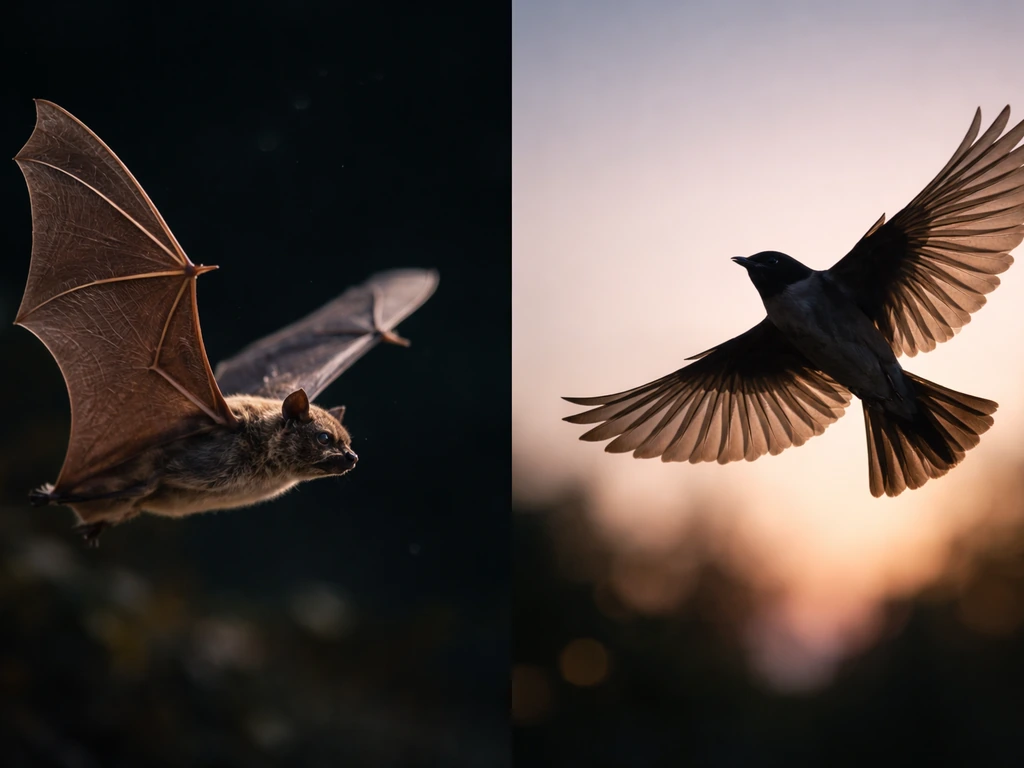
No, bats are not a type of bird. Bats are mammals, classified in the order Chiroptera, which is part of class Mammalia. Birds belong to an entirely separate class called Aves. The two groups share almost nothing in terms of biology beyond being warm-blooded and capable of flight, and flight alone is nowhere near enough to make something a bird.
Are Bats a Type of Bird? How to Tell Mammals From Birds

Sarah Chen
30 Apr 2026
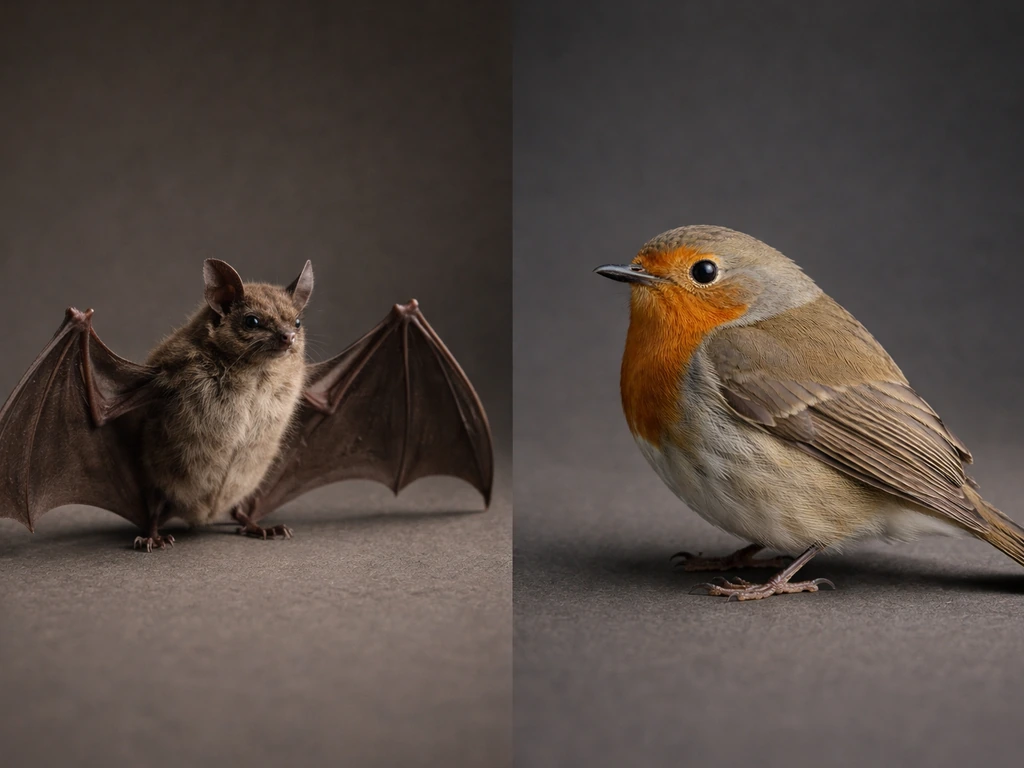
Bats vs. birds: the quick version
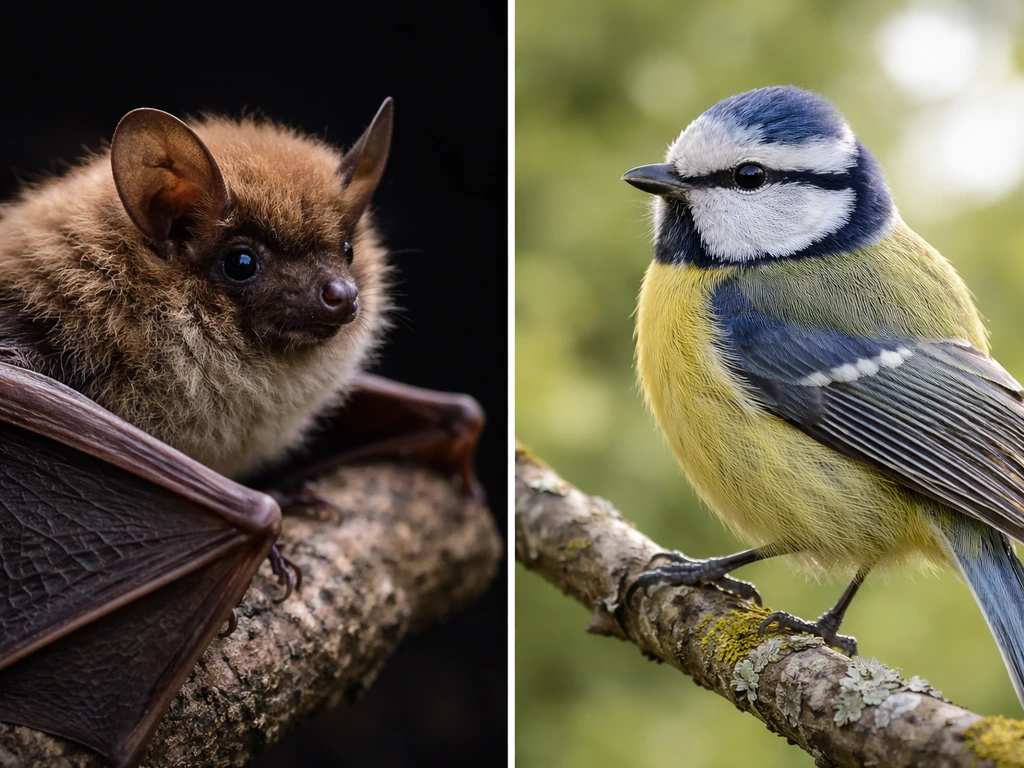
If you need a fast answer, here it is. Bats have fur, give birth to live young, and nurse them with milk. Birds have feathers, lay hard-shelled eggs, and have hollow bones. Those differences map directly onto the two biological classes: Mammalia for bats, Aves for birds. There is no overlap, no gray area, and no version of taxonomy in which a bat qualifies as a bird.
| Trait | Bats | Birds |
|---|---|---|
| Biological class | Mammalia | Aves |
| Order | Chiroptera | Many (e.g., Passeriformes, Strigiformes) |
| Body covering | Fur | Feathers |
| Reproduction | Live birth (most species) | Hard-shelled eggs |
| Young fed by | Milk from mother | Regurgitated food or insects |
| Bones | Dense, flexible | Hollow and lightweight |
| Wings made of | Skin membrane stretched over elongated fingers | Feathers attached to forelimb bones |
| Beak or muzzle | Muzzle with teeth | Beak (no teeth in modern birds) |
What actually makes something a bird
Biologists place animals into class Aves based on a specific set of physical traits, not on whether the animal can fly. According to Britannica, the single most important defining characteristic of birds is feathers. No other living animal group has them. The Smithsonian National Museum of Natural History adds two more key markers: hollow bones (which reduce weight for flight) and hard-shelled eggs. Warm-bloodedness, or endothermy, is also a bird trait, though it is shared with mammals.
It is worth being clear that flight is not a requirement for being a bird. Penguins cannot fly at all, but they still have feathers, hollow bones, and lay hard-shelled eggs, so they are unambiguously birds. Ostriches are the same story. The ability to fly is a behavior some birds have and some have lost over evolutionary time. It is a derived trait within class Aves, not the defining one. So when people ask whether a bat is a bird because it flies, they are actually using the least reliable trait to check.
Why bats are mammals, not birds
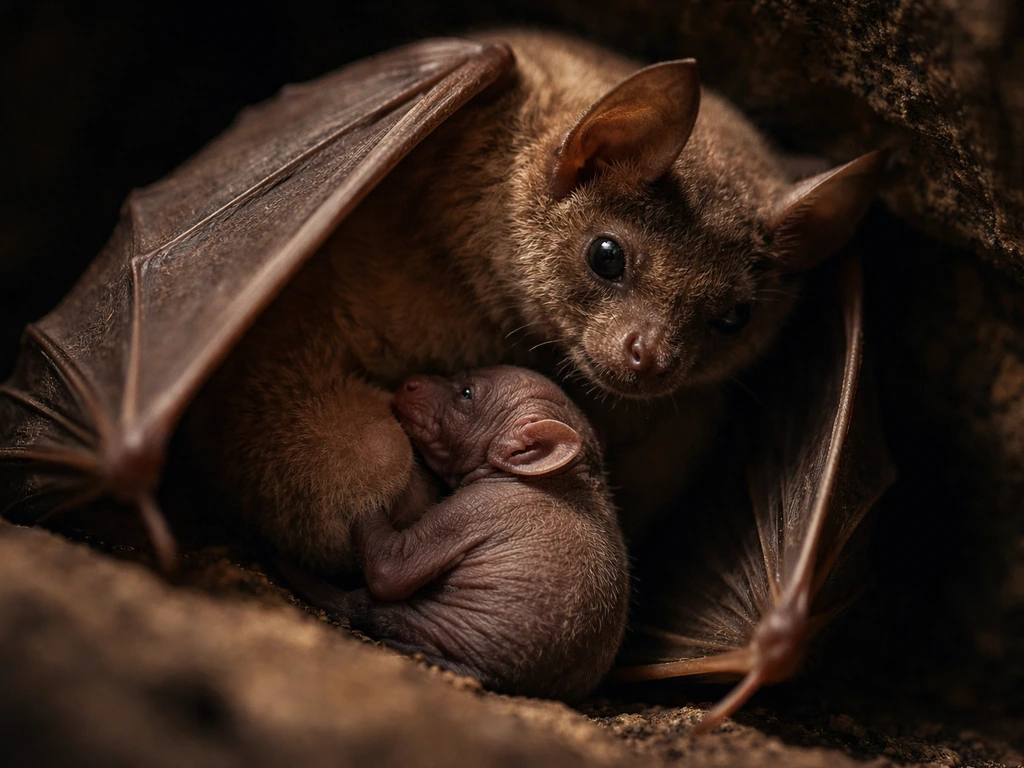
Bats belong to the order Chiroptera, a name derived from the Greek words for 'hand' and 'wing,' which is a reference to the way their wing membrane stretches across elongated finger bones. Chiroptera sits inside class Mammalia, the same class as dogs, whales, and humans. Bats are the only mammals to have evolved true powered flight, which is remarkable, but it does not move them out of Mammalia or into Aves.
The mammal credentials of bats are hard to argue with. Most bat species give birth to live pups and nurse them with milk, which are the two core mammal traits by definition. They also have fur rather than feathers, a muzzle with teeth rather than a beak, and dense bones rather than the hollow, lightweight bones found in birds. Within Chiroptera, bats are further divided into megabats (large fruit bats) and microbats (smaller, mostly insect-eating species), but both groups are squarely within Mammalia.
If you look up any bat species in a taxonomic database like ITIS or the Catalogue of Life, the classification chain will read something like: Kingdom Animalia, Phylum Chordata, Class Mammalia, Order Chiroptera. You will never see Class Aves anywhere in that chain. That is the most reliable way to confirm it: follow the taxonomy, not the behavior.
Other flying animals people commonly mix up with birds
Bats are not the only animals that cause this kind of confusion. Pterosaurs, the winged creatures from the age of dinosaurs, are another common example. They were not birds and they were not dinosaurs either. The Natural History Museum of Utah and the American Museum of Natural History both classify pterosaurs as flying reptiles in their own separate lineage. They had wings made of a skin membrane similar to bats, not feathers, and they went extinct about 66 million years ago. No living pterosaur exists, and none were ever birds.
The confusion with bats specifically seems to come from a few places: both bats and birds are active at dusk, both can appear as dark shapes against the sky, and people casually associate flight with birds. But biology does not work on casual association. The moment you look at the actual traits, bats and birds are clearly in different categories. Related questions like whether a bat should be considered a bird, whether brown bats count as birds, or whether bats belong to the bird family all point to the same answer: they do not, because family-level classification in biology traces back through order and class, and bats never reach class Aves.
How to tell a bird from a non-bird in seconds
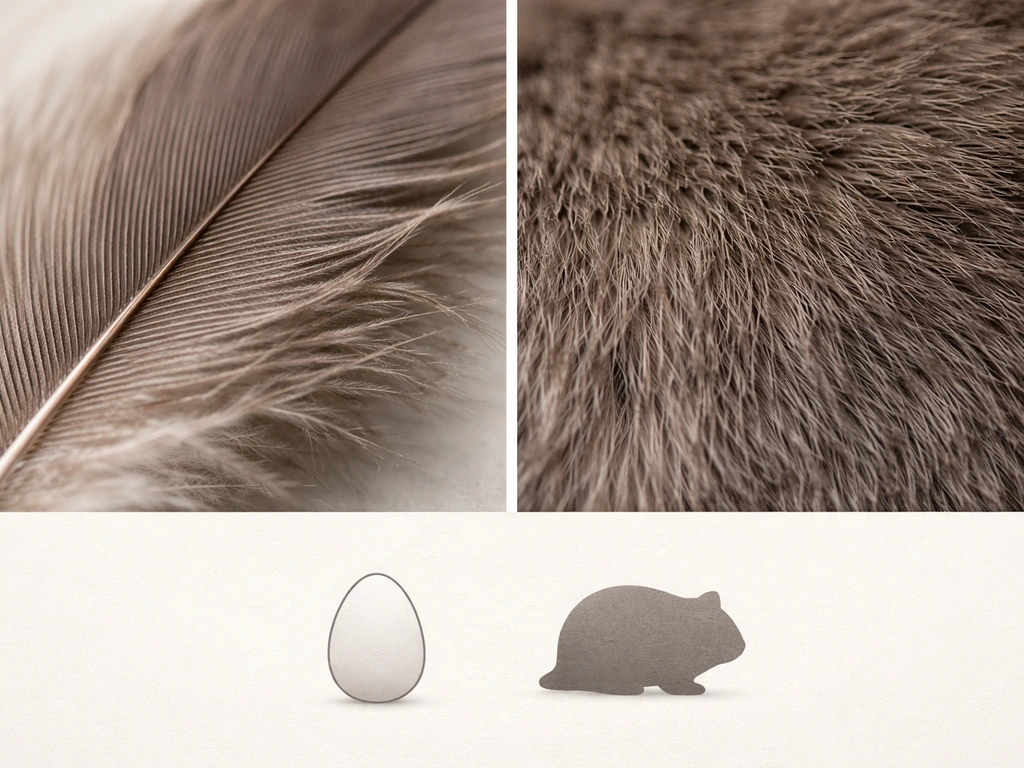
Once you know what to look for, the check is fast. You do not need a lab or a textbook. Here is the practical checklist I use when an animal's classification is not immediately obvious:
- Check the body covering. Feathers mean bird, every single time. Fur, scales, or bare skin mean look elsewhere.
- Look at the face. A beak with no teeth points strongly to bird. A muzzle with visible teeth points to mammal or reptile.
- Ask how it reproduces. Hard-shelled eggs laid by the mother are a bird indicator. Live birth means mammal. Soft-shelled eggs suggest reptile.
- Check the wings, if it has them. Bird wings are covered in feathers attached to a modified forelimb. Bat wings are a skin membrane (called a patagium) stretched between elongated finger bones. Pterosaur wings were also membranous. Feathered wings equal bird.
- Look up the taxonomy when in doubt. Search the animal's name on ITIS (itis.gov) or the Catalogue of Life. Find the Class field. If it says Aves, it is a bird. If it says Mammalia, it is a mammal. That field does not lie.
Running through that list takes about thirty seconds for any animal, and it works on edge cases too. A penguin: feathers, yes; beak, yes; hard-shelled egg, yes. Bird. A bat: fur, not feathers; muzzle with teeth; live birth. Mammal. A pterosaur: membranous wings, no feathers (based on current fossil evidence for most species); reptile lineage. Not a bird. The checklist holds up. And that is why the phrase “is a bat in the bird family” is a helpful way to remember the distinction: bats belong with mammals, not birds.
The takeaway and how to check any future 'is X a bird?' question
Bats are not birds. They are mammals in the order Chiroptera, full stop. The fact that they fly is interesting and biologically impressive, but flight is a behavior, not a taxonomic category. Birds are defined by feathers, hollow bones, and hard-shelled eggs, and they all belong to class Aves. Britannica describes birds’ hollow (pneumatized) bones and notes that their forelimbs are modified for flight with feathers attached to flight-relevant skeletal structures blank" rel="noopener noreferrer">hollow bones. Bats have none of those features and belong to class Mammalia instead.
For any future 'is this a bird?' question, use the feathers-first rule. If an animal has feathers, it is a bird. If it does not, it is not, no matter how much it looks like one or how well it flies. Then back that up with a quick taxonomy check. ITIS and the Catalogue of Life are both free, searchable, and reliable. Find the Class field in the result, and you have your answer in under a minute. That simple workflow handles bats, pterosaurs, flying squirrels, and anything else that might drift through the edges of the 'what is a bird?' question.
FAQ
If bats do not have feathers, does that automatically mean they are not birds even if they fly well?
Yes. For bird identification, feathers are the key defining trait. Flight can occur in many unrelated animals, so without feathers (and the related egg-and-bone traits), a bat stays in Mammalia, not Aves.
Are bats ever classified as birds in some special case, like informal naming or biology exceptions?
No. Informal wording may call something “bird-like” based on appearance or behavior, but formal taxonomy uses traits and hierarchical ranks. A bat’s classification chain places it in class Mammalia under order Chiroptera, and it never appears under class Aves.
How can I tell a bat from a “flying mammal” that is not actually a bat?
Use the method that checks for mammal traits and the type of flight. Flying squirrels glide with a skin membrane but do not have the true bat wing structure and powered flight anatomy. A bat will have fur and the bat-style wing membrane stretched across elongated fingers.
Do bats lay eggs the way birds do, or is their reproduction completely different?
Completely different. Bats give birth to live young and feed them with milk. That live birth plus lactation is what separates mammals from birds, even if both groups are active at night and use flight.
What is the quickest “offline” way to confirm a bat is a mammal if I do not have internet access?
Rely on the fur-first plus reproduction check. If you can confirm fur (not feathers) and see mammal indicators like live birth and nursing, the classification follows. In contrast, birds are consistently tied to feathers and hard-shelled eggs.
Why are hollow bones and flight-related traits not enough to prove an animal is a bird?
Because those traits can vary across groups and can evolve for similar reasons. The defining combination for birds includes feathers plus egg type (hard-shelled) and the bird body plan. Without feathers, you can’t reliably conclude Aves from any single flight-related feature.
Are there any extinct animals that were “almost birds,” like transitional forms, where bats might be confused with them?
There are many transitional or winged animals in evolutionary history, but bats are still mammals by core traits like fur and live birth. When confusion arises, it usually involves convergence (similar flight habits), not shared classification with birds.
If I find “bat family” information, does that ever imply a bird family?
No. “Family” is a rank within a class, and bat families are within class Mammalia. You may see charts labeled with families, but they do not change the class level, so a bat family still traces back to Mammalia, not Aves.
Next Article
Why Bat Is Not a Bird: Mammal vs Bird Traits
Bats fly but are mammals, not birds: compare fur, live birth, and mammary glands vs feathers and eggs.