The crocodile and bird association is most commonly described as an example of mutualism, specifically a cleaning mutualism, in which the bird removes parasites or food debris from the crocodile and both partners supposedly benefit. That is the textbook answer. The honest scientific answer, though, is that the famous version of this story, the Egyptian plover hopping inside a crocodile's open mouth to clean its teeth, has never been reliably documented by modern fieldwork. What we actually have is a well-traveled historical anecdote, a genuinely interesting tolerance relationship between birds and crocodiles in the wild, and a legitimate classification question that science has not yet fully resolved. So the short verdict: call it a proposed or historically reported cleaning mutualism, but treat the 'dental cleaning' detail with real skepticism until the evidence catches up.
Crocodile and bird association is an example of mutualism?

Short answer: the crocodile-bird verdict and its caveats
If you are answering an exam question, the expected answer is mutualism or cleaning mutualism, a type of symbiosis. That framing is not wrong in principle; it correctly identifies the interaction type that the relationship would represent if both parties consistently received measurable fitness benefits. The caveat is significant, however. Contemporary ornithological and herpetological sources are clear that the iconic 'plover cleans crocodile teeth' behaviour has not been captured in verifiable photographs, video, or replicated field observations with independent confirmation. Scholars who have traced the story back to its source find that it originates with the Greek historian Herodotus writing around 440 BCE, and it has been retold and embellished ever since. This does not mean nothing interesting is happening between birds and crocodiles. It means the precise form of the interaction, and therefore its precise classification, is still an open question.
What is symbiosis? Mutualism, commensalism and parasitism defined
Symbiosis, in modern ecology, refers to any close, long-term association between two different species. Modern ecological definitions describe symbiosis as close associations that can be mutualistic, commensal or parasitic, with mutualism defined as a +/+ interaction in which both partners receive net fitness benefits (Host–Symbiont Relationships: Understanding the Change from Guest to Pest, review, PMC) Host–Symbiont Relationships: Understanding the Change from Guest to Pest (review, PMC). The word does not automatically mean 'beneficial to both'; it is an umbrella term covering three quite different outcomes. Understanding those three outcomes is essential before deciding what category the crocodile-bird relationship belongs to.
| Type | Effect on Species A | Effect on Species B | Simple example |
|---|---|---|---|
| Mutualism | Benefit (+) | Benefit (+) | Bees pollinate flowers; both gain |
| Commensalism | Benefit (+) | Neutral (0) | Cattle egrets follow buffalo to catch flushed insects |
| Parasitism | Benefit (+) | Harm (–) | Tick feeds on a deer; deer loses blood |
Mutualism is the +/+ category: both partners receive a net fitness benefit, meaning they survive better, reproduce more successfully, or carry fewer harmful parasites because of the relationship. Commensalism is +/0: one partner gains while the other is neither helped nor harmed in any measurable way. Parasitism is +/–: one partner gains at a direct cost to the other. In practice, ecologists find that many real interactions shift between these categories depending on environmental conditions, which is exactly why the crocodile-bird case is complicated.
The Egyptian plover and the crocodile: where the story comes from
The Egyptian plover (Pluvianus aegyptius) is a striking, real bird, a wader found along rivers and wetlands in sub-Saharan Africa, recognised by its bold black, white and buff patterning. It earned the popular name 'crocodile bird' from a story that is almost 2,500 years old. Herodotus, writing in his Histories (Book 2, Chapter 68) around 440 BCE, described a small bird he called trochilos that would enter the open mouth of a Nile crocodile to eat leeches from its gums while the crocodile held still, grateful for the service. The crocodile, Herodotus wrote, would not harm the bird because it depended on this cleaning.
Later European naturalists and travel writers picked up the story and, over centuries, assigned Herodotus' trochilos to various African wading birds. The Egyptian plover and the spur-winged lapwing were both named as candidates at different times. The story passed from classical texts into 19th- and 20th-century natural history books and eventually into biology textbooks as a neat, memorable example of mutualism. Academic research into the trope's transmission, including a detailed study by scholar Luigi Prada published in 2022, shows that the story was propagated largely through literary tradition rather than independent field observation. In other words, most accounts of the cleaning behaviour cite earlier accounts rather than original fieldwork.
What the scientific evidence actually shows
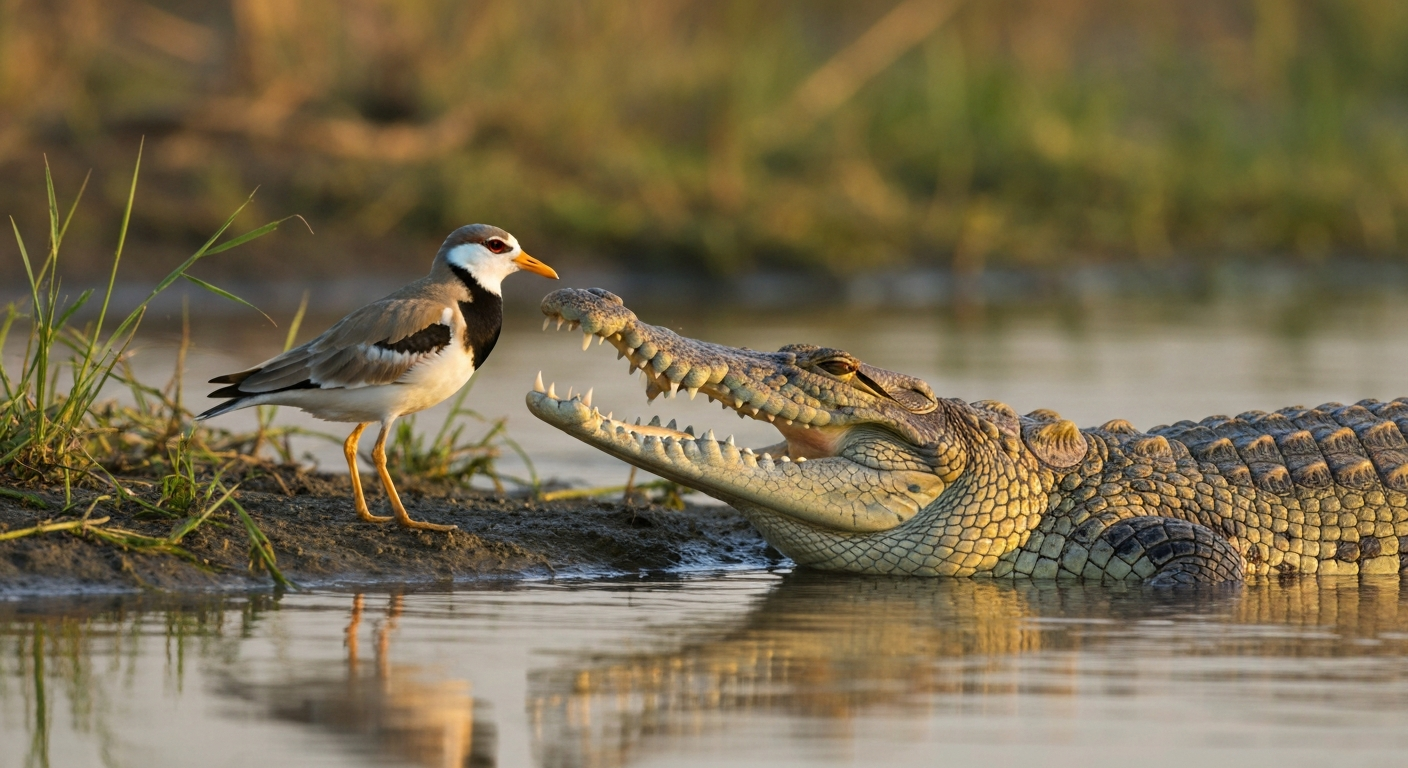
Here is where being honest about the evidence matters. Multiple ornithological and herpetological sources, including comprehensive crocodile field studies, confirm that certain shorebirds, including spur-winged plovers and various waders, regularly forage on and near basking crocodiles. The crocodiles tolerate these birds. That part is documented. What is not documented, at least not in any peer-reviewed, replicated study with verified photographic or video evidence, is a bird actively entering a crocodile's open mouth and systematically removing leeches or food material from the teeth.
Hugh Cott's classic 1961 field study of Nile crocodile ecology (published in the Transactions of the Zoological Society of London) noted birds foraging near crocodiles and being tolerated by them, but did not provide systematic evidence of dental cleaning. More recently, critical scholarly reviews have concluded that the 'crocodile dentist' behaviour is best described as an unverified historical and ethnographic trope. See Luigi Prada (2022), review of the 'crocodile bird' trope and evidence (ZÄS article). There are images online that appear to show a plover near a crocodile's mouth, but no verified, peer-reviewed observational record with location data, date, and independent replication has been published. Until that changes, the responsible scientific position is to describe the mouth-cleaning version of the story as unconfirmed.
- Birds foraging near resting crocodiles: documented and observed repeatedly
- Crocodile tolerance of nearby birds: documented
- Birds removing ectoparasites from crocodile skin surfaces: plausible and partially observed
- Birds entering crocodile mouths to clean teeth: not confirmed by peer-reviewed, replicated field evidence
How scientists actually decide: mutualism vs commensalism
Ecologists who study cleaning relationships do not classify an interaction by observation alone. They apply specific empirical tests, and that standard is why the crocodile-plover case cannot currently be signed off as confirmed mutualism. The key criteria, drawn from cleaning-symbiosis research published in journals including Biology Letters and Biological Reviews, are straightforward:
- Demonstrate removal: show that the cleaner actually removes parasites, food debris or other harmful material, typically by comparing parasite counts before and after interactions or measuring removal rates directly
- Show client benefit: document a measurable fitness gain for the animal being cleaned, such as reduced parasite load, better health, improved survival, or higher reproductive success
- Use controls or exclusion experiments: compare individuals or populations that have access to cleaners against those that do not, using replicated observations or experiments rather than single anecdotes
- Account for context: assess whether the benefit is consistent or conditional, since some cleaning interactions shift between mutualism and commensalism depending on season, parasite pressure, or individual variation
None of these tests have been applied rigorously to the Egyptian plover-crocodile interaction. That is not a judgment on anyone; it is simply a gap in the field data. Until parasite-removal rates and crocodile fitness outcomes are measured under controlled conditions, the interaction cannot be confidently labelled mutualism any more than commensalism. The crocodile might not be gaining anything meaningful at all, which would make the bird's presence commensal at best.
Two well-documented bird examples worth comparing
The crocodile-plover story stands in interesting contrast to two terrestrial bird interactions that have been studied much more rigorously: oxpeckers and cattle egrets. Both involve birds and large animals. Both look superficially similar to mutualism. And both turn out to be more complicated than the textbook version suggests, which is precisely why they are instructive.
Oxpeckers: mutualism that gets complicated
Oxpeckers (Buphagus africanus and Buphagus erythrocephalus) are African birds that spend most of their time on large mammals, including buffalo, rhinoceroses, and cattle, picking off ticks and other ectoparasites. At first glance this looks like textbook mutualism: the bird gets food, the mammal gets parasite removal. Research has shown, however, that oxpeckers also probe and enlarge open wounds to feed on blood and tissue, sometimes preventing wounds from healing. Depending on the individual host, the season, and the availability of ticks, the relationship can range from genuinely mutualistic (net tick reduction, healthier host) to mildly parasitic (wound feeding that costs the host). This example is used in the scientific literature specifically to illustrate why rigorous cost-benefit measurement matters before assigning a classification. Calling it simply 'mutualism' glosses over real complexity.
Cattle egrets: a cleaner case of commensalism
Cattle egrets (Bubulcus ibis) follow large grazing animals, including cattle, buffalo, and even tractors plowing fields, to catch insects, frogs, and small vertebrates disturbed by the animal's movement. The bird gains a reliable food source. The large animal, as far as field studies show, gains essentially nothing and loses nothing; it is simply a walking beater flushing prey. This is a much cleaner example of commensalism (+/0) than the oxpecker relationship and illustrates why the presence of a bird near a large animal does not automatically mean mutualism is occurring.
Simple field observations you can make
You do not need a research grant to start thinking about these interactions in an evidence-based way. If you are in an area where large animals and birds interact, a few straightforward, low-risk observations can sharpen your understanding of how ecologists approach classification.
- Watch before labelling: observe the interaction for a sustained period (at least 15 to 20 minutes) before deciding what is happening. A bird perching on an animal is not the same as a bird actively removing parasites
- Note what the bird actually takes: is it picking at the animal's skin or coat (suggesting parasite removal), catching insects the animal disturbs (commensalism), or doing something else entirely?
- Watch the host's response: does the large animal appear unbothered, irritated, or actively cooperative? A host that tolerates or even positions itself to facilitate the bird's access is a useful behavioural signal, though not proof of benefit
- Look for wound interaction: if a bird is spending time on open wounds rather than parasite-covered skin, the interaction may be less beneficial to the host than it appears
- Compare individuals: if you can observe multiple animals of the same species, note whether those with birds seem to behave differently from those without. Informal comparisons like this won't replace controlled studies, but they train the observational habit that good field science requires
For crocodile-bird interactions specifically, the honest observation goal is simpler: try to document what the bird is actually removing and from where. If you ever do witness a bird inside a crocodile's mouth, a clear photograph or video with date, location, and duration would be genuinely valuable to herpetology, because that evidence does not currently exist in the peer-reviewed record.
Why none of this changes what a bird is, and how classification confusions arise
One thing worth being clear about: ecological associations like cleaning symbioses have no bearing on how we classify animals taxonomically. A bird that forages on a crocodile is still a bird. A bird that has a commensal relationship with a buffalo is still a bird. Ecological behaviour and biological classification are separate frameworks. Birds belong to Class Aves, defined by features including feathers, a beak, hollow bones, warm-bloodedness, and the laying of amniotic eggs. See the article how is a platypus like a bird for a concise discussion of egg-laying mammals and other traits that superficially resemble bird characteristics. None of those features change because of what another species the bird associates with.
This site fields a lot of questions that mix up ecological relationships with taxonomic categories, and it is an easy thing to do. Someone learning about the crocodile-plover story might reasonably wonder whether crocodiles and birds are closely related, which they actually are in evolutionary terms (both belong to Archosauria, the group that also includes dinosaurs), but that phylogenetic proximity is a separate question from whether their day-to-day interaction is mutualistic or commensal. For a concise explanation of whether a bird is homologous or analogous to other animals, see is a bird homologous or analogous.
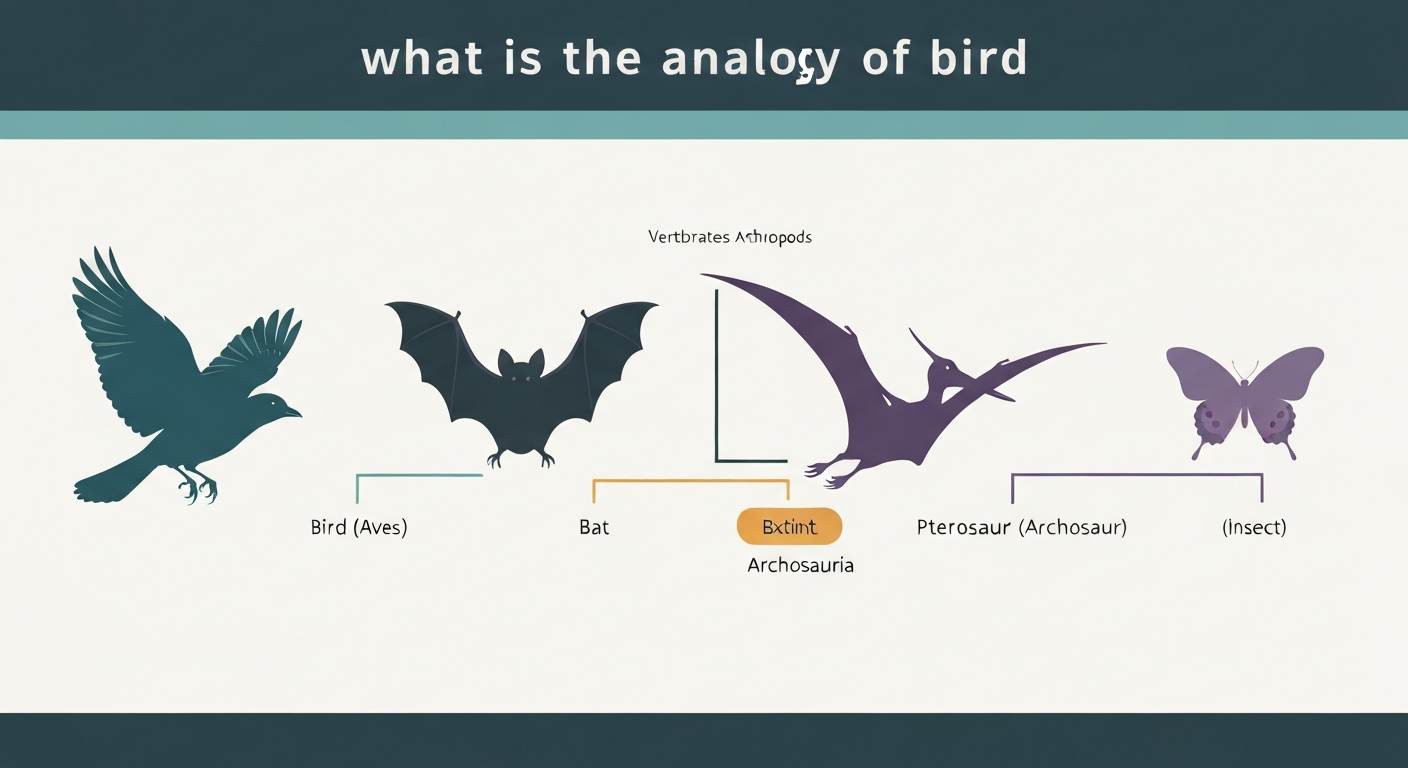
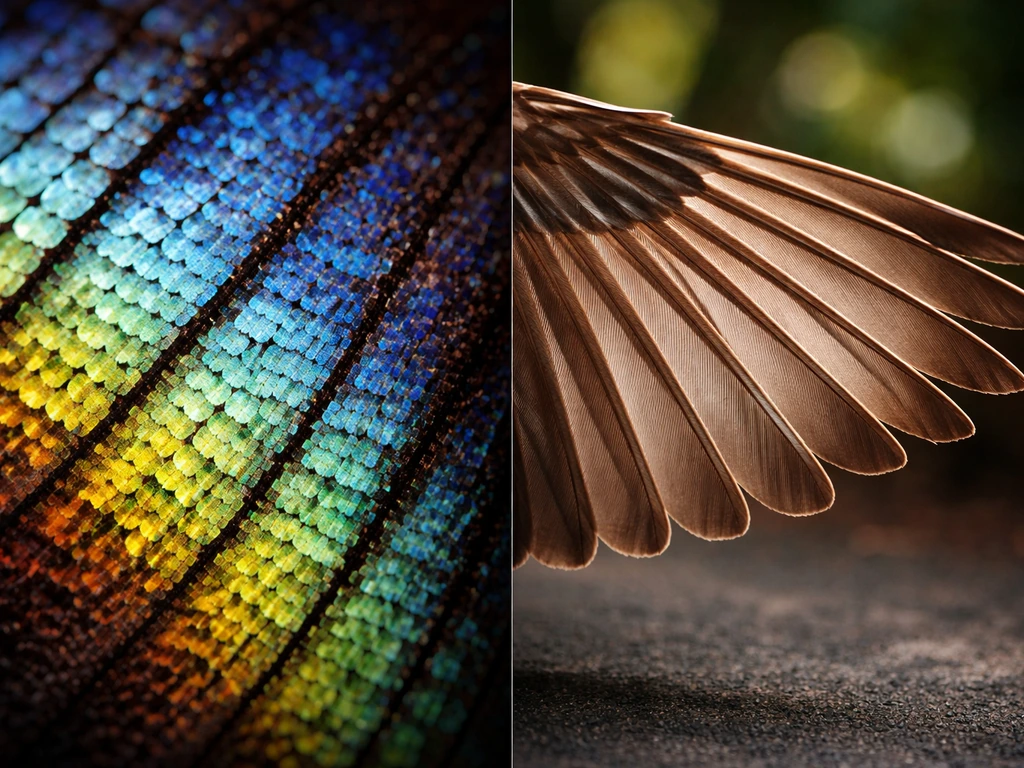
The same kind of category confusion appears in questions about structural similarities between animals. For example, the question 'are butterfly wings and bird wings homologous or analogous structures' has a clear answer: they are analogous, both serve flight but evolved independently from different ancestral structures rather than from a common winged ancestor. When readers ask whether the wings of a bat and a bird are homologous or analogous, they are asking about evolutionary origin, not ecological relationship. Homologous structures share an evolutionary origin (the forelimb bones of a bat and a bird both derive from the vertebrate forelimb, even though they function differently), while analogous structures perform the same function but evolved independently. That distinction, like the mutualism-versus-commensalism question, requires looking at evidence rather than surface appearance. For a clear example, consider that the wings of a bat and a bird are analogous organs, similar in function but evolved independently rather than from a common ancestral wing. The platypus raises similar classification puzzles: it has features associated with both mammals and birds (it lays eggs, like birds, but has fur and produces milk, like mammals), and understanding why it is classified as a mammal rather than a bird requires the same taxonomy-first thinking that helps resolve the crocodile-plover question.
The broader lesson from the crocodile-bird story is one that applies across all of these classification questions: labels like 'mutualism' or 'bird' or 'homologous' are conclusions, not starting points. They should follow from evidence, not from a compelling story that has been repeated for 2,500 years. The Egyptian plover is a real and fascinating bird. Its relationship with the Nile crocodile is genuinely interesting. The right answer to 'what kind of association is it?' is: probably some form of commensal foraging tolerance, possibly mutualistic if the skin-parasite-removal component turns out to be significant, and not yet confirmed as the dental-cleaning mutualism that Herodotus described.
FAQ
What kind of ecological association is the crocodile–bird (Egyptian plover) interaction an example of?
If the classical story (bird entering a crocodile’s mouth to remove leeches/food) were reliably documented and shown to increase fitness for both species, it would be classified as a cleaning mutualism (a form of symbiosis where both partners benefit). However, modern reviews and field literature find that the ‘crocodile‑dentist’ behaviour lacks robust, replicated observational or experimental evidence. So the interaction is best described today as a historically reported/legendary cleaning mutualism that remains unverified; more conservatively it’s treated as tolerated commensal foraging (birds feeding near or on crocodiles) until parasite‑removal and fitness data are produced.
What is symbiosis and what are its main subtypes?
Symbiosis is the ecological term for a close, long‑term association between individuals of different species. Subtypes are defined by effects on partners’ fitness: mutualism (+/+) where both benefit; commensalism (+/0) where one benefits and the other is unaffected; and parasitism (+/−) where one benefits at the expense of the other. These classifications are empirical: scientists assign them after measuring costs and benefits.
What evidence supports the crocodile–plover cleaning story?
The origin of the tale goes back to Herodotus and later naturalists who identified small waders (often the Egyptian plover) with the myth. Contemporary ornithological and herpetological sources note the traditional name 'crocodile bird' but explicitly state there is no reliable photographic, video, or peer‑reviewed observational documentation of repeated dental cleaning inside crocodile mouths. Field studies report birds foraging on or near basking crocodiles and being tolerated, but not systematic evidence of mouth‑entering cleaning behaviour.
Why do scientists remain skeptical about calling it a mutualism?
Because classifying an interaction as mutualism requires data showing (1) the purported cleaner removes parasites or tissue (measured removal rates), and (2) the client’s fitness improves (reduced parasite load, higher survival/reproduction). No replicated, controlled studies or verified observational time‑series have demonstrated these outcomes for crocodile–plover interactions; therefore the mutualism claim is unverified and possibly a historical trope.
What empirical tests do researchers use to decide mutualism versus commensalism?
Common approaches include: (a) quantifying parasite or debris removal by the cleaner (before‑after counts or removal rate measures); (b) measuring client fitness consequences (parasite loads, health, survival, reproduction); (c) exclusion/experimental manipulation (preventing cleaners and comparing outcomes); and (d) replicated observational studies controlling for confounding factors. If both parasite removal and client fitness benefit are demonstrated, the interaction is mutualistic; if only the cleaner benefits and the client shows no measurable effect, it’s commensalism.
Are there well‑documented bird cleaning examples to compare with the crocodile story?
Yes. Classic, well‑documented cleaner systems include marine cleaner fish (client‑cleaner stations) and terrestrial examples like oxpeckers (Buphagus spp.) on large mammals and cattle egrets following livestock. Oxpeckers clearly remove ticks but sometimes wound‑feed, so their interaction ranges from mutualism to parasitism depending on context and measured costs/benefits—showing why rigorous data matter. Cattle egrets feeding on insects flushed by livestock are a clearer example of commensalism (birds benefit; livestock largely unaffected).
What analogy of bird means: contrasts analogy vs homology, wing comparisons, penguins, bats, misconceptions
Butterfly vs bird wings: analogous structures with shared flight function but different evolutionary and developmental o
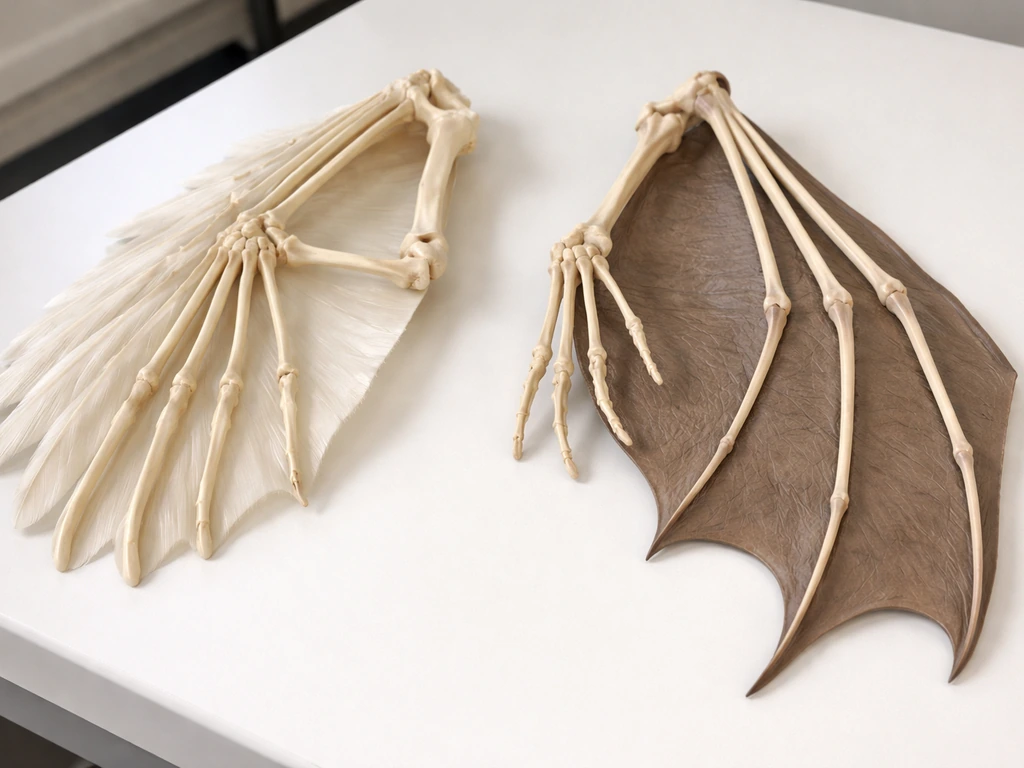
Learn which bird traits are homologous or analogous, with examples for bats, pterosaurs, and flightless birds.