When people search 'what is the analogy of bird,' they're usually asking one of two things: either what a bird can be compared to in everyday terms, or (more often in a biology context) whether bird features like wings are analogous or homologous to similar structures in other animals. The science-based answer is this: bird wings are homologous to the forelimbs of other tetrapods (vertebrates with four limbs), but they are analogous to bat wings, pterosaur wings, and insect wings as flight structures, because powered flight evolved independently in each of those groups.
What Is the Analogy of Bird? Understanding Analogies vs Homology

Sarah Chen
12 Jul 2026
What people actually mean when they ask this question
The query 'analogy of bird' shows up a lot from students working through biology assignments and curious readers who've just encountered the terms analogy and homology for the first time. It's a reasonable thing to be confused about. In everyday language, an analogy just means a comparison. In biology, the word has a much more specific meaning tied to evolutionary history, and that's the sense that makes the question genuinely interesting. This article works through both the biology definitions and then applies them directly to birds, bats, butterflies, pterosaurs, crocodiles, and the platypus.
Analogy vs homology: the core distinction
Homology means two structures in different species are similar because they were inherited from a shared common ancestor. The similarity is historical: the same ancestral structure was modified differently in each lineage over time. A human arm, a dolphin flipper, a cat's front leg, and a bird's wing all contain the same fundamental set of bones (humerus, radius, ulna, and hand/wrist elements) because all four animals descended from a common tetrapod ancestor that had those bones. The bones look different and do different jobs, but they trace back to the same source. That's homology.
Analogy (sometimes called homoplasy or convergent evolution) is the opposite situation. Two structures in different species look similar or do similar jobs, but they evolved independently and do not trace back to the same ancestral structure. The similarity is functional, not historical. Bird wings and insect wings are both used for flight, but they arose from completely different developmental programs in completely different lineages. There is no common 'ancestral wing' that birds and butterflies both inherited. That's analogy.
A useful rule of thumb: ask whether the underlying structure is the same. If yes, you're probably looking at homology. If two things just end up doing the same job but got there by different routes, that's analogy. The tricky part, which comes up with bird and bat wings, is that both can be true at different levels of comparison.
What is a bird? The short classification answer
A bird is a member of the class Aves, which sits within the theropod dinosaurs. Yes, birds are technically dinosaurs by every modern classification system. The diagnostic features that define a bird (as opposed to any other living animal) are a specific cluster of traits that evolved together in this lineage. The most reliable of those are:
- Feathers: keratinous skin appendages found in no other living animal group. Feathers serve insulation, display, and flight.
- A toothless keratinous bill: all modern birds have a beak rather than teeth (though some extinct birds had teeth).
- A furcula (wishbone): a fused collarbone structure unique to birds among living animals.
- Pneumatic (air-filled) bones: connected to a system of air sacs that also drives their highly efficient one-way breathing.
- Hard, calcified eggs laid externally.
- Forelimbs modified into wings, even in flightless species like penguins and ostriches.
That last point is worth emphasizing. Penguins cannot fly through the air, and ostriches have wings that are useless for flight, but both are still unambiguously birds because they have feathers, a furcula, pneumatic bones, and all the other markers of Aves. The ability to fly is not a requirement for being a bird. Conversely, bats fly perfectly well but are mammals, not birds, because they have fur, live young, and none of the avian skeletal features above.
How analogy arises: convergent evolution in brief
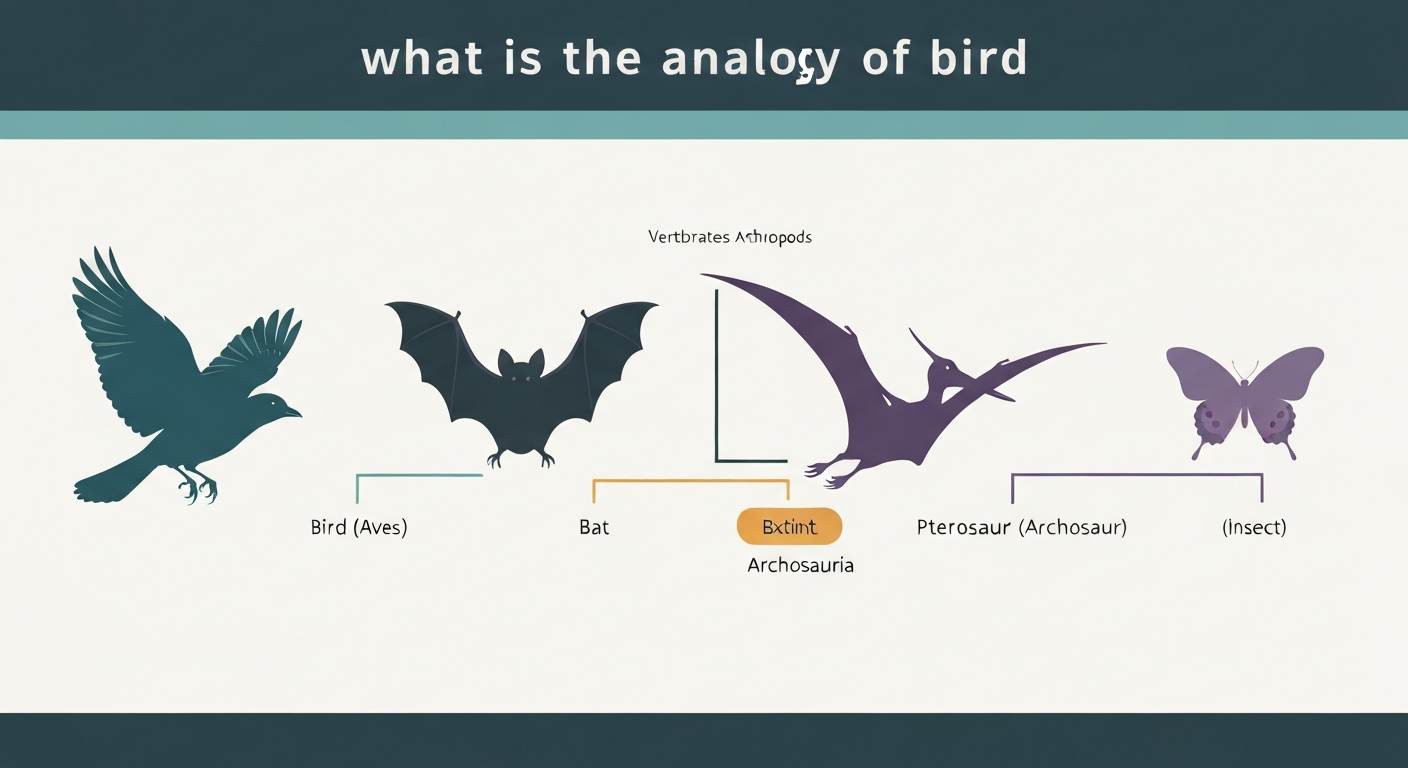
Convergent evolution happens when separate lineages, facing similar environmental pressures, independently evolve similar solutions. Flight is one of the most striking examples in animal evolution because the aerodynamic problem is the same whether you are a bird, a bat, or an insect: you need a large surface area to generate lift. Natural selection found flight as a solution at least four separate times in animals: insects, pterosaurs (extinct flying reptiles), birds, and bats. Bell (2011), Integration and dissociation of limb elements in flying vertebrates: a comparison of pterosaurs, birds and bats, documents that flight evolved repeatedly in vertebrates with different anatomical solutions (birds: forelimb + feathers; bats: elongated digits + patagium; pterosaurs: membrane attached to an elongated manual digit) Integration and dissociation of limb elements in flying vertebrates: a comparison of pterosaurs, birds and bats — Journal of Evolutionary Biology (Bell 2011). Each time, the underlying anatomy is different, but the outcome, a surface that generates lift, is functionally similar. That functional similarity without shared ancestry is precisely what biologists call analogy.
Are bird and bat wings homologous or analogous?
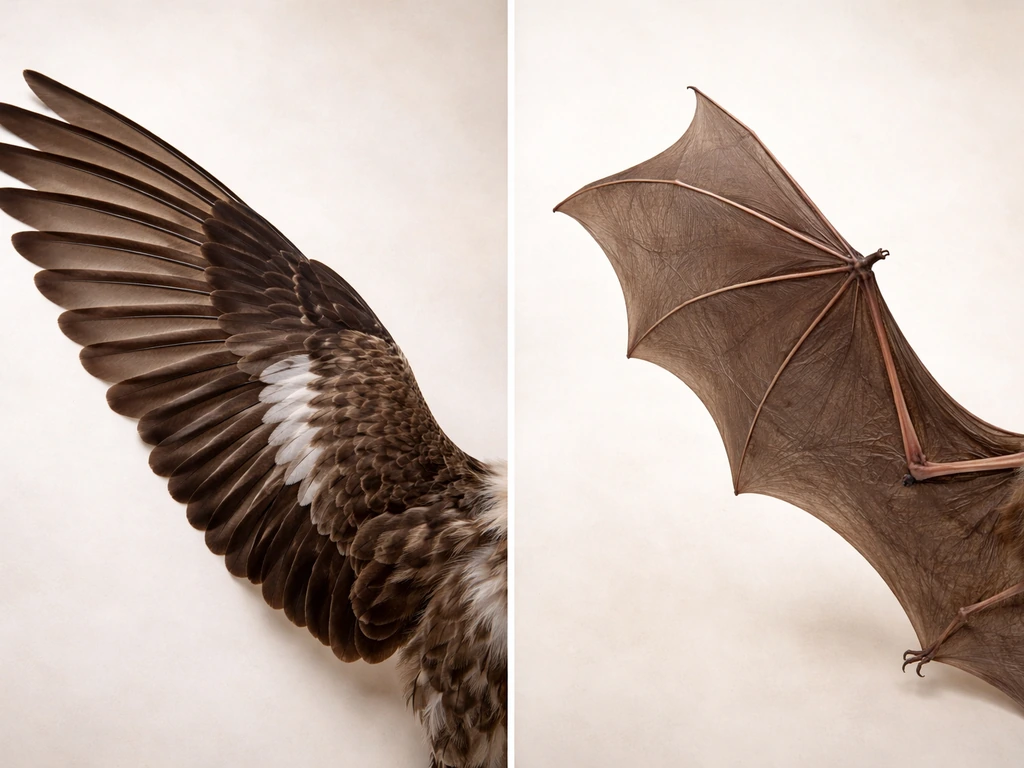
This is one of the most frequently asked questions in this area, and the answer depends on which level you're asking about. At the level of the forelimb skeleton, bird wings and bat wings are homologous. Both contain a humerus, a radius and ulna, and modified hand and wrist bones because both birds and bats descended from the same ancient tetrapod ancestor that had those bones. The bones were not invented twice.
But at the level of the wing as a flight structure, bird wings and bat wings are analogous. In short: the wings of a bat and a bird are analogous organs. Birds evolved flight within the theropod dinosaur lineage, developing feathers along modified arm and hand bones. Bats evolved flight separately within the mammal lineage, developing an elastic membrane (called a patagium) stretched between greatly elongated finger bones (digits II through V). The flight apparatus itself, the whole system of feathers plus bone arrangement in birds versus membrane plus elongated fingers in bats, evolved independently in each group. Same job, different evolutionary history, different anatomy.
So the precise and correct answer is: bird and bat wings are homologous as forelimbs, but analogous as wings. See the Proceedings/PMC review 'Rebuilding ships while at sea, Character individuality, homology, and evolutionary innovation' for a detailed discussion of character identity and levels of homology blank" rel="noopener noreferrer">Rebuilding ships while at sea—Character individuality, homology, and evolutionary innovation — Proceedings/PMC review (concepts of character identity and homology). Both statements are true simultaneously, and the level of comparison determines which applies. For a short focused explanation on whether a bird is homologous or analogous, see the section titled 'is a bird homologous or analogous'.
Are butterfly wings and bird wings homologous or analogous?
Butterfly (and insect) wings vs. bird wings is a cleaner case than the bat comparison: they are analogous at every meaningful level. Insect wings develop from epidermal tissue during metamorphosis and arose from a fundamentally different developmental program than vertebrate forelimbs. There is no shared ancestral structure between an insect wing and a bird wing. Birds are vertebrates; insects are arthropods. Their last common ancestor predates the origin of wings entirely in both lineages. The resemblance is purely functional: both structures generate lift. That makes them a textbook example of analogy and convergent evolution. For a focused answer to the question 'Are butterfly wings and bird wings homologous or analogous structures?' see the section comparing insect and bird wings. Unlike the bird-bat comparison, there is no homology argument to make here at any structural level.
Comparing wing types across flying animals
| Animal | Wing structure | Relation to bird wing | Flight origin |
|---|---|---|---|
| Bird | Feathered forelimb; modified humerus, radius/ulna, carpometacarpus, fused digits | Self (reference) | Independent within theropod dinosaurs |
| Bat | Patagium (membrane) stretched over elongated finger bones (digits II-V) | Homologous as forelimb; analogous as wing | Independent within mammals |
| Pterosaur (extinct) | Membrane anchored to an elongated fourth finger (wing-finger) | Homologous as forelimb; analogous as wing | Independent within archosaurs |
| Butterfly / Insect | Chitinous panels from epidermal tissue; no bone | Analogous only (no shared structure) | Independent within arthropods |
Pterosaurs deserve a specific note here. They were not birds or dinosaurs in the strict clade sense (though they were archosaurs, the broader group that includes both). Pterosaur wings were built around one enormously elongated finger, whereas bird wings use the whole forearm modified with feathers. Pterosaur wings are a third, completely independent vertebrate solution to powered flight, analogous to both bird and bat wings.
What about the platypus and crocodiles?
The platypus (Ornithorhynchus anatinus) is a mammal, specifically a monotreme, despite laying eggs. If you’re asking 'is a platypus a bird', the short answer is no: the platypus is a monotreme (an egg-laying mammal) and lacks the diagnostic features of birds. Egg-laying is actually where the analogy question gets interesting: egg-laying in platypuses and egg-laying in birds look similar and serve the same reproductive function, but they evolved in separate lineages (mammalian and avian) and the eggs themselves differ structurally. This is another case of analogy, functional similarity without shared ancestry of the specific trait. If you want a brief comparison, see the note on how is a platypus like a bird that explains similarities (egg-laying and some superficial traits) and key differences in anatomy and classification. Genetically, the platypus shows a fascinating mosaic of reptile-like and mammal-like gene families, but it is not a bird and shares none of the diagnostic features of Aves.
Crocodiles and birds are actually the two living groups that sit within Archosauria. This means crocodilians are the closest living relatives of birds among animals alive today, which surprises most people who would guess something more visually bird-like. Their shared archosaur ancestry is why certain features (aspects of skull anatomy, pneumatic bones in some dinosaurs, and a four-chambered heart) appear in both lineages. That relationship is homology in action: shared features from a shared ancestor. This is also why the crocodile-bird association is used in biology as an example of a shared evolutionary lineage rather than mere physical resemblance. For more detail, see crocodile and bird association is an example of.
Quick answers for readers in a hurry
- Are bird and bat wings homologous or analogous? Both: homologous as forelimbs, analogous as independent flight structures.
- Are butterfly wings and bird wings analogous? Yes, fully analogous at every structural level.
- Are pterosaur wings analogous to bird wings? Yes, a third independent origin of vertebrate flight.
- Is a platypus a bird? No. It is a mammal (monotreme) that lays eggs but has fur and produces milk.
- Why are crocodiles associated with birds? They share a common archosaur ancestor and are each other's closest living relatives.
- Are penguins and ostriches still birds even though they cannot fly? Yes. Flight is not a requirement; feathers, furcula, and pneumatic bones define them as birds.
- What defines a bird? Feathers, a keratinous bill, a furcula (wishbone), pneumatic bones, and hard calcified eggs.
Common misconceptions worth correcting
One of the most persistent mix-ups is assuming that anything with wings is related to birds, or that anything that flies is somehow 'bird-like' in a biological sense. Bats are more closely related to you than to any bird. Pterosaurs were not birds and were not direct ancestors of birds. Insects are not vertebrates at all. The wing shape converges because the physics of flight constrains what works aerodynamically, not because these animals share recent ancestry.
Another common confusion is conflating analogy with relatedness. Two animals can share an analogous trait (say, streamlined body shape in dolphins and sharks) while being very distantly related. Conversely, two animals can be closely related but look and function very differently. Classification in biology is built on ancestry and shared derived features, not on what an animal looks like or what it does.
It's also worth noting that the terms homologous and analogous apply to specific structures, not to whole animals. It makes no sense to say 'birds and bats are analogous.' The correct framing is always: the wings of birds and bats are analogous as flight structures, but homologous as tetrapod forelimbs.
A note on 'deep homology'
Modern genetics has added a useful nuance called deep homology. Researchers have found that some of the same developmental genes and genetic switches are reused in building structures that are anatomically analogous, like vertebrate eyes and insect eyes. The structures are not homologous in the classical sense (they did not descend from one ancestral eye), but the genetic toolkit that builds them is ancient and shared. This doesn't change the classification of bird and insect wings as analogous, but it explains why independent evolution sometimes arrives at similar-looking results: because both lineages are drawing on the same deep genetic toolkit. It's an active and fascinating area of evolutionary biology, and it shows that the boundary between analogy and homology can be more layered than a textbook definition suggests.
FAQ
What does 'analogy of bird' mean in evolutionary biology?
'Analogy' describes similarity in function or appearance that evolved independently in different groups (convergent evolution). When people ask about the "analogy of bird," they usually want to know whether a bird trait (for example, wings) is the same because of shared ancestry (homology) or because different animals evolved similar solutions separately (analogy).
What is the difference between analogy and homology?
Homology: similarity because a trait was inherited from a common ancestor (a historical, descent‑with‑modification claim). Analogy (homoplasy/convergence): similarity in function or form that evolved independently, not inherited from a common ancestor. A single structure can be homologous at one level (e.g., forelimb) but analogous at another (e.g., wing used for flight).
How are birds defined — what are the key diagnostic features?
Modern birds (class Aves) are characterized by a suite of traits used in classification: feathers (unique keratinous skin appendages), a beak (toothless in living birds), modified pectoral skeleton (including furcula/wishbone and specialized wrist bones), pneumatic (air‑filled) bones linked to air sacs, and hard shelled eggs. Birds are also nested within theropod dinosaurs, so many features trace to that lineage.
Are bird wings homologous or analogous to bat wings?
Both. Bird and bat forelimbs are homologous as tetrapod forelimbs (they share common ancestry at the limb level). However, their wings — the structures used for powered flight — evolved independently: bird wings (feathered forelimbs) and bat wings (elongated digits with a membrane) are analogous as flight adaptations (convergent evolution).
Are bird wings analogous to insect wings?
Yes. Insect wings and vertebrate wings (birds, bats, pterosaurs) evolved independently from different tissues and developmental programs. They are analogous: similar in function (flight) but not homologous in origin or structure.
What about pterosaur wings — are they homologous with bird wings?
Pterosaur wings are analogous to bird wings. Pterosaurs used a membranous wing supported mainly by an elongated fourth finger — a different anatomical solution from feathered bird wings. All three vertebrate flying groups (birds, bats, pterosaurs) represent independent origins of powered flight.
Next Articles
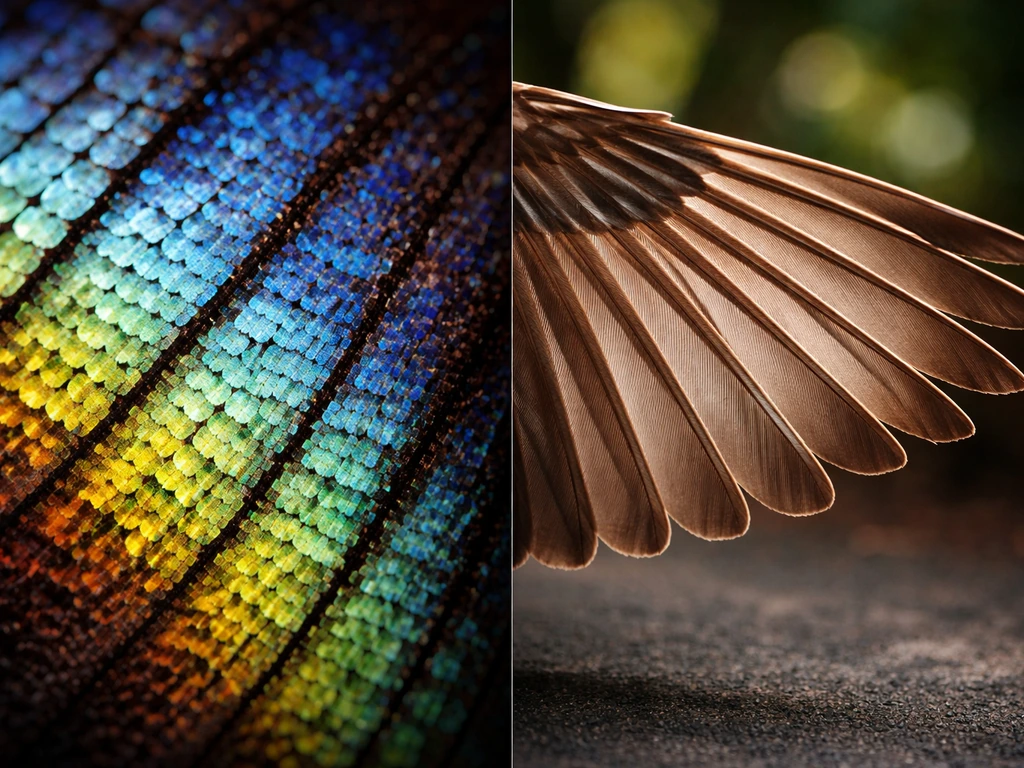
Are Butterfly Wings and Bird Wings Homologous or Analogous?
Butterfly vs bird wings: analogous structures with shared flight function but different evolutionary and developmental o
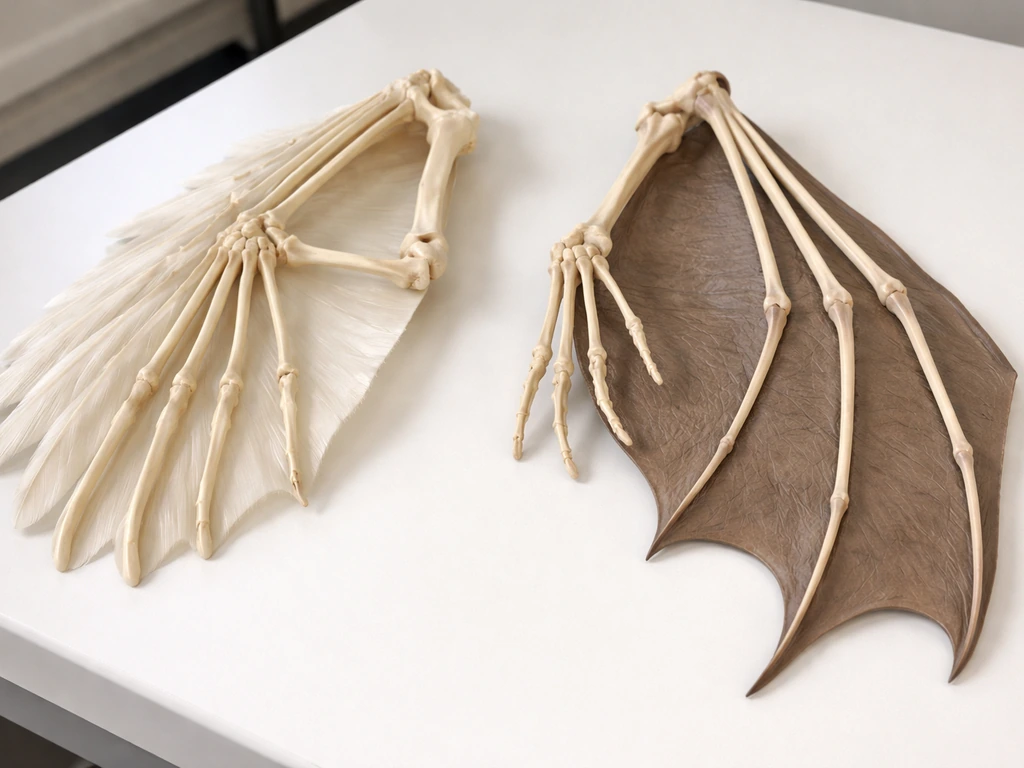
Is a Bird Homologous or Analogous? How to Tell Trait Similarity
Learn which bird traits are homologous or analogous, with examples for bats, pterosaurs, and flightless birds.
Are Bird and Bat Wings Homologous or Analogous?
Bird and bat wings are homologous as tetrapod forelimbs, but analogous as flight adaptations.