
Bird wings and bat wings are both homologous and analogous, depending on which part you're talking about. Their underlying forelimbs are homologous, meaning both birds and bats inherited the same basic tetrapod forelimb skeleton from a common four-limbed ancestor. But the wings themselves, as flight structures, are analogous: birds and bats evolved flight independently, using that shared forelimb blueprint in completely different ways. So if a biology question asks whether bird and bat wings are homologous or analogous, the most precise answer is that the forelimbs are homologous, but the flight wings are analogous structures produced by convergent evolution.
Are Bird and Bat Wings Homologous or Analogous?

Sarah Chen
3 May 2026
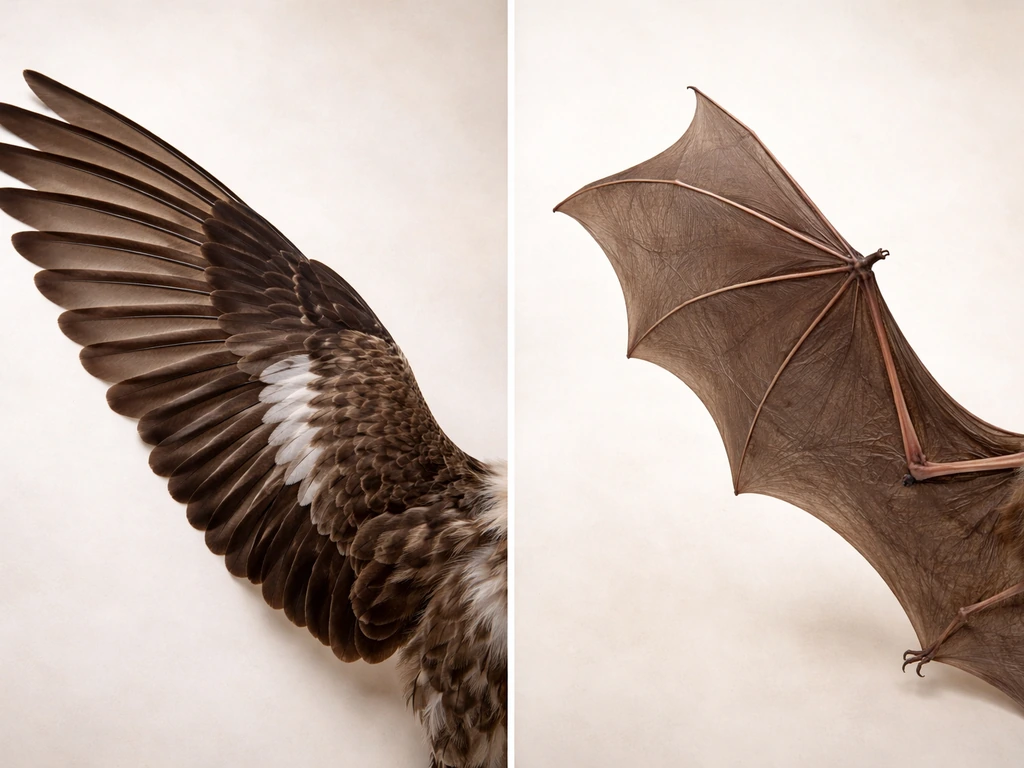
Homologous vs analogous: what those words actually mean
Homologous traits are similarities in structure or development that exist because two species descended from a common evolutionary ancestor. The trait doesn't have to look the same or even do the same job today; what matters is that it came from the same ancestral structure. Your arm and a whale's flipper are homologous, even though one throws a baseball and the other steers through water.
Analogous traits are the opposite situation. Two species end up with similar-looking structures that perform similar functions, but those structures did not come from the same ancestral origin. Analogous structures like wings can arise independently in lineages that did not share the trait in the last common ancestor, a process called convergent evolution blank" rel="noopener noreferrer">Two species end up with similar-looking structures that perform similar functions, but those structures did not come from the same ancestral origin.. The similarity is the result of convergent evolution: independent lineages facing similar environmental pressures (like the need to fly) stumble onto similar solutions. A bird wing and an insect wing both generate lift, but they arose from completely different ancestral structures with no shared blueprint. Analogies like these also come up when people ask about bird wings in comparison to other flying animals bird wing and insect wing. That makes them analogous.
The practical test: ask where the structure came from, not what it does. Shared origin means homology. Similar function without shared origin means analogy. Function alone is never enough to establish homology.
What bird wings and bat wings actually look like inside
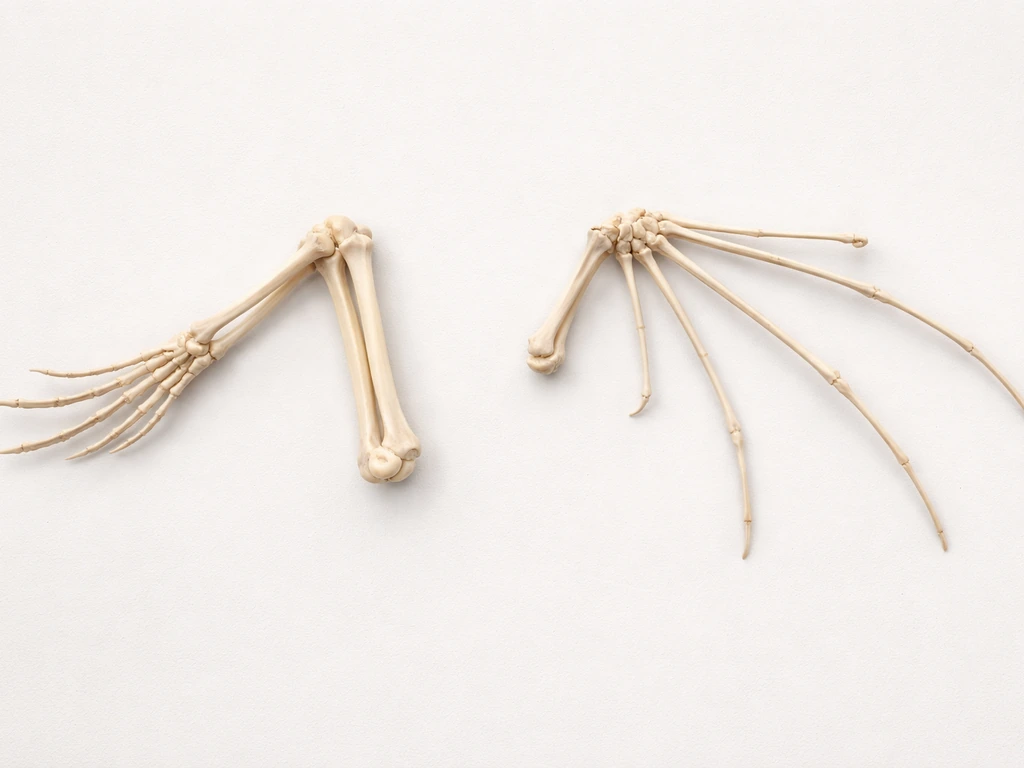
Both wings start with the same basic tetrapod forelimb layout: a humerus (upper arm bone), a radius and ulna (forearm bones), and then wrist and hand bones. That's the homologous foundation they share. But from the wrist and hand outward, the two groups took wildly different paths.
The bird wing
In birds, the humerus, radius, and ulna are well developed and recognizable. Further down, the wrist and hand bones are reduced and fused into a structure called the carpometacarpus, with most of the digits (fingers) either fused or lost entirely. Primary flight feathers anchor to this carpometacarpus and to the remaining digits, and the number of primary feathers attached is actually a diagnostic feature of major bird groups. The elbow and wrist are restricted to motion in one plane, which stabilizes the wing during flapping. The whole system is built for feathers to do the aerodynamic work.
The bat wing
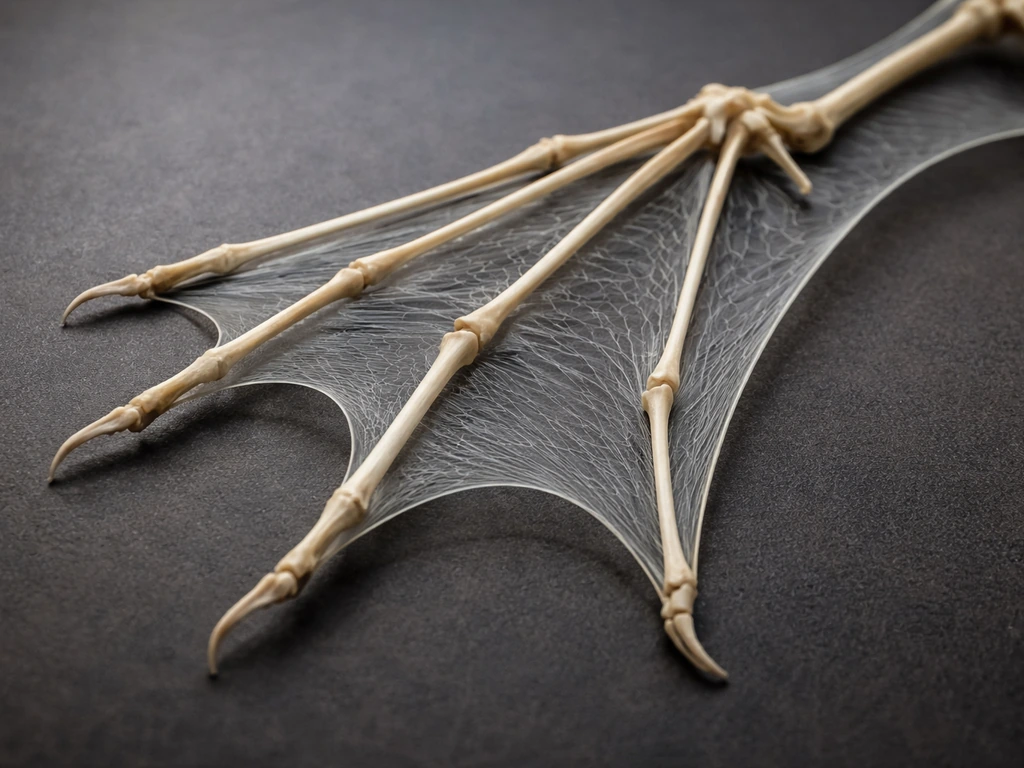
Bats kept all five fingers. Rather than reducing or fusing them, evolution massively elongated digits II through V (the index through pinky fingers), and stretched a thin membrane called the patagium between those elongated fingers, down the sides of the body, and often to the ankle. The thumb stays short and free, useful for clinging and grooming. The patagium itself is two layers of skin with blood vessels and nerves running between them. The ulna is actually reduced in diameter compared to many other mammals, while the elongated radius and digit bones do the heavy structural lifting. The whole wing is essentially a stretched hand.
| Feature | Bird Wing | Bat Wing |
|---|---|---|
| Basic forelimb bones (humerus, radius, ulna) | Present | Present |
| Digits (fingers) | Reduced and fused into carpometacarpus | All five retained; digits II–V massively elongated |
| Flight surface | Feathers anchored to modified hand bones | Skin membrane (patagium) stretched between elongated fingers |
| Thumb | Vestigial or absent | Short, free, and clawed |
| Wrist/hand fusion | Yes, into carpometacarpus | No; bones remain separate and elongated |
| Evolutionary flight origin | Independent from bats | Independent from birds |
How scientists actually decide what's homologous
Anatomy is the starting point: if two species share the same bones arranged in the same way, that's a strong signal of common ancestry. Both bird and bat forelimbs have humerus, radius, ulna, and a wrist-and-hand region, which maps directly to the standard tetrapod forelimb that appeared hundreds of millions of years ago. That shared skeletal plan is the evidence for forelimb homology.
Developmental and genetic evidence adds another layer. Studies on bat wing development show that digit elongation involves changes in the expression of specific genes during limb development, including Hoxd13, Fgf8, and Bmp2/4 signaling. High levels of Fgf signaling and suppressed Bmp signaling during embryonic development actually prevent the webbing between bat fingers from being reabsorbed, which is what happens in most mammal embryos. Bird wing development involves its own distinct set of developmental changes, including fusion events that produce the carpometacarpus. Researchers use this embryological and genetic evidence to trace which parts of the developing limb correspond to which ancestral structures, confirming the deep homology of the forelimb while showing that the flight adaptations were built on top of it independently.
Evolutionary lineage is the final check. Birds evolved from theropod dinosaurs; bats evolved from small mammalian ancestors. Their most recent common ancestor was a four-limbed vertebrate that lived long before either flight system existed. That ancestor's forelimb is what they share. Neither group inherited wings from that ancestor; wings evolved separately in each lineage after they diverged.
So what's the actual answer: homologous, analogous, or both?
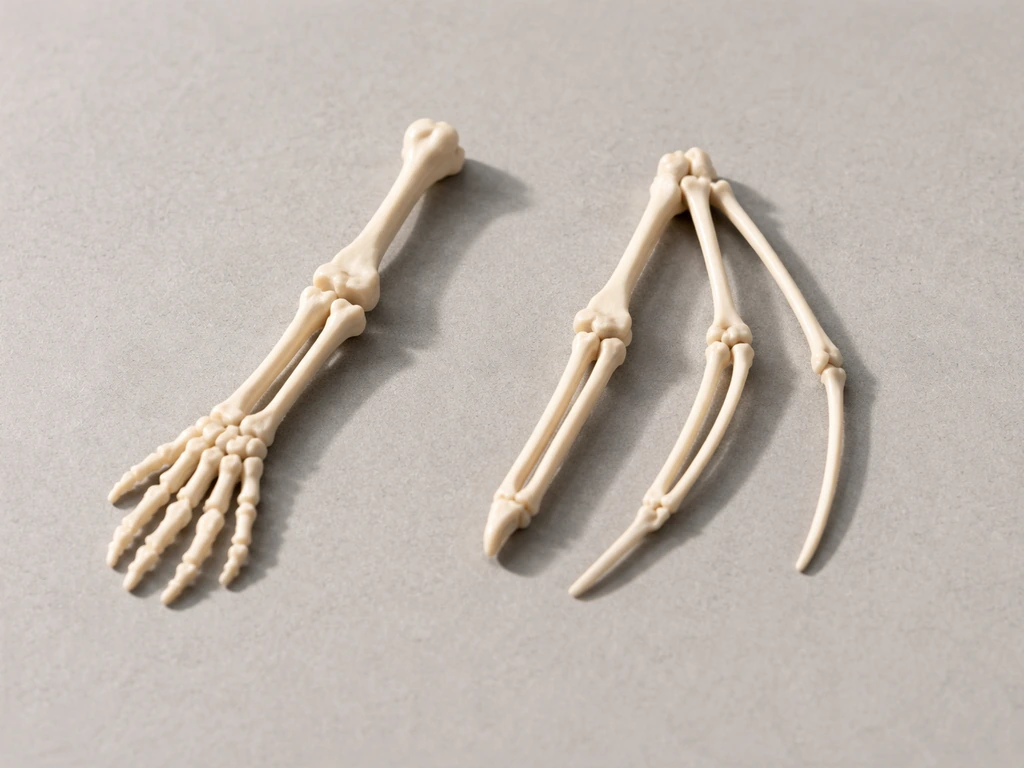
Both, precisely applied. blank" rel="noopener noreferrer">The tetrapod forelimb that underlies each wing is homologous): same ancestral bones, same developmental origin, shared because birds and bats both descended from four-limbed vertebrates. The flight wings, meaning the full specialized structures that generate lift and enable powered flight, are analogous: they evolved independently in separate lineages as convergent solutions to the same aerodynamic challenge. Birds evolved feather-based wings. Bats evolved membrane-based wings. Those are not the same invention handed down from a common flying ancestor. They are two separate inventions built on top of the same inherited forelimb.
A clean way to remember this: the raw material (the forelimb) is homologous. The product (the flight wing) is analogous. This same logic applies when you compare bird wings to butterfly wings, which are genuinely analogous at every level because insects don't share any forelimb ancestry with vertebrates at all. Butterfly wings are therefore shaped by the insect lineage and evolved flight adaptations, rather than sharing vertebrate forelimb ancestry with birds.
Misconceptions people bring to this question
The biggest one is assuming that anything that flies must be closely related. Wings are a function, not a family. Bats are mammals, not birds. They nurse their young, have fur, and give live birth. The fact that both bats and birds flap wings and navigate through the air does not mean they are more closely related to each other than to other members of their own classes. A bat is far more closely related to a dog than to a sparrow.
A related mistake is thinking that because forelimbs are homologous, the wings must be too. Homology exists at a level of ancestral structure, and the modifications built on top of that structure can be entirely independent evolutionary innovations. The forelimb being homologous does not mean everything built from it is homologous. Both birds and bats used the same starting point and ended up in completely different places.
There's also a tendency to treat 'wing' as if it implies 'bird.' Bats have wings. Pterosaurs had wings. Many insects have wings. None of them are birds. A bird is specifically defined by features like feathers, a toothless beak, hollow bones, and warm-bloodedness within the class Aves. No bat has feathers. No bat is a bird. The wing is just a shape, and that shape evolved more than once.
Applying the same logic to pterosaurs (and other flying animals)
Once you've got the bird/bat framework down, pterosaurs are easy to handle. Pterosaurs were flying reptiles, not birds and not bats, and their wings are also analogous to both bird and bat wings as flight structures. But their forelimbs are homologous to both, again because all three groups inherited the tetrapod forelimb from a common ancestor.
What makes pterosaur wings distinct is which digit supported the flight membrane. In pterosaurs, the wing membrane was anchored primarily by an enormously elongated fourth finger. Compare that to bats, which elongated digits II through V, and birds, which reduced and fused their digits into a feather-bearing carpometacarpus. Three different solutions to the same problem, three independent evolutionary inventions, all built on the same basic tetrapod forelimb blueprint.
| Animal | Class | Flight surface | Key digit(s) supporting wing | Relationship of wings to other groups |
|---|---|---|---|---|
| Bird | Aves (Class) | Feathers on carpometacarpus | Fused remnant digits; carpometacarpus | Analogous to bat and pterosaur wings |
| Bat | Mammalia (Class) | Skin membrane (patagium) | Digits II–V elongated | Analogous to bird and pterosaur wings |
| Pterosaur | Reptilia (extinct) | Skin membrane (patagium) | Fourth digit enormously elongated | Analogous to bird and bat wings |
| Butterfly/insect | Insecta (Class) | Wing scales (no forelimb origin) | Not a modified forelimb at all | Analogous to all vertebrate wings; not even forelimb-homologous |
The reliable method here is always the same: identify the evolutionary lineage, find the common ancestor, and check whether the trait in question was inherited from that ancestor or evolved independently afterward. If it was inherited, it's homologous. If it evolved independently in response to similar pressures, it's analogous. Apply that test and you'll get the right answer for birds, bats, pterosaurs, or any other flying animal you encounter. This same framework is useful when thinking about other unusual cases like butterfly wings compared to bird wings, or even how flight relates to what makes something a bird in the first place.
FAQ
If bird and bat wings are analogous, why do they both start from the same forelimb bones?
Because “homologous” and “analogous” apply to different levels. The shared tetrapod forelimb bones (humerus, radius, ulna, then wrist and hand) are inherited from a common ancestral forelimb, but the actual flight wing structures are later modifications that evolved separately (feathers in birds, membranes in bats).
Are the bird’s carpometacarpus and the bat’s elongated digits homologous to each other?
Not in the strict, piece-by-piece sense. Both are adaptations built from a common wrist and hand region, but birds fuse and reduce most digits into the carpometacarpus, while bats elongate specific fingers and use them to support the patagium. The underlying region is homologous, while the specific end products are analogous adaptations.
Is the patagium in bats homologous to the feathers in birds?
No. The patagium is a skin membrane structure used for flight, while feathers are specialized epidermal appendages. Even though they both function in producing lift and controlling flight, they are independently evolved solutions built on different tissues and developmental pathways.
Can I use function (both wings generate lift) to decide whether they are homologous?
Function alone is not enough. You generally need evidence about shared origin, such as whether the structures derive from the same ancestral developmental program and underlying parts. Similar function with no shared ancestry is a hallmark of analogy.
How do I classify a “wing” for an organism that has both a membrane and feathers, like some extinct animals or hybrids in cartoons?
Use a trait-level approach: check which parts are truly inherited (homology) versus independently evolved for flight (analogy). In real biology, animals do not “mix” inherited wings from separate lineages into one shared structure, so you would dissect the feature into components and classify each by ancestry.
Are bird and bat wings more closely related to each other than to their own non-flying relatives?
Usually not in the way people assume. Bats are mammals related to other mammals like dogs, birds are reptiles related to other reptiles like dinosaurs, and the flight wing parts are independent innovations within each lineage. So “both fly” does not imply closer relationship between birds and bats.
Do pterosaur wings count as homologous to bird or bat wings?
As complete flight structures, pterosaur wings are analogous to both bird and bat wings because powered flight evolved independently in each group. As for the forelimb, pterosaurs share the tetrapod forelimb architecture with birds and bats, so that underlying limb is the homologous foundation.
What is the most practical first step when I am unsure whether a trait is homologous or analogous?
Start by identifying the evolutionary lineages and the most recent common ancestor. Then ask whether the specific structure you mean (not just the “job” it does) was inherited from that ancestor or arose later independently.
Are insect wings analogous to bird wings because both evolved for flight?
Yes, they are analogous in the same general sense. Insects do not share the vertebrate tetrapod forelimb ancestry, so their wings are a separate evolutionary invention for flight, not a modified version of the vertebrate forelimb.
Next Article
Is a Platypus a Bird or Mammal? The Simple Answer
No, a platypus is not a bird. It is a mammal, and the traits that prove it, plus how to classify similar animals.