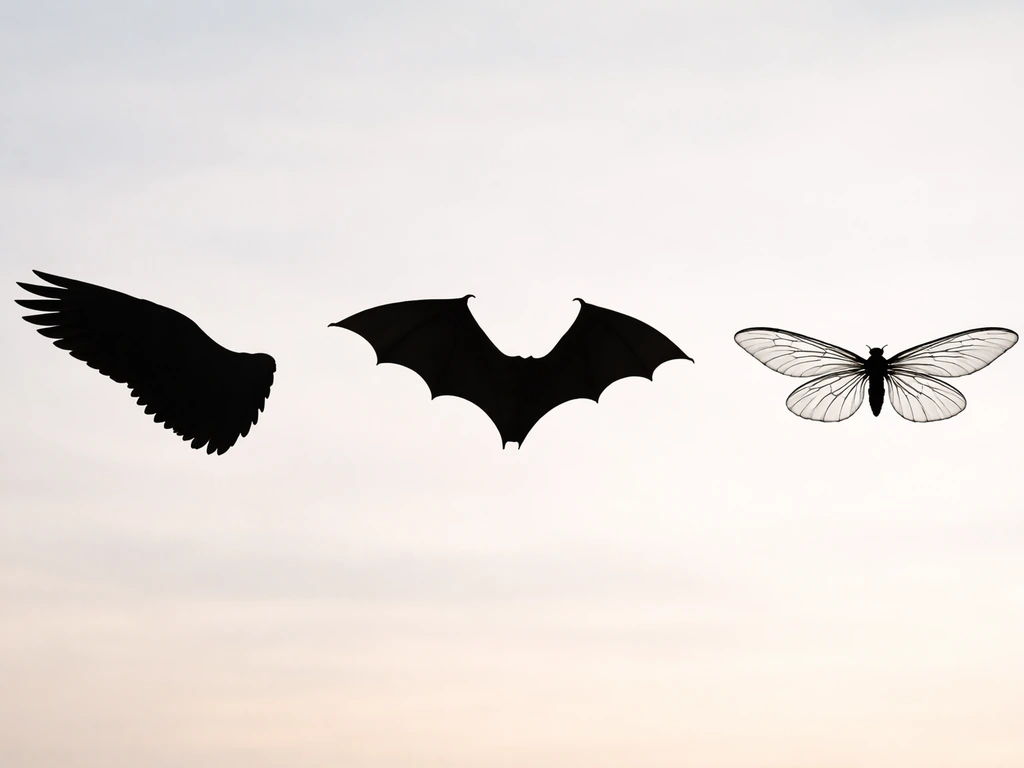
Lots of animals have wings but are not birds. Bats are mammals with skin-membrane wings. Insects are invertebrates whose wings grow from their exoskeleton. Flying lizards like the Draco glide on rib-supported skin folds. And extinct pterosaurs flew on leathery membranes stretched from an elongated fourth finger. None of them are birds, because wings alone do not make a bird. What makes a bird is a specific package of traits, and the presence of wings is just one optional feature in that package.
What Has Wings But Is Not a Bird: A Clear Guide

Sarah Chen
29 Jun 2026
What actually makes something a bird
Birds belong to the class Aves, and biologists define them by a cluster of traits that show up together, not just one. A true bird is a warm-blooded vertebrate with feathers, a toothless beak, a four-chambered heart, a high metabolic rate, a lightweight skeleton with hollow bones, and it lays hard-shelled eggs. Every single modern bird shares those traits. No exceptions.
The key thing to notice is that flight is not in that list. Penguins and ostriches are birds. Bats can fly but are not birds. The diagnostic feature that matters most in practice is feathers, because no other living animal has them. Feathers are made of keratin (the same protein as your fingernails), and they are unique to birds. If you can confirm feathers, you have a bird. If you see fur, a membrane, or bare skin instead of feathers, you do not.
Winged animals that are definitely not birds
Bats
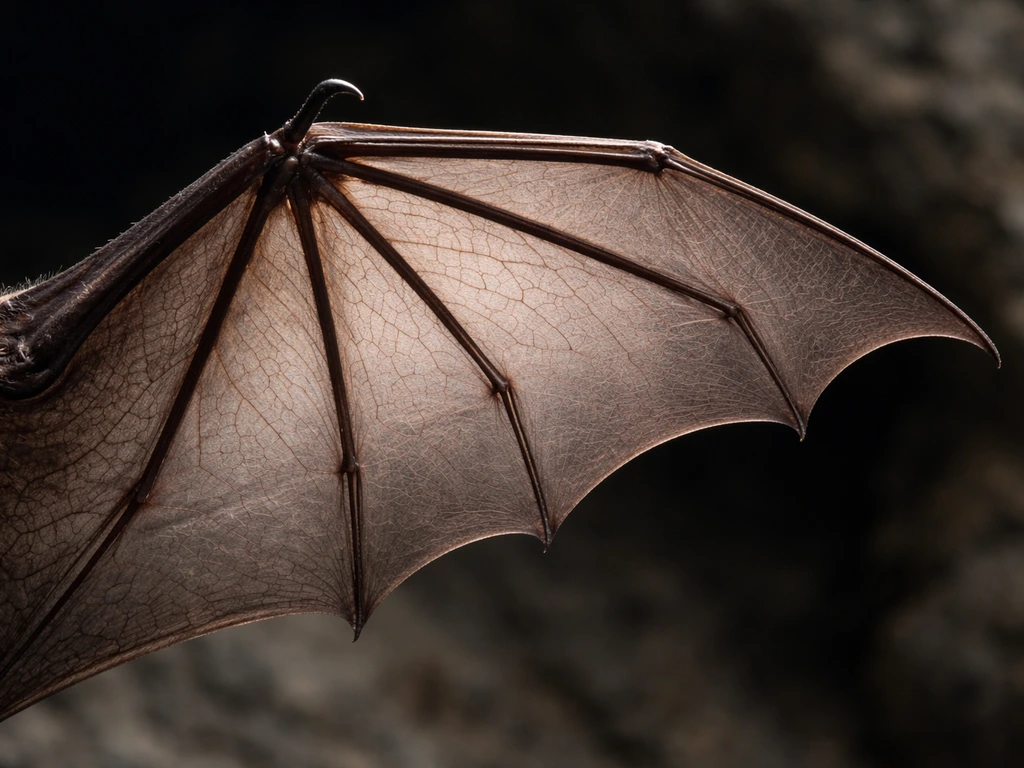
Bats are mammals, full stop. Their wings are modified forelimbs covered by a thin membrane (called a patagium) made of skin, blood vessels, and muscle stretched between elongated finger bones and the body. They have fur, not feathers. They give birth to live young and nurse them with milk. The Smithsonian notes that bats are actually the only mammals capable of true powered flight, which is impressive, but powered flight still does not make them birds. A quick glance at the covering on their wings tells you everything: fur and bare skin, not feathers.
Insects
Insects are invertebrates, meaning they have no backbone at all. Their wings are outgrowths of the exoskeleton (the hard outer shell), attached to the second and third segments of the thorax. They typically have two pairs of wings: forewings and hindwings. The muscles that power insect flight work by deforming the thorax itself rather than attaching directly to the wing base, which is completely different from how any vertebrate flies. Insects, birds, and bats all arrived at flight independently through evolution, which is a classic example of convergent evolution.
Flying and gliding reptiles
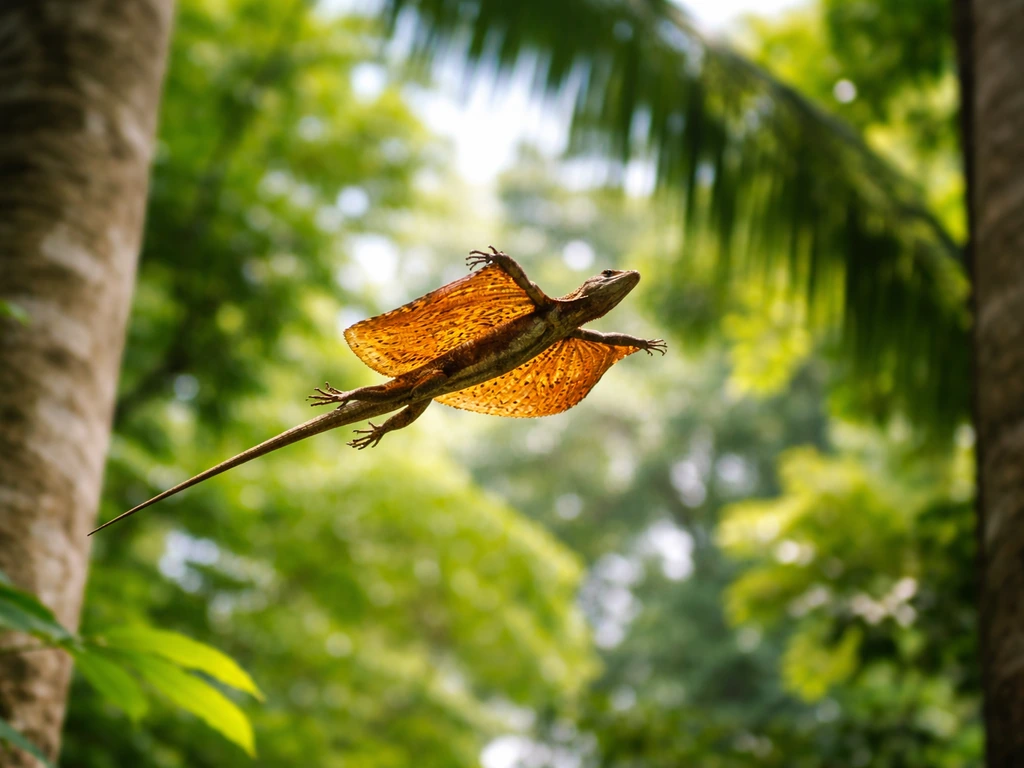
The Draco lizard (sometimes called the flying dragon) is a living reptile that glides between trees using winglike skin folds supported by dramatically elongated ribs. Those folds lie flat against the body when not in use and unfurl like a parachute when the lizard leaps. The forelimbs attach to the leading edge of the membrane but do not drive the glide the way a wing does in powered flight. Draco is a lizard, a reptile, and nowhere near a bird. Going further back, the late Permian reptile Weigeltisaurus used wide gliding membranes long before birds or even pterosaurs existed, which is a good reminder that winglike structures have evolved many times in many lineages.
Extinct creatures with wings that people confuse for birds
Pterosaurs are probably the most common source of confusion here. They flew, they lived alongside dinosaurs, and some popular depictions make them look vaguely bird-like. But pterosaurs were not birds and were not even dinosaurs. They were a separate group of flying reptiles. Their wings were formed by an elastic skin-and-muscle membrane that stretched from a dramatically elongated fourth finger back to the ankle. Like birds, pterosaurs had hollow, air-filled bones, but they had no feathers in the way birds do. There is ongoing scientific debate about whether some pterosaurs had simple bristle-like structures, but nothing like the complex feathers that define birds.
Archaeopteryx is a fascinating borderline case going the other direction. It is a 150-million-year-old fossil animal with true feathers (including wing-related feathers) that most scientists classify as an early bird or very close to the bird lineage. Modern birds are technically a group within the dinosaur family tree, sharing a common ancestor with non-avian dinosaurs. So while pterosaurs had wings and were not birds or dinosaurs, Archaeopteryx had feathers and was essentially a feathered dinosaur on the path to becoming a bird. The presence of true feathers is what puts it in (or very near) class Aves.
The borderline cases that trip people up most
The animals people most often misclassify as non-birds are actually birds that cannot fly. This is worth spending a moment on because it is genuinely counterintuitive.
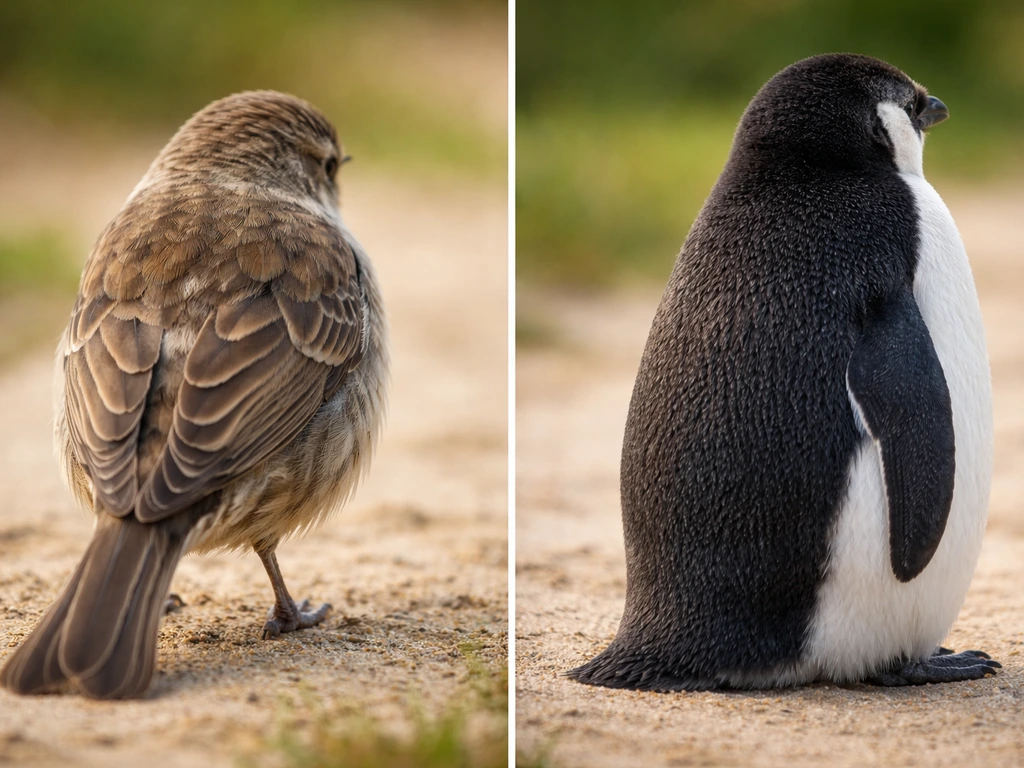
- Penguins belong to the order Sphenisciformes and are flightless seabirds. Their wings evolved into stiff flippers for swimming, and they are extraordinary underwater. But they have feathers, lay hard-shelled eggs, and have all the other traits of class Aves. They are 100% birds.
- Ostriches are the world's largest living bird and belong to a group called ratites, which also includes emus, cassowaries, rheas, and kiwis. All ratites are flightless. Ostriches have small, vestigial wings and their feathers are softer and less structured than flight feathers, but they are still feathers. Ostriches are birds.
- Kiwis from New Zealand are flightless birds in the order Apterygiformes. They have hair-like feathers that make people think of mammals, but they are birds. They even lay proportionally enormous eggs relative to body size.
The reason these animals matter in a discussion about wings is that they flip the confusion around: instead of a winged animal that is not a bird, they are birds that look like they might not be. Flight is not the test. Feathers, a beak, and the other Aves traits are the test.
A simple checklist to identify what you're looking at
If you are trying to figure out whether a winged animal is a bird or not, work through these questions in order. If you see feathers but the animal is not classified as a bird, it helps to reconsider whether the key traits for Aves are actually present. You usually do not need to get past the first two.
- Does it have feathers? Feathers are unique to birds. If yes, it is a bird (or very close to one). If no, keep going.
- Does it have a toothless beak? No teeth, hard beak, and it almost certainly belongs in class Aves. Combine this with feathers and you are done.
- Is the wing made of skin membrane stretched over bones or ribs? That points to a bat (mammal), a pterosaur (extinct reptile), or a gliding lizard like Draco, depending on the body plan.
- Does it have fur or hair anywhere on its body? That makes it a mammal, almost certainly a bat if it has wings.
- Does it have six legs and an exoskeleton? You are looking at an insect.
- Is it a fossil with wings but no confirmed feathers and a fourth-finger-supported membrane? Pterosaur, not a bird.
- Does the animal have wings but clearly cannot fly (e.g., flippers used for swimming, tiny vestigial wings)? Check for feathers and a beak. If those are present, it is still a bird.
Myths worth busting
Myth: If it flies, it must be a bird
This is the most common assumption, and it is wrong in both directions. Bats fly but are mammals. Insects fly but are invertebrates. Pterosaurs flew but were reptiles. And as discussed above, many birds cannot fly at all. Flight evolved independently multiple times across the tree of life, so it tells you almost nothing about classification on its own.
Myth: If it has wings, it must be a bird
Wings are a structural solution to a physical problem (moving through air), and evolution has solved that problem in very different ways. Bird wings are feathered forelimbs. Bat wings are skin-membrane forelimbs. Insect wings are exoskeletal outgrowths with no forelimb involvement at all. Draco's wings are rib-supported skin folds. These are all called wings because they perform a similar function, not because they share an origin.
Myth: Penguins and ostriches are not real birds
This one comes up a lot. Because penguins swim and ostriches run, people sometimes assume they belong in a different category. They do not. Both have feathers, lay hard-shelled eggs, have beaks without teeth, and share all the core traits of class Aves. Bird tongues vary by species, but the common answer is that birds do have a tongue have beaks. Flightlessness is an evolutionary adaptation, not a disqualification. Smithsonian Ocean places penguins in the order Sphenisciformes and describes them as flightless seabirds with torpedo-shaped bodies, using blank" rel="noopener noreferrer">their wings as flippers rather than for flight. A bird does not always need to fly to be a bird, just as you do not need to swim to be a mammal.
Myth: Pterosaurs were just ancient birds
Pterosaurs were not birds and were not dinosaurs. They were a distinct lineage of flying reptiles that went extinct at the end of the Cretaceous. The confusion comes from the fact that they lived at the same time as dinosaurs and early birds, and popular culture often lumps all prehistoric flying things together. The anatomical differences are significant: no feathers (at least not true feathers), wings built from a stretched membrane on an elongated fourth finger, and a completely different skeletal structure from any bird.
How these categories compare at a glance

| Animal | Classification | Wing Type | Has Feathers? | Lays Hard-Shelled Eggs? | Is It a Bird? |
|---|---|---|---|---|---|
| Bat | Mammal | Skin membrane over elongated fingers | No (has fur) | No (live birth) | No |
| Insect (e.g., dragonfly) | Invertebrate | Exoskeletal outgrowth | No | Soft eggs only | No |
| Draco lizard | Reptile | Rib-supported skin fold (gliding only) | No | Yes (soft-shelled) | No |
| Pterosaur (extinct) | Reptile (extinct) | Skin membrane on elongated 4th finger | Uncertain, likely not true feathers | Likely soft-shelled | No |
| Penguin | Bird (Aves) | Modified flipper-like wings | Yes | Yes | Yes |
| Ostrich | Bird (Aves) | Small vestigial wings | Yes | Yes | Yes |
| Eagle | Bird (Aves) | Feathered forelimbs | Yes | Yes | Yes |
The pattern is clear once you lay it out this way. Feathers and a hard-shelled egg are the two most reliable markers. Every animal in the 'Yes' column has both. None of the animals in the 'No' column have true feathers. If you are ever uncertain about a specific creature, those two questions will get you most of the way there. For animals that seem to blur the line, like flightless birds or ancient fossil species, the other Aves traits (toothless beak, hollow bones, four-chambered heart) fill in the rest of the picture.
FAQ
If something has wings and flies, how can I tell quickly whether it is a bird?
Not from the usual “wing” clue. You can be sure it is a bird only when you confirm true feathers (not just winglike skin folds) plus other Aves traits such as a toothless beak and hard-shelled eggs. If you see fur, a membrane, scales, or bare skin instead of feathers, it is not a bird even if it flies.
Can a bird ever have wings but not be able to fly?
Flightless birds still meet the core Aves package. Penguins and ostriches are examples, they have feathers, beaks, hard-shelled eggs, and the bird-style body plan, they just evolved to rely on swimming or running rather than powered flight. “Cannot fly” is not a classification test.
What about Archaeopteryx, is it considered a bird or not?
Archaeopteryx is one of the closest look-alike fossils to “both answers,” because it had true feathers. Most scientists place it as an early bird or extremely near the bird lineage, so it is far more likely to be “a bird or basically a bird ancestor” than a non-bird flier like pterosaurs.
Could a creature with hairlike bristles still count as a bird?
Not if it lacks true feathers. Some animals can grow bristle-like or hairlike coverings, but birds have complex keratin feathers with a specific feather structure. For classification, “hair” or “bristles” is not enough, you need true feathers.
What is the most common mistake people make when trying to classify a winged animal?
You can miss birds if you treat flight as the main criterion. If you are trying to identify a winged animal, check feathers first, then confirm the bird-style markers (toothless beak and hard-shelled eggs, and generally hollow bones). This prevents the common mistake of calling any flyer a “bird.”
Why can two animals both be described as having wings, yet one is not a bird?
Some animals have wings that are actually modified structures but still are not “forelimb feathers.” For example, bat wings are skin membranes stretched over elongated fingers, insect wings are exoskeleton outgrowths, and Draco’s are rib-supported skin folds. If the “wing” is a membrane or shell outgrowth rather than feathers, it is not a bird.
What if I only have partial evidence, for example a photo of a winged animal I cannot identify?
Yes, and the decision shortcut is practical. Many living birds can be hard to recognize, but the feathers-and-beak combination is usually observable, and hard-shelled eggs are a decisive trait if you are working from broader natural history data. If you cannot confirm feathers, you should not conclude “bird.”
How do I distinguish pterosaurs from early birds in a quick, real-world way?
Pterosaurs most often fool people because they look birdlike in illustrations and because they were active in the same general prehistoric timeframe as early birds. The fast way to separate them is feathers versus no feathers, pterosaur wing membranes attach to an elongated fourth finger and they lack the true feather system birds have.
Does the way an animal flies or glides tell you whether it is related to birds?
In general, winglike gliding and powered flight have evolved multiple times independently, so taxonomy cannot be inferred from the presence or style of flight alone. You need trait-based evidence, especially feathers for birds. Two animals can both glide and still be unrelated.