The Opila Bird is not a monster in any biological sense, and it is also not a recognized bird species. It is a fictional character from the Garten of Banban video game franchise: a stylized, birdlike mascot designed to be unsettling. No authoritative ornithological checklist, no museum specimen, and no validated field observation records anything called "Opila" as a real animal. If you searched for this because something you saw online looked like a terrifying creature, the explanation is simpler than you might expect.
Opila bird is not a monster: How to ID and Why It’s a Bird

Sarah Chen
6 Aug 2026
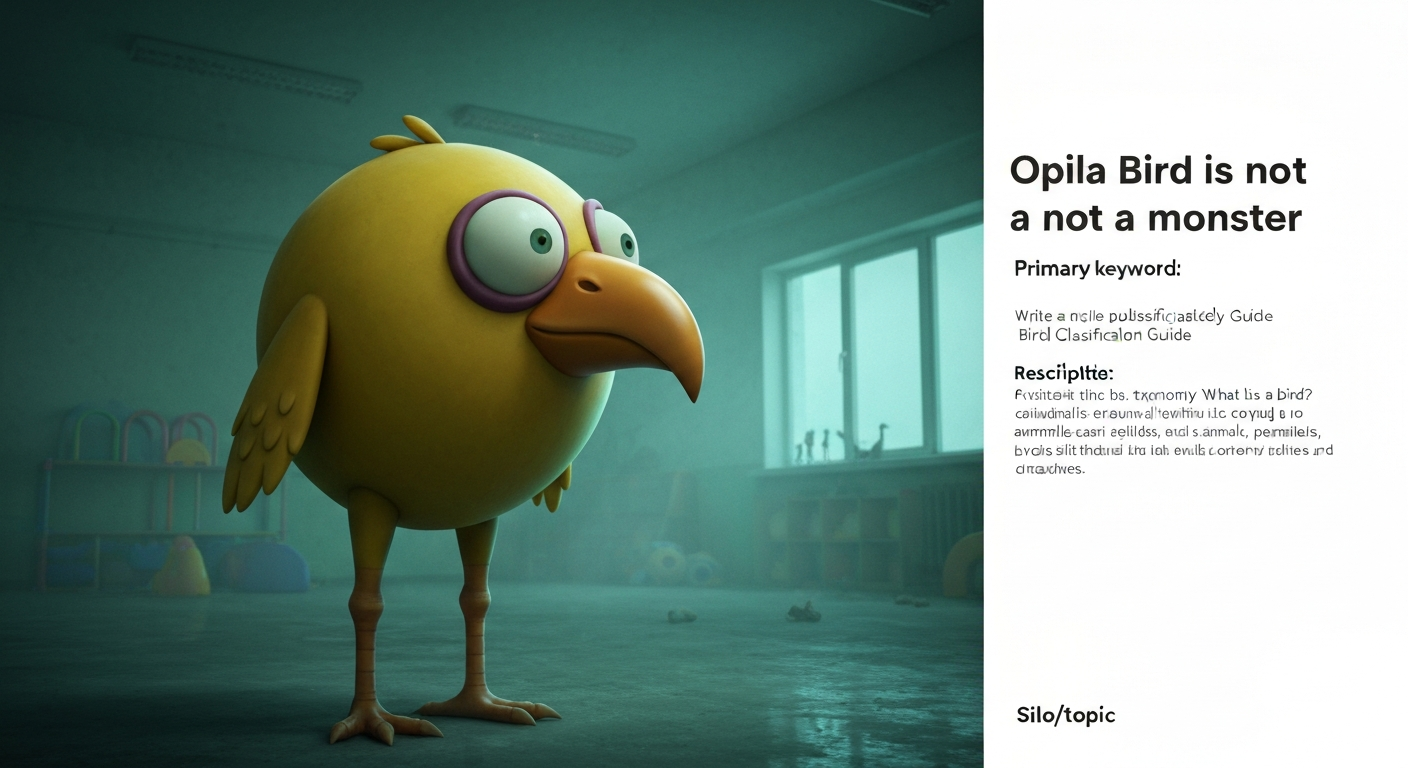
Quick verdict: bird, monster, or something else entirely?
Opila is none of the above in a zoological sense. It occupies a third category: fictional creature. The character appears in Garten of Banban (released 2023 onward), where it is deliberately designed with exaggerated birdlike features to provoke unease. The game's official character roster lists Opila Bird as a mascot character, and the sounds and visuals associated with it online are game assets or fan-made media, not field recordings or specimen photographs. When you check the databases that ornithologists actually use, the IOC World Bird List (currently at version 15.2), Avibase, eBird/Clements, GBIF, and iNaturalist, there is no taxon with the common or scientific name "Opila." That absence is definitive. A real bird leaves a paper trail of specimens, observations, and literature. Opila leaves game trailers.
What does "opila" actually refer to? Sorting out the name
The name "Opila Bird" originates entirely within the Garten of Banban franchise. Within the game's lore, the character is portrayed as a giant, humanoid bird creature that roams an abandoned childcare facility. Fan communities have elaborated extensively on this lore, including some posts that claim Opila's fictional genome contains flamingo DNA, specifically referencing Phoenicopterus roseus (the greater flamingo). That detail is fan-written fiction, not biological evidence, and it does not appear anywhere in taxonomic literature. It does, however, explain why some readers arrive at a bird classification site asking about this character: the flamingo reference sounds plausible enough to blur the line between a game story and a real species.
There is no documented ambiguity in scientific databases. Searches of Avibase and the IOC World Bird List return no entry for "Opila" as either a common name or any part of a scientific binomial. GBIF and iNaturalist, the two largest aggregators of specimen and photographic observation records for wild organisms, carry no research-grade entry for a creature by this name. If a bird named Opila existed in the wild, it would appear in at least one of these systems. It does not.
What actually makes something a bird: the diagnostic checklist
Because Opila is designed to look birdlike, it is worth reviewing exactly what biologists use to confirm an organism belongs to class Aves. Related common ID questions (for example, is booby a bird) are covered in our booby identification guide. These are the same criteria applied to borderline cases like penguins (which swim but are absolutely birds) and pterosaurs (which flew but are absolutely not birds).
- Feathers: The single most diagnostic trait. All living birds have feathers, and feathers are found in no other living animal group. Feathers are modified from the same keratin protein as reptile scales, but their structure (barbs, barbules, and hooks) is unique to birds.
- Toothless beak: Modern birds lack teeth entirely. Their beaks are covered in a keratin sheath called the rhamphotheca. Some ancient bird relatives (like Hesperornithiformes) had teeth, but no living species does.
- Hard-shelled amniotic eggs: Birds reproduce by laying eggs with a hard, calcified shell. Reptiles lay eggs too, but bird eggs have a distinct shell structure and are incubated at high, stable temperatures.
- Four-chambered heart and high metabolic rate: Birds are endothermic (warm-blooded), maintaining a constant internal temperature through metabolic heat. This allows sustained flight and activity.
- Avian air-sac respiratory system: Birds breathe through a unique system of air sacs that allow a continuous, unidirectional flow of air through the lungs, even during exhalation. No other living animal group shares this system.
- Fused clavicles (furcula/wishbone) and hollow, pneumatized bones: Bird skeletons are lightweight due to air-filled (pneumatized) bones, a direct extension of the respiratory air-sac system.
- Warm blood and feathered integument confirmed in fossil record: The evolutionary link to theropod dinosaurs is well established, but the combination of all the above traits distinguishes modern birds from their reptilian ancestors.
Cornell Lab of Ornithology's Bird Academy summarizes the practical shorthand neatly: all birds have feathers, and only birds have feathers. That single character, confirmed visually or from a specimen, is enough to place an organism in class Aves. An animated game character, however lifelike, has no feathers in a biological sense. It has pixels and polygons.
What Opila looks like: the fictional design and what it borrows from real birds
Opila Bird in the game is depicted as a very large, bipedal creature, roughly human-height or taller, with a round yellow body, a large cartoonish beak, and wide eyes. Its design borrows visual cues from wading birds and large parrots, particularly the exaggerated beak proportions and bright coloration associated with toucans or hornbills. Juveniles in the game's lore are sometimes depicted with different coloration or proportions, which fans have interpreted as developmental stages, but these are narrative and art choices, not descriptions of a real molt cycle.
It is worth noting what makes real birds look dramatically different between age classes, because this is a genuine source of confusion for people encountering unfamiliar wild birds. Many species show strikingly different juvenile and adult plumage. Young herring gulls, for example, are mottled brown for their first three years before becoming the familiar white-and-grey adults. A juvenile great blue heron looks disheveled and strange compared to the elegant adult. If you see an unfamiliar bird in the field and it looks "wrong" or even alarming, juvenile or eclipse plumage is one of the first things to consider, not supernatural explanations.
Vocalizations and recordings: what the evidence actually shows
Many people encounter Opila first through audio: the character has a distinctive, unsettling call that circulates widely on YouTube, TikTok, and sound-effect sites. These recordings are game audio assets or fan edits derived from the game, not entries in any scientific bioacoustics repository. The two main archives used by ornithologists and birdwatchers to compare unknown vocalizations are Xeno-canto (a community-driven global archive of wild bird recordings) and the Macaulay Library at the Cornell Lab of Ornithology. Neither contains any recording attributed to a wild Opila. When researchers want to confirm a bird species from audio, they run spectrogram analysis and compare the frequency and temporal patterns against verified recordings in these libraries. That process, applied to Opila audio files, would immediately identify them as synthesized sound design rather than biological vocalizations.
For comparison: if you hear an unknown bird call in your garden and want to identify it, tools like Merlin Bird ID (from Cornell Lab) can match the spectrogram of your recording against thousands of verified wild-bird vocalizations in seconds. That is evidence-based ornithology. No such match exists for Opila because the sounds were composed, not recorded in a field.
Why people think Opila is a monster (or a real terrifying bird)
The confusion is understandable when you look at the overlapping reasons it happens. Game designers intentionally exploit the "uncanny valley" of birdlike features, making Opila recognizable enough to feel real but distorted enough to trigger unease. Several specific factors push people toward the "monster" interpretation. Analyses of famous sightings show photographic artifacts, cropping, perspective, and low resolution can convert mundane animals into 'monster-like' shapes (see Is there any truth behind the legend of the Loch Ness Monster? | National Geographic).
- Scale distortion: Opila is depicted at near-human scale. Most familiar birds are small. A chicken-sized or larger bird already reads as unsettling to many people. Real birds like the southern cassowary (up to 1.8 meters tall, capable of serious injury) and the ostrich (up to 2.8 meters) demonstrate that very large birds genuinely exist and can be alarming in person, which lends the fiction some plausibility.
- Exaggerated proportions: The oversized head and beak mimic known visual triggers for fear responses (large eyes, disproportionate facial features). Real birds with large beaks, like toucans, shoebills, or puffins, often strike people as comically or disturbingly "wrong" on first encounter.
- Juvenile or disease-affected plumage in real birds: People who see a real bird with severe feather loss, avian pox lesions, or beak deformity (all documented veterinary conditions) sometimes genuinely mistake it for something otherworldly. Avian pox causes wart-like skin growths; beak-and-feather disease causes progressive feather loss and beak deformity. A bird in advanced stages of either condition looks nothing like a healthy member of its species.
- Low-resolution video and cropping: Much of the amateur video evidence offered for "monster birds" online consists of heavily cropped or low-resolution footage. The same perceptual effect documented in analyses of the Loch Ness "Surgeon's Photo" applies: perspective, resolution loss, and cropping can convert a perfectly ordinary diving bird or large wader into an unrecognizable shape.
- Fictional lore reinforcement: Fan wikis, Reddit threads, and game commentary treat Opila's backstory as if it were case notes about a real creature. The writing style in some fandom posts deliberately mimics scientific or medical documentation, which blurs the line for readers who encounter it out of context.
- Jump-scare audio conditioning: The sounds associated with Opila are mixed and composed for maximum startle effect. Hearing them outside the game, without visual context, makes the creature feel like a documented, dangerous animal rather than a game asset.
Opila versus other commonly confused animals: a quick comparison
Since Opila sits at the intersection of "looks like a bird" and "seems like a monster," it is useful to place it alongside the animals that most often confuse people about what a bird actually is. Penguins, ostriches, bats, and pterosaurs all generate genuine classification questions, and the same diagnostic criteria that settle those questions settle the Opila question too.
| Animal | Has feathers? | Lays hard-shelled eggs? | Class Aves? | Why people get confused |
|---|---|---|---|---|
| Opila Bird (game character) | No (fictional/animated) | Not applicable | No (fictional) | Birdlike design, flamingo DNA lore, scary sounds |
| Penguin | Yes | Yes | Yes | Cannot fly; lives in water; looks like a fish-mammal hybrid to some |
| Ostrich | Yes | Yes | Yes | Cannot fly; enormous size; looks reptilian |
| Bat | No (has fur/hair) | No (live birth) | No (class Mammalia) | Flies; nocturnal; leathery wings superficially resemble bird wings |
| Pterosaur (extinct) | No confirmed feathers (had pycnofibers) | Likely leathery eggs | No (order Pterosauria, separate from Aves) | Flew; found alongside dinosaurs; sometimes called "flying dinosaurs" |
| Cassowary | Yes (modified, hair-like) | Yes | Yes | Helmet-like casque, dangerous behavior; looks prehistoric and threatening |
The pattern is consistent: every real animal in that table, no matter how strange it looks, meets at least the feather criterion if it belongs to class Aves. Opila meets none of them because it does not exist as a biological organism. Bats and pterosaurs fail the feather test and are definitively not birds. Penguins and ostriches pass it and are definitively birds, regardless of whether they can fly. Flight is not a defining character of birds.
Is the Opila Bird female? How sex determination works in real birds
Questions about Opila's sex come up frequently, partly because the game's lore is ambiguous and partly because people extend the question to real birds they own or observe. For the game character specifically, sex is a matter of fictional lore, not biology, so any answer is canon-dependent rather than evidence-based. For background on whether the word "bird" functions as a common-gender term in English, see the article titled "Is bird a common gender.". For a focused discussion on whether Opila is portrayed as female in the game's lore, see Is Opila Bird female Is Opila Bird female?. The character's official materials do not conclusively establish a biological sex in a scientific sense.
For real birds, especially those kept in captivity where sex matters for breeding management or behavioral interpretation, the answer is much more rigorous. Many bird species are sexually monomorphic, meaning males and females look identical to the human eye. In those cases, visual inspection tells you nothing. The standard, reliable method is molecular sexing: a PCR (polymerase chain reaction) assay targeting the CHD1 gene on avian sex chromosomes (the Z and W chromosomes). The article 'Molecular techniques for sex identification of captive birds - PMC' documents the Griffiths PCR-based CHD1 protocol and its follow-up primer sets as standard, robust methods used in conservation and veterinary labs blank" rel="noopener noreferrer">Practical tests used to confirm biological sex in birds are molecular (PCR-based) assays targeting sex-linked genes (most commonly CHD1 on avian Z/W chromosomes).. Birds use a ZZ/ZW sex-determination system rather than the XY system of mammals. Males are ZZ; females are ZW. A small blood or feather sample sent to a veterinary genetics lab will return a definitive result within days. For questions about same-sex behavior and how it differs from biological sex in pet birds, see the guide Is my bird gay, which explains bonding, mating displays, and how to interpret those behaviors versus sex determination. This protocol, developed by Griffiths and colleagues and refined since, is the method used in conservation programs and avian veterinary practice worldwide.
Behavioral and morphological cues can supplement molecular testing in sexually dimorphic species. In species where males and females differ visibly (think the bright plumage of a male mallard versus the brown female, or the size difference in raptors where females are typically larger), experienced observers can make reliable visual assessments. Molt timing also varies between sexes in some species. But for ambiguous cases, including many parrots, finches, and shorebirds, molecular testing is the only way to be certain. If you are an owner trying to determine your bird's sex, that is the route to a definitive answer.
Practical steps if you are genuinely trying to identify an unknown bird
If you encountered something in the wild, on video, or in a photograph and you are genuinely unsure whether it is a real bird, here is how to work through it systematically.
- Check for feathers first. If you have a clear photo or video, look for the characteristic barbed structure of feathers. Fur, scales, and skin all look different under magnification or in good light.
- Search Avibase or the IOC World Bird List by the name you have been given. Both are free and searchable. If the name returns nothing, the creature is either undescribed (extremely rare and it would be major news), misidentified, or fictional.
- Upload a photo to iNaturalist. The platform's computer-vision tool cross-references your image against millions of verified observations and will suggest the closest matching real species. Community experts can then confirm or correct the suggestion.
- For audio, use Merlin Bird ID's Sound ID feature or upload a recording to Xeno-canto. These tools compare spectrograms against validated wild-bird recordings. A synthesized game sound will not match any entry.
- If the image source is a video game, fan wiki, or social-media meme, treat it as fictional until you can verify it against a peer-reviewed source or authoritative checklist.
- For sex determination of a bird you own, request a CHD1 PCR assay from an avian veterinarian or a certified genetics lab. Results are definitive and typically cost less than a standard veterinary consultation.
The bottom line
Opila Bird is a game character, not a biological taxon and not a monster in the zoological sense. The classification question resolves cleanly because the tools ornithologists use, checklists, specimen databases, field observations, and bioacoustics repositories, contain no evidence of a real animal by this name. The sounds and images circulating online are game assets. The flamingo-DNA lore is fan fiction. The frightening appearance is intentional game design that borrows just enough from real bird morphology to feel plausible. Understanding exactly what makes a bird a bird, feathers, beak, hard-shelled eggs, air-sac respiration, and hollow bones, makes it straightforward to evaluate any creature, fictional or real, against those criteria. Opila fails every biological test. A cassowary, an ostrich, or a shoebill stork might look just as alarming in a dark corridor, but they pass every one.
FAQ
Verdict — is the “Opila” a bird or a monster?
Evidence-based verdict: Opila is a fictional game character (a stylized birdlike mascot) from the Garten of Banban franchise and not a recognized biological taxon or wild bird species. Authoritative bird checklists (IOC, Avibase/Clements), biodiversity repositories (GBIF, iNaturalist) and museum records contain no species named “Opila.” Public images and sounds labeled Opila are game assets, fan media, or edited recordings, not validated field specimens or bioacoustic records (sources: Garten of Banban character pages; IOC World Bird List; Avibase; GBIF).
Why we can be confident Opila is not a real species (taxonomic identity explained)
Taxonomic identity relies on published names, type specimens, and inclusion in curated checklists. Major global checklists (IOC World Bird List, Avibase) and specimen/observation aggregators (GBIF, iNaturalist) list formally described taxa; none list “Opila.” In contrast, Opila appears on official and fan pages for a video-game franchise, and audiovisual files trace to game assets. Therefore, there is no peer-reviewed or museum-backed taxonomic evidence for Opila as an avian species. (See IOC World Bird List; Avibase; GBIF; Garten of Banban character page.)
What diagnostic bird traits would prove an organism is a bird?
Ornithological diagnostic traits: feathers (unique to birds), a toothless beak, hard-shelled eggs, a four-chambered heart/high metabolic rate, and avian respiratory anatomy. Field-confirmation also uses feather structure, flight anatomy, and vocalizations. If a candidate organism shows these anatomical and reproductive characters and appears in museum records or peer-reviewed descriptions, it is classified in class Aves (sources: Encyclopaedia Britannica; Cornell Lab of Ornithology).
If someone finds an Opila-like animal, what physical features and behaviors should they document to determine if it’s a real bird?
Key evidence to record: high-resolution photos of plumage/feathers, close-up of the beak and feet (to see scales/claws), images of body outline in natural posture (wing shape, tail), video showing gait or flight, and audio recordings of calls. Also note habitat, behavior (feeding, nesting), and any egg or nest observations. Compare audio to Xeno-canto/Macaulay Library and images to field guides or Avibase. Feathers and a beak without teeth are decisive evidence of an avian identity (sources: Cornell Lab; Xeno-canto; Avibase).
Why might people mistake Opila (or a real bird) for a “monster”?
Common reasons for “monster” misperception: stylized or damaged appearance (severe feather loss, deformity, lesions from disease), juvenile or molting plumages that look odd, unusual lighting/perspective/cropping in photos, low-resolution video artifacts, and cultural priming from game lore or urban legends. Avian diseases (avian pox, beak-and-feather disease, severe molt) and photographic artifacts are documented causes of extreme-looking birds (sources: avian pathology reviews; National Geographic analysis of visual misidentifications).
How can you tell an individual’s biological sex in birds — is “Opila Bird” a female?
Sex in birds is determined biologically by Z/W sex chromosomes (males ZZ, females ZW in most species). Visual sexing is possible in sexually dimorphic species (different plumage, size, or ornamentation). For ambiguous cases, molecular sexing (PCR tests targeting CHD1 gene differences on Z and W chromosomes) provides reliable identification. For a fictional character like Opila, there is no biological sex to test — any stated sex is part of game lore or fandom, not lab-confirmed biology (source: molecular sexing literature; PCR CHD1 methods).