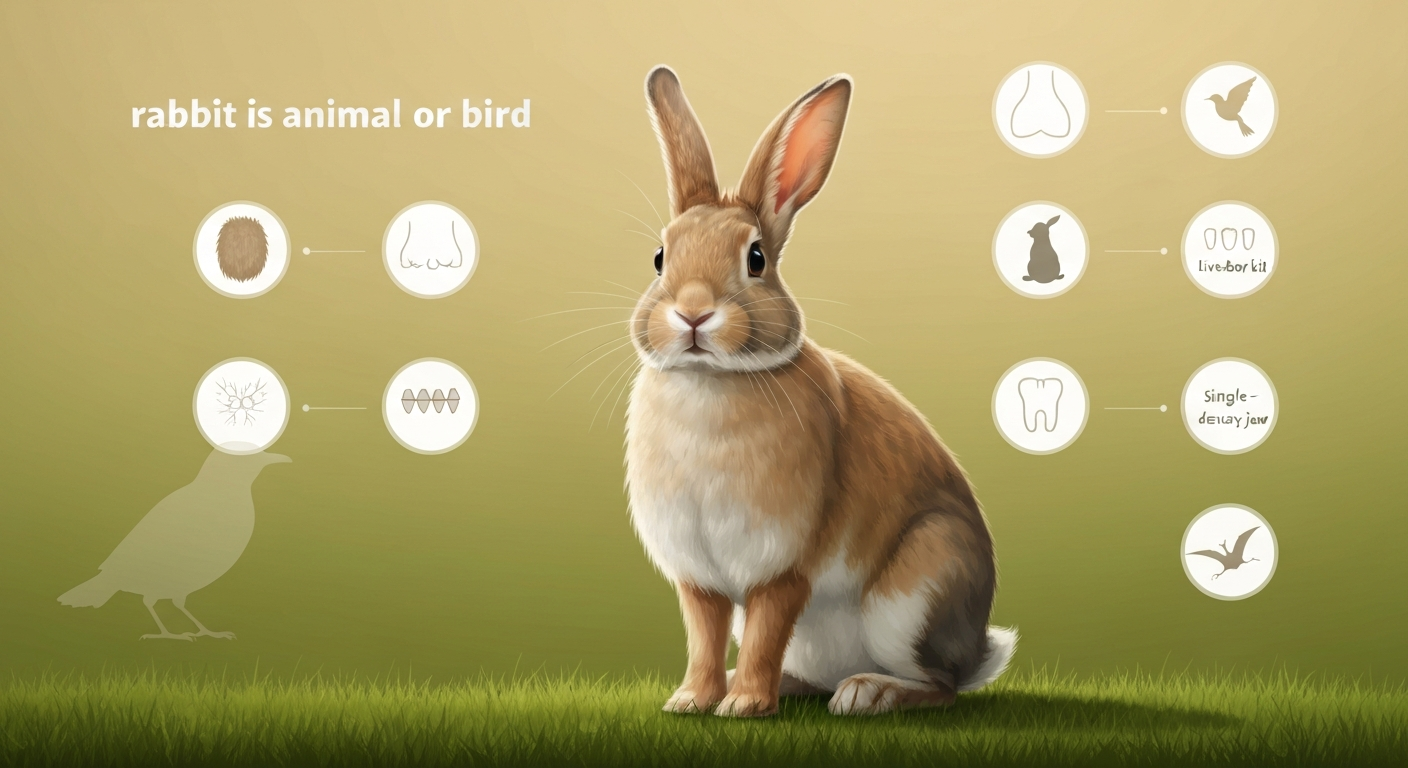
A rabbit is a mammal, not a bird. Every rabbit species, including the common European rabbit (Oryctolagus cuniculus), is classified in Class Mammalia. Birds belong to a completely separate class, Aves, and rabbits share none of the defining traits that place an animal in that group.
Rabbit Is Animal or Bird? Quick Answer & Key Differences

Sarah Chen
4 Aug 2026
Where rabbits sit in the tree of life
Taxonomically, rabbits belong to the order Lagomorpha, family Leporidae, within Class Mammalia. That places them alongside squirrels, monkeys, and hens in the broad category of 'animals,' but firmly within the mammal subgroup rather than anywhere near birds. Class Aves, the group that contains all birds, is a separate branch of warm-blooded vertebrates defined by an entirely different set of biological features. No rabbit has ever been reclassified as a bird, and there is no ambiguity in the scientific literature on this point.
Why rabbits are mammals: the traits that seal it
Mammalia is not just a label. The class is defined by a specific suite of anatomical and reproductive traits, and rabbits check every box. Mammary glands and lactation are universal features of living mammals and are the diagnostic basis for the name Mammalia (Animal Diversity Web, Mammalia (mammary glands and lactation)) Animal Diversity Web — Mammalia (mammary glands and lactation). Understanding these traits is the clearest way to see why a rabbit cannot be a bird.
- Fur: Rabbits are covered in dense fur, a keratinous filamentous structure unique to mammals. No bird has fur, and no mammal has feathers.
- Mammary glands: Female rabbits produce milk to feed their young. The name 'Mammalia' comes directly from these glands (Latin: mamma), and their presence is the single most definitive mammalian trait.
- Live birth: Rabbits give birth to live young through a process called kindling. Gestation lasts approximately 31 to 32 days for Oryctolagus cuniculus. This viviparous reproduction is a hallmark of most mammals.
- Three middle-ear bones: Mammals possess three tiny ear ossicles (malleus, incus, and stapes). Birds and other non-mammalian vertebrates have only one (the stapes, also called the columella). This is a deeply reliable anatomical difference used in vertebrate anatomy.
- Teeth: Rabbits have a characteristic dental formula with continuously growing incisors adapted for herbivory. Most living birds have no teeth at all, relying instead on a horny beak.
- Single dentary jaw bone: Each side of a mammalian lower jaw is made up of a single bone (the dentary). Birds and reptiles have multiple bones in the lower jaw, another clear anatomical divide.
Taken together, these traits make the classification unambiguous. A rabbit growing fur, nursing live offspring, and chewing with specialized teeth is about as far from a bird as a vertebrate can get.
What actually makes something a bird
Class Aves is defined by a combination of features that no other living animal group shares as a complete package. If you want to check whether any creature is a bird, these are the traits to look for.
- Feathers: This is the single most reliable indicator. Feathers are a keratinous integumentary structure found exclusively in birds among living animals. If an animal has feathers, it is a bird. If it does not have feathers, it is not.
- Beak (no teeth): Living birds have a horny beak rather than toothed jaws. This is a near-universal trait in Class Aves today, though some ancient bird relatives in the fossil record did have teeth.
- Wings: The forelimbs of birds are modified into wings. Not all birds use them to fly (more on that below), but the modified forelimb structure is present in all species.
- Hard-shelled amniotic eggs: All birds reproduce by laying calcified eggs. The calcified shell is a standard diagnostic reproductive feature of Aves.
- Avian skeleton: Birds have a furcula (the fused clavicles, commonly called the wishbone) and, in flying species, a keeled sternum for anchoring flight muscles. Many bones are also hollow and fused, reducing weight.
- Air sac respiratory system: Birds have rigid lungs connected to a system of air sacs that produce largely one-way airflow through the lungs. This is an avian-specific respiratory adaptation not found in mammals.
Rabbit vs bird: a side-by-side comparison
| Trait | Rabbit (Mammalia) | Bird (Aves) |
|---|---|---|
| Body covering | Dense fur | Feathers |
| Reproduction | Live birth (viviparous); ~31–32 day gestation | Lays calcified hard-shelled eggs |
| Feeding of young | Mammary glands produce milk | Regurgitation or foraging; no mammary glands |
| Jaw structure | Toothed jaws; continuously growing incisors | Horny beak; no teeth in living species |
| Forelimbs | Four-legged; front limbs are legs | Forelimbs modified into wings |
| Middle ear | Three ossicles (malleus, incus, stapes) | One ossicle (stapes/columella) |
| Skeletal features | No furcula; solid jaw made of single dentary bone | Furcula (wishbone); keeled sternum in most species |
| Respiratory system | Standard tidal lung breathing | Rigid lungs plus air sacs; near-unidirectional airflow |
| Taxonomic class | Mammalia | Aves |
Borderline cases that trip people up
Most of the confusion around animal classification comes from a handful of cases where one or two bird-like traits show up in non-birds, or vice versa. Here are the most common ones worth knowing about.
Penguins and ostriches: birds that do not fly
Penguins and ostriches are both fully-fledged birds despite being flightless. They retain feathers, beaks, wings (modified for swimming in penguins), and they lay eggs. Flightlessness does not remove an animal from Class Aves. The complete avian trait package is still present, which is what the classification is based on.
Bats: the flying mammal
Bats (order Chiroptera) are the only mammals capable of powered flight, which leads many people to assume they must be birds. They are not. Bats have fur, produce milk, give birth to live young, and have three middle-ear ossicles. They have no feathers, no beak, and no avian skeleton. A bat is a mammal that flies, not a bird.
Pterosaurs: ancient fliers that were neither birds nor mammals
Pterosaurs were flying reptiles from the Mesozoic era. They were not birds (no feathers in the modern sense, and they fall outside Class Aves entirely) and were not mammals. They represent a third, now-extinct evolutionary branch of flying vertebrates.
Platypus and echidnas: egg-laying mammals
Monotremes like the platypus and echidna lay eggs, which is something most people associate with birds. But they also have fur and produce milk, and they are firmly classified in Mammalia. This is a good reminder that egg-laying alone does not make something a bird. You need the full avian trait package, especially feathers.
Quick answers for related creatures people often wonder about
The rabbit question is part of a broader pattern. People frequently ask the same 'animal or bird? See the page titled 'monkey is animal or bird' for a clear, concise classification of monkeys. For a closely related question, see the page titled "Is a monk a bird?" (internal link). ' question about other familiar creatures. Here are the straightforward answers, using the same classification logic.
| Animal | Classification | Key reason it is not a bird |
|---|---|---|
| Hen (domestic chicken) | Bird (Class Aves) | Hens ARE birds: they have feathers, a beak, lay eggs, and belong to Class Aves |
| Squirrel | Mammal (Class Mammalia) | Has fur, gives birth to live young, produces milk, no feathers |
| Turtle | Reptile (Class Reptilia) | Has a bony shell and scales, no feathers, no beak in the avian sense, lays soft or leathery eggs |
| Tortoise | Reptile (Class Reptilia) | Same reasoning as turtle: reptilian traits, no avian features |
| Monkey | Mammal (Class Mammalia) | Has fur, opposable digits, gives birth to live young, nurses offspring |
| Snake | Reptile (Class Reptilia) | Has scales, no limbs or wings, no feathers, lays eggs or bears live young depending on species |
Note that the hen is the one exception in that list. A hen is a bird, which makes it a useful contrast when thinking about what bird classification actually requires. The other creatures, including rabbits, squirrels, turtles, tortoises, monkeys, and snakes, are all non-birds for clear anatomical reasons. For a focused explanation of whether a tortoise is an animal or bird, see the tortoise is animal or bird resource (ID 979212da-9311-4ba8-8f7d-8b3f164b4c90). If you're curious specifically about turtles, see the related page 'Is a turtle a bird' for a clear explanation. For a specific look at snakes and why they are not birds, see the snake is animal or bird page.
How to classify any animal yourself
If you are ever unsure whether an animal is a bird, run through this short checklist. You rarely need to check more than the first two items to get your answer.
- Does it have feathers? If yes, it is almost certainly a bird. If no, it is not a bird.
- Does it have a beak and wings? These support the bird identification but are not sufficient on their own (beaks appear in some non-bird animals like the platypus, and wings appear on bats and insects).
- Does it lay hard-shelled calcified eggs? This is a bird reproductive trait, but remember that some mammals (monotremes) also lay eggs, so use this alongside other checks.
- Does it have fur or hair? If yes, it is a mammal, not a bird.
- Does it nurse young with milk? If yes, it is a mammal.
- Does it have scales and no fur or feathers? It is likely a reptile or fish.
- When in doubt, look up the animal's taxonomic class. Class Aves means bird. Class Mammalia means mammal. Class Reptilia means reptile.
For deeper reading, the pages on penguins and ostriches on this site are great starting points if you want to see how the bird checklist applies to flightless species. The hen page is also worth visiting since it illustrates exactly what a bird classification looks like in a familiar, everyday animal, making the contrast with rabbits, squirrels, and monkeys even clearer.
FAQ
Quick answer: Is a rabbit an animal or a bird?
A rabbit is an animal and specifically a mammal (not a bird). Rabbits belong to Class Mammalia (e.g., Oryctolagus cuniculus is listed in Mammalia by ITIS).
Why are rabbits classified as mammals?
Rabbits have the defining mammal traits: fur (hair), functional mammary glands that produce milk for young, three middle‑ear bones, a single dentary (lower jaw) bone, and they give birth to live young (viviparity). These anatomical and reproductive features place them in Class Mammalia (family Leporidae, order Lagomorpha).
What is the biological definition of a bird (Aves)?
Birds (Class Aves) are diagnosed by a suite of traits used in field and academic contexts: feathers (unique to birds and their dinosaur ancestors), a beak without true teeth (in most living species), forelimbs adapted as wings in many species, laying calcified hard‑shelled eggs, and characteristic skeletal/respiratory features (furcula, keeled sternum, air‑sac system). Feathers are the single most reliable living‑animal indicator of a bird.
Side‑by‑side comparison: rabbit vs bird (rapid clarity)
General classification: Rabbit = Mammalia; Bird = Aves. Integument: Rabbit has fur (hair); Bird has feathers. Reproduction: Rabbit gives live birth (kindling) and nurses young with milk; Bird usually lays hard‑shelled eggs and does not produce milk. Skull/feeding: Rabbit has teeth (continuously growing incisors for herbivory); Bird has a horny beak (most lack teeth). Middle ear: Rabbit has three ossicles (malleus, incus, stapes); Bird has one (stapes/columella). Limbs: Rabbit has four legs adapted for running/jumping; many birds have wings (forelimb modified) and two legs for walking. Respiratory/skeletal specializations: Rabbits lack avian air‑sac respiratory system, furcula, and keeled sternum; birds have these features. Conclusion: anatomical and reproductive traits clearly separate rabbits (mammals) from birds.
Common misconceptions: Could a rabbit ever be a bird because of appearances or behavior?
No. Superficial traits (size, colour, habitat) do not change fundamental anatomy. Rabbits lack feathers, beaks, egg‑laying with calcified shells, and avian skeletal/respiratory specializations. Even flightless birds (penguins, ostriches) retain feathers, eggs, and other avian traits; they remain birds. Conversely, flying mammals (bats) are still mammals because they have fur, lactation, and mammalian ear/cranial traits.
Borderline or confusing examples explained
Penguins and ostriches: flightless but clearly birds because they have feathers, beaks, eggs, and avian skeletons. Bats: flying mammals — have fur and milk, not feathers. Pterosaurs (extinct): not birds; they were flying archosaurs with different anatomy (extinct group). Monotremes (platypus, echidnas): egg‑laying mammals — they have fur and mammary glands, so they are mammals despite laying eggs. Squirrels, turtles, hens, monkeys: squirrels and monkeys are mammals; hens are birds; turtles are reptiles — classification depends on diagnostic anatomical/reproductive traits.