A squirrel is an animal, specifically a mammal, not a bird. It belongs to class Mammalia, order Rodentia, and family Sciuridae. Like all mammals, it has fur, feeds its young on milk, and reproduces by giving birth to live young. It has no feathers, no beak, and no wings. There is no genuine taxonomic ambiguity here: squirrels sit firmly on the mammal branch of the tree of life, separated from birds by hundreds of millions of years of evolutionary distance.
Is Squirrel Animal or Bird? Clear Answer and Classification

Sarah Chen
14 Jul 2026
The scientific classification of squirrels
Every recognized squirrel species falls within the same clean taxonomic lineage. Take the eastern gray squirrel (Sciurus carolinensis) as a concrete example: the NCBI Taxonomy database, ITIS (Integrated Taxonomic Information System), and GBIF (Global Biodiversity Information Facility) all list it under Mammalia, within the order Rodentia, and the family Sciuridae. The family Sciuridae was formally described by Fischer de Waldheim in 1817 and currently includes tree squirrels, ground squirrels, chipmunks, marmots, prairie dogs, and flying squirrels, all mammals, all rodents.
| Taxonomic rank | Classification |
|---|---|
| Kingdom | Animalia |
| Phylum | Chordata |
| Class | Mammalia |
| Order | Rodentia |
| Family | Sciuridae |
| Example genus/species | Sciurus carolinensis (eastern gray squirrel) |
Birds, by contrast, belong to class Aves. The gap between Mammalia and Aves is not a minor one: mammals and birds last shared a common ancestor roughly 300 million years ago. Placing a squirrel in the same category as a robin or a hawk would require ignoring every layer of that classification system.
Why squirrels are mammals, not birds
The easiest way to confirm a squirrel is a mammal is to run through the core diagnostic traits that define Mammalia. According to the Encyclopaedia Britannica and the Animal Diversity Web, the three non-negotiable defining characteristics of mammals are: the presence of hair or fur, mammary glands that produce milk for offspring, and a chain of three middle-ear bones (the malleus, incus, and stapes). Squirrels check all three boxes without exception.
Beyond those three anchors, squirrels also show the broader mammal profile: they are endothermic (warm-blooded), they have a lower jaw made of a single bone called the dentary, they possess a diaphragm for breathing, and they give birth to live young after placental development. Female squirrels nurse their pups on milk from mammary glands, which is something no bird does.
As rodents specifically, squirrels also carry the defining dental feature of order Rodentia: a single pair of continuously growing (ever-growing, or hypselodont) incisors in each jaw, separated from the cheek teeth by a gap called the diastema. Those large, chisel-like front teeth are adapted for gnawing through nuts, bark, and hard seed cases. Birds, by contrast, have no teeth at all. Modern birds replaced teeth with a keratinous beak tens of millions of years ago.
Mammal vs bird: a direct comparison
The table below lays out the key diagnostic traits side by side. These are the same field-observable and anatomical markers that birders, educators, and wildlife guides use to separate the two classes.
| Trait | Mammals (e.g., squirrel) | Birds (class Aves) |
|---|---|---|
| Skin covering | Hair or fur | Feathers (unique to birds) |
| Reproduction | Viviparous (live birth); placental development in most species | Oviparous (lay hard-shelled eggs) |
| Feeding young | Mammary glands; mother produces milk | No mammary glands; regurgitated food or insects |
| Limbs | Four limbs with clawed digits | Forelimbs modified into wings; hind limbs with scaled feet |
| Dentition | Teeth present (rodents: ever-growing incisors) | No teeth; keratinous beak |
| Bones | Dense, marrow-filled bones | Lightweight, pneumatic (air-filled) bones |
| Locomotion | Walking, climbing, gliding (patagium) | Powered flight (most), walking, swimming |
| Examples | Squirrel, rabbit, monkey, bat | Robin, eagle, penguin, ostrich |
The recommendation here is simple: if you can see fur and teeth on an animal, it is not a bird. That alone rules out squirrels immediately.
Where the confusion comes from
Confusing a squirrel with a bird is more understandable than it might seem. Several factors push people in that direction, and it is worth going through each one honestly.
Arboreal habits
Tree squirrels spend most of their lives up in the canopy, leaping between branches at heights and speeds that feel decidedly birdlike. Watching a gray squirrel launch itself across a 2-metre gap and land with precision, it is easy to mentally file it alongside the birds you see in the same trees. But climbing and leaping through trees is arboreal locomotion, not flight, and the animal doing it is still covered in fur with four clawed paws and front teeth built for gnawing.
Flying squirrels
Flying squirrels (tribe Pteromyini within family Sciuridae) add a layer of genuine visual drama. They extend a furred membrane called a patagium, which stretches from wrist to ankle, and glide up to 45 metres between trees. National Geographic and the U.S. National Park Service are both explicit about this: flying squirrels glide, they do not achieve powered flight. There is no flapping, no flight feathers, and no avian anatomy involved. The patagium is a skin fold of fur and elastic tissue, not a modified forelimb with flight feathers like a bird's wing. Flying squirrels are still fully classified as Mammalia, Rodentia, Sciuridae, the name 'flying' is colloquial and biologically misleading.
Flightless birds and the flight assumption
Some readers approach this question from the other direction: if a squirrel can 'fly' (glide), does that make it a bird? It does not, for the same reason that penguins and ostriches are still birds despite being flightless. Bird classification is anchored in anatomy (feathers, beak, pneumatic bones, egg-laying) rather than the ability to fly. A flying squirrel without feathers or a beak is not a bird; an ostrich without flight is still very much one.
Bats and pterosaurs
Bats are mammals that achieve genuine powered flight using a patagium supported by elongated finger bones, yet they are firmly in class Mammalia alongside squirrels. Pterosaurs were flying reptiles, extinct for 66 million years, that were not birds either. Both cases reinforce the same point: flight is not what defines a bird. Feathers, a keratinous beak, hard-shelled eggs, and pneumatic bones define a bird. Squirrels have none of these.
How to tell if an animal is a bird: a quick checklist
This checklist follows the field-identification cues recommended by Cornell Lab of Ornithology and the Animal Diversity Web. Cornell Lab of Ornithology, What Is Unique to Birds? (feathers, beak, egg-laying, pneumatic bones) summarizes bird-unique traits such as feathers, a keratinous beak, hard-shelled eggs, and pneumatic bones Cornell Lab of Ornithology — What Is Unique to Birds? (feathers, beak, egg-laying, pneumatic bones). Run through it for any animal you are unsure about.
- Does it have feathers? Feathers are unique to birds. No other living animal has them. If the answer is yes, you almost certainly have a bird.
- Does it have a keratinous beak with no teeth? Modern birds have beaks and no teeth. Squirrels have prominent ever-growing incisors.
- Are its forelimbs modified into wings with flight feathers? Bird wings are structurally different from the paws, arms, or patagium of mammals.
- Does it lay hard-shelled eggs? Birds are oviparous. Squirrels are viviparous — they give birth to live young.
- Does the mother nurse young on milk from mammary glands? If yes, it is a mammal, not a bird.
- Does it have lightweight, pneumatic (air-filled) bones? This is an internal trait but worth knowing for reference.
- If the animal glides rather than flaps its wings in powered flight, check for fur: gliding mammals like flying squirrels have a fur-covered patagium, not wings.
A squirrel fails the first four checks and passes the last two (fur-covered, nursing mother, no hard-shelled eggs, gliding rather than powered flight). It is a mammal by every observable and anatomical measure.
Image suggestions
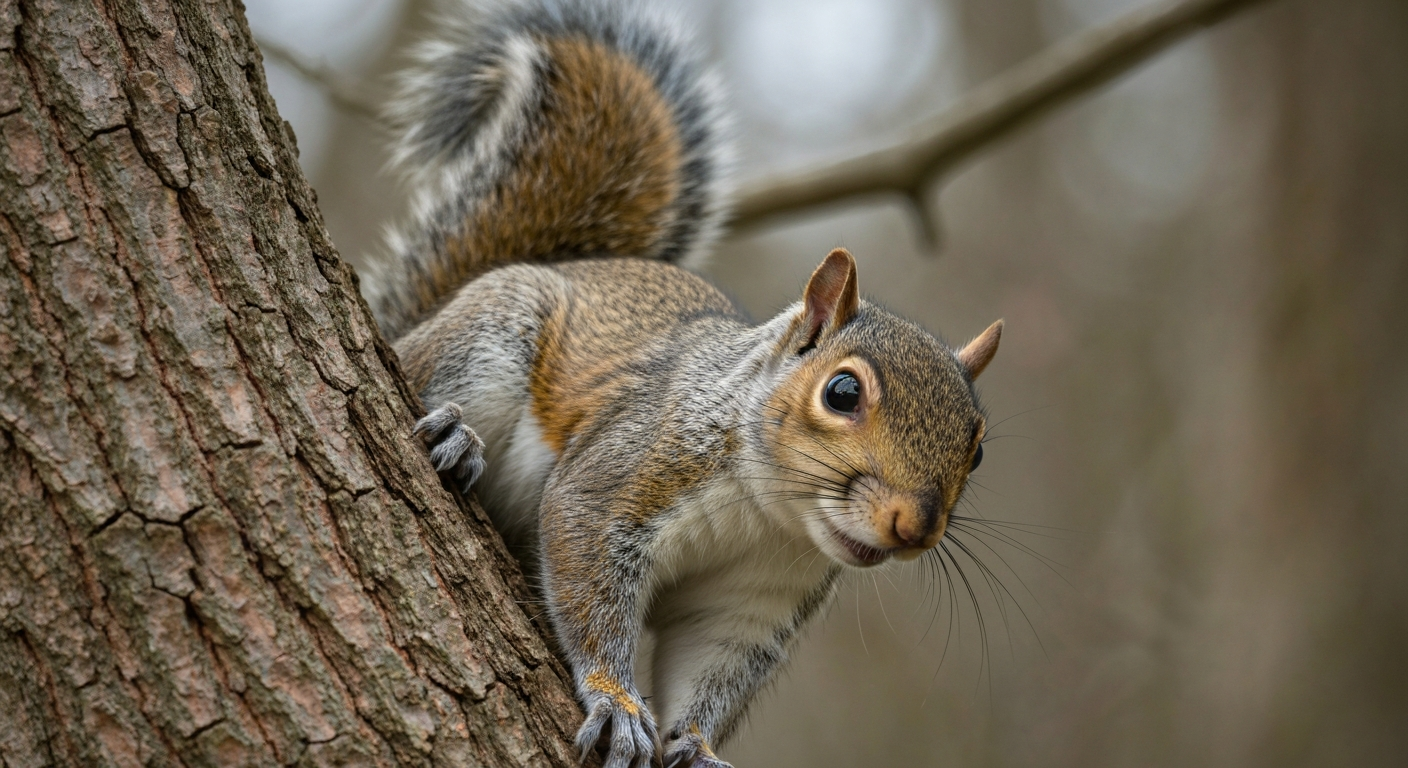
- Image 1 (place near the top, after the opening paragraph): A close-up photograph of an eastern gray squirrel (Sciurus carolinensis) clinging to a tree branch, clearly showing its fur coat, clawed forepaws, and gnawing incisors. Alt text: 'Eastern gray squirrel on a tree branch showing fur and clawed paws, confirming it is a mammal not a bird.'
- Image 2 (place alongside the comparison table): A simple side-by-side diagram contrasting fur and rodent teeth (squirrel) with feathers and a beak (bird), such as a sparrow or robin. Alt text: 'Diagram comparing squirrel fur and teeth with bird feathers and beak to illustrate mammal vs bird classification differences.'
- Image 3 (optional, place near the flying squirrel section): A photograph of a flying squirrel mid-glide with the patagium extended, showing the fur-covered membrane. Alt text: 'Flying squirrel gliding with patagium extended — a mammal that glides, not a bird.'
Related classification questions on this site
The squirrel question belongs to a broader pattern of queries that mix up animals and birds. Related: Is a tortoise an animal or a bird Is a tortoise an animal or a bird?. Is a monk a bird is a related question; the short answer is that monks are humans (Homo sapiens), not birds. Readers who land here often have similar questions about other common animals. Is a hen an animal or a bird? (It is both, a hen is an animal that is specifically classified as a bird.) Is a monkey an animal or a bird? See the related page “Is a monkey an animal or a bird?” (ID f399c0e9-0e7e-4533-beb4-9111ab1122da) for a full discussion. Like the squirrel, a monkey is a mammal. Is a rabbit an animal or a bird? See the separate discussion 'Is a rabbit an animal or a bird?' for a short explanation of why a rabbit is a mammal rabbit is animal or bird. A rabbit is a mammal in order Lagomorpha. Is a snake an animal or a bird? Snakes are reptiles in class Reptilia. For more detail, see the related discussion 'Is a snake an animal or a bird'. Is a tortoise or a turtle a bird? Both are reptiles. Each of these cases reinforces the same underlying principle: birds are defined by a specific cluster of anatomical traits, not by where they live, how they move, or how unfamiliar they seem.
What this all comes down to
A squirrel is an animal, that part is true for every living creature. But when people ask 'animal or bird,' they usually mean 'is it a bird or something else?' The answer is something else: specifically, a mammal and a rodent. Its fur, ever-growing incisors, live birth, and milk-feeding are the four most visible proof points. Flying squirrels add a fun wrinkle with their gliding membrane, but gliding fur-covered rodents are still rodents. If you remember only one rule from this page, let it be this: feathers are the single fastest way to confirm a bird. Squirrels do not have them.
- Squirrels are class Mammalia, order Rodentia, family Sciuridae — not birds.
- The three mammal anchors (fur, mammary glands, three middle-ear bones) all apply to squirrels.
- Birds are defined by feathers, a keratinous beak, hard-shelled egg-laying, and pneumatic bones — squirrels have none of these.
- Flying squirrels glide using a fur-covered patagium; they do not have wings or feathers and are not birds.
- Flight alone does not make something a bird: bats fly and are mammals; ostriches cannot fly and are birds.
- Use the seven-point checklist above whenever you need to classify an unfamiliar animal quickly.
FAQ
Title and meta description for the article
Title: Is a Squirrel an Animal or a Bird? Short answer and classification Meta description: Clear, concise answer: squirrels are mammals (not birds), with classification and key trait comparisons. (≤160 chars)
Direct short answer (core question)
Short answer: A squirrel is an animal and specifically a mammal (class Mammalia), not a bird.
Scientific classification of squirrels (class, order, family)
Typical classification (example eastern gray squirrel): Class: Mammalia; Order: Rodentia; Family: Sciuridae. (Sources: NCBI, ITIS, GBIF)
Why are squirrels mammals, not birds? Key trait comparison
Squirrels have mammal diagnostic traits: fur (hair), mammary glands that produce milk for young, a single-bone lower jaw and three middle-ear bones, and live birth with parental care. Birds instead have feathers, beaks (no true teeth in modern birds), wings with flight feathers, and typically lay hard‑shelled eggs. These clear anatomical and reproductive differences show squirrels are mammals, not birds. (Sources: Britannica, Animal Diversity Web, Cornell Lab)
Common sources of confusion and brief clarifications
- Arboreal habits: Both squirrels and many birds live in trees, which can cause confusion, but tree-dwelling does not determine class. - Flying vs gliding squirrels: Flying (gliding) squirrels have a furred patagium for gliding; they do not have wings or feathers and cannot perform powered flight like birds or bats. - Flightless birds, bats, and extinct pterosaurs: Flightless birds are still birds because they have feathers and avian anatomy; bats are mammals with powered flight; extinct pterosaurs were flying reptiles — different groups with different traits. Observing fur vs feathers and teeth vs beak resolves most confusion.
Compact side-by-side diagnostic trait comparison (table-style text)
Trait | Squirrels (Mammals) | Birds (Aves) Skin covering | Fur/hair | Feathers Reproduction | Mostly live young (placental), milk from mammary glands | Eggs with hard shells, no mammary glands Limbs/locomotion | Four limbs with clawed digits; some glide with patagium | Wings with flight feathers (in flying species); beaks Dentition | Teeth (ever‑growing incisors in rodents) | No true teeth in modern birds; beak Respiratory/skeleton | Typical mammal lungs, no pneumatic air‑sac system | Lightweight/pneumatic bones, air‑sac system Examples | Sciurus (tree squirrels), Glaucomys (flying squirrels) | Sparrows, eagles, penguins (Use these observable traits to distinguish squirrels from birds.) (Sources: ADW, Cornell Lab, Britannica)
Next Article
Is a Turtle a Bird? Simple Taxonomy Checklist and Facts
No, turtles are not birds. Learn the traits that define birds versus reptiles and fix common shell and egg misconception