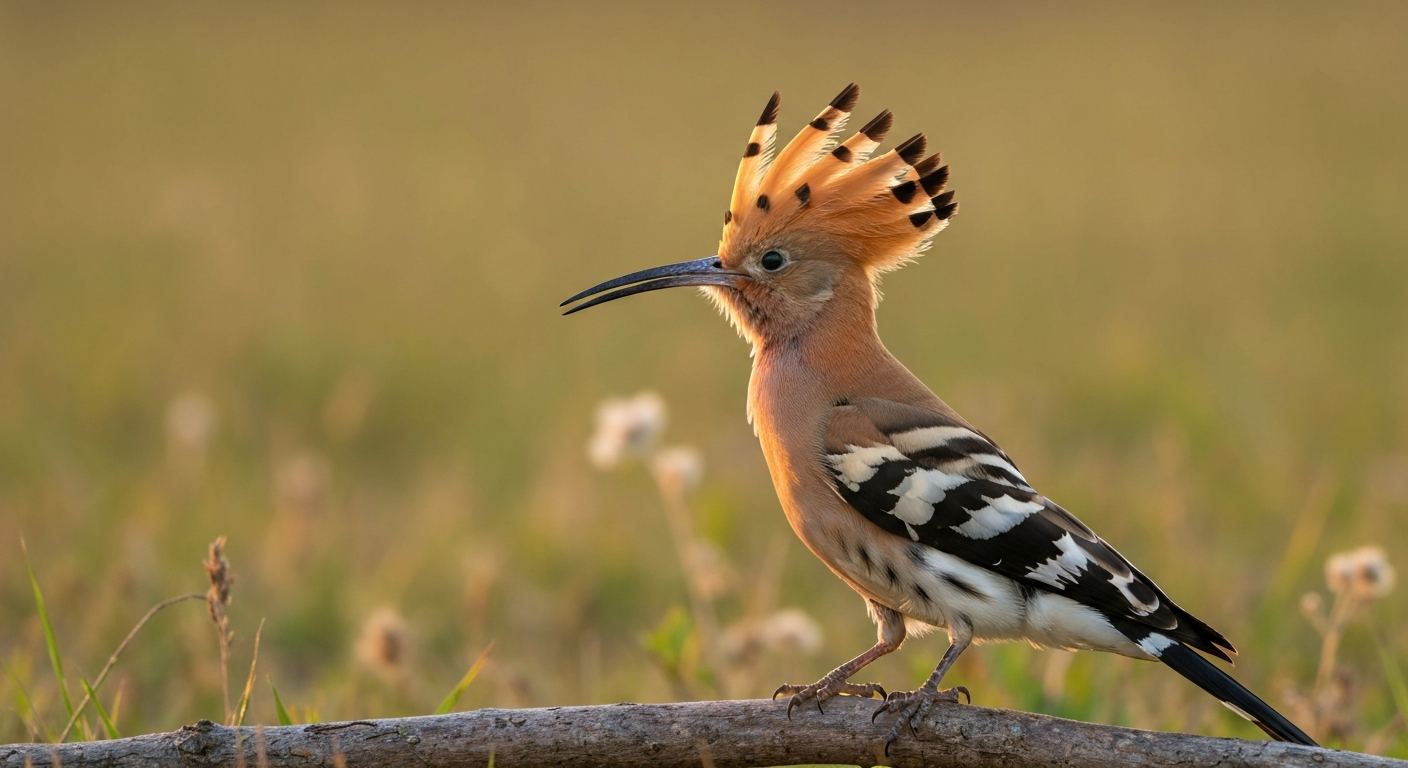
No, the hoopoe (Upupa epops) is not a climbing bird. It is a ground-foraging species that walks, probes soil with its long decurved bill, perches on branches and rocks, and nests inside cavities, but it does not habitually hitch up tree trunks the way woodpeckers, nuthatches, or treecreepers do. It lacks the specialized anatomy those true climbing birds rely on, specifically the zygodactyl (two-toes-forward, two-toes-back) or otherwise reinforced foot arrangement, and the stiffened tail feathers used as a prop during vertical ascent. By the functional criteria ornithologists actually use to define a climbing bird, the hoopoe does not qualify.
Is Hoopoe a Climbing Bird? Clear ID Guide and Verdict

Sarah Chen
27 Jul 2026
Is the hoopoe a climbing bird? The quick answer
The confusion is understandable. Hoopoes are cavity nesters, they occasionally clamber on rough bark, and their striking, almost prehistoric appearance makes people wonder whether they belong to some unusual behavioral guild. But cavity nesting and occasional clambering are not the same as being a climbing specialist. A species earns the label 'climbing bird' when it has evolved specific anatomical tools for sustained, controlled movement up and down vertical surfaces, and the hoopoe simply has not. It is, in every functional sense, a ground-forager and percher.
Hoopoe at a glance: taxonomy and key physical traits
The Common Hoopoe is Upupa epops, first formally described by Linnaeus in 1758 and placed in its own family, Upupidae. Depending on which checklist you consult it sits within the order Bucerotiformes or Coraciiformes, but all modern authorities agree it is a true bird (class Aves) with feathers, a beak, and a wishbone. It is the sole living member of its family in most treatments, though the African Hoopoe is sometimes split into a separate species.
Physically, the hoopoe is unmistakable: a pinkish-buff body, boldly barred black-and-white wings, and a fan-shaped erectile crest tipped in black. It measures roughly 25 to 29 centimeters in length with a wingspan of 44 to 48 centimeters. The bill is long, slender, and gently curved downward, perfectly shaped for probing soil and leaf litter. The legs are short and the feet are what ornithologists call anisodactyl: three toes pointing forward and one pointing back, the standard arrangement for a perching or walking bird. There is nothing in this foot plan that equips the hoopoe for gripping a vertical trunk.
How hoopoes actually get around
Watch a hoopoe for even a few minutes in the field and its locomotion pattern becomes obvious. It spends most of its foraging time walking briskly across open ground: short grassland, orchards, pastures, golf courses, and the edges of paths. It probes repeatedly into soft soil or dung, extracting beetle larvae, earwigs, and other invertebrates. BirdLife International, Common Hoopoe (Upupa epops) species factsheet reports that the hoopoe forages mainly on the ground, walking and probing the soil with its long decurved bill BirdLife International — Common Hoopoe (Upupa epops) species factsheet. The walk has a characteristic bobbing quality, the head pumping forward with each step, which is partly why it can look a little reptilian to first-time observers.
In flight the hoopoe is conspicuous and slightly erratic, with deep undulating wingbeats that have been compared to a giant butterfly. It perches readily on wires, walls, rocky outcrops, and branches, but perching on a branch is not the same as climbing a trunk. When it comes to nesting, it selects natural cavities in trees, walls, rock faces, and even termite mounds, but it accesses those cavities by flying or hopping to the entrance, not by hitching upward along the bark the way a treecreeper does. Encyclopedic accounts such as Grzimek's Animal Life Encyclopedia do note that hoopoes 'can climb rough surfaces,' but this refers to occasional, opportunistic clambering, not the sustained, specialized vertical locomotion that defines a true climbing bird.
What actually makes a bird a 'climbing bird'?
The term 'climbing bird' in ornithology refers to species that habitually travel up and down vertical surfaces, typically tree trunks or large branches, as a primary foraging or locomotion strategy. It is not enough to occasionally land on bark or peek into a crevice. True climbing birds have evolved specific anatomical features that allow them to do this safely and efficiently, and those features are quite distinct from what you find in a perching or walking bird.
Two main anatomical criteria are used. The first is foot geometry. Many climbing birds have a zygodactyl foot (two toes forward, two back, as in woodpeckers) or a strongly reinforced anisodactyl arrangement with hypertrophied claws (as in treecreepers), giving them a vice-like grip on bark. The second is tail support. Woodpeckers and many other trunk-climbers have stiffened, spine-tipped tail feathers that press against the bark and act as a third support point during vertical movement. Research published in the Proceedings of the Royal Society B has confirmed that this tail-loading ability in climbing birds is achieved through specific geometric modifications to the tail feathers, not just stiffer feather material. Nuthatches are the exception: they climb headfirst downward without tail support, relying instead on large, powerful feet with an exceptionally long hind claw. The common thread is always some combination of specialized grip and body-support adaptation.
The anatomy of true climbing birds: woodpeckers, nuthatches, and treecreepers
It helps to look at the three main groups of climbing birds and see exactly what the hoopoe is missing.
Woodpeckers (family Picidae) are the archetypal trunk-climbers. Their zygodactyl feet (two toes facing forward, two facing back) create a wide, stable grip on bark. Their tail feathers are stiff and pointed, and the central pair is especially robust, functioning as a prop that takes significant compressive load while the bird hammers or forages. The bill is chisel-like and backed by a hyoid bone system that wraps around the skull, absorbing shock. Every element of woodpecker anatomy is tuned for vertical trunk work.
Nuthatches (family Sittidae) take a different evolutionary route. They retain a standard three-forward, one-back foot plan but have unusually powerful legs and a remarkably long, curved hind claw that locks onto bark. Crucially, they are the only birds that routinely descend tree trunks headfirst, relying on that strong grip without any tail prop. This unique ability is made possible by their short, stiff tail and the strength of their tarsal and toe musculature.
Treecreepers (family Certhiidae) occupy a niche similar to woodpeckers in their tail use. Their tail feathers are stiff and pointed, pressing against bark as a prop, and their feet are long and curved for gripping rough surfaces. They always move upward in a spiral path around a trunk, then fly to the base of the next tree and start again. The combination of prop-tail and curved feet is the diagnostic package.
How the hoopoe compares: where it falls short as a climber
When you hold the hoopoe up against any of those three templates, the contrast is stark. Morphological work by Zelenkov (2007) in the Paleontological Journal, which compared the distal tarsometatarsus (the lower foot bone) of Upupa epops against trunk-climbing taxa, found that the hoopoe shows the standard coraciiform pattern with anteriorly oriented toe joints. This is structurally consistent with a perching and walking bird, not a trunk-climber. The trochlear geometry (the shape of the joint surfaces that control toe direction and gripping force) is simply not configured for the lateral and vertical loading demands of sustained trunk-climbing.
The hoopoe's feet are also described in authoritative sources, including A Dictionary of Birds, as short-legged with relatively weak feet. That is not a criticism of the bird; those feet are perfectly adequate for walking across soft ground and gripping a perch. They are just not built for clinging to bark under the bird's full body weight for extended periods. Add the fact that the hoopoe's tail feathers are soft and fan-shaped (useful for display) rather than stiffened and pointed (useful as a prop), and there is simply no anatomical basis for calling it a climbing specialist.
Side-by-side comparison: hoopoe versus true climbing birds
| Feature | Hoopoe (Upupa epops) | Woodpecker (Picidae) | Nuthatch (Sittidae) | Treecreeper (Certhiidae) |
|---|---|---|---|---|
| Foot arrangement | Anisodactyl (3 forward, 1 back); weak grip | Zygodactyl (2 forward, 2 back); strong grip | Anisodactyl with powerful, elongated hind claw | Anisodactyl with long, curved toes for bark grip |
| Tail feathers | Soft, fan-shaped; no prop function | Stiff, spine-tipped; used as bark prop | Short and stiff; no prop function needed | Stiff, pointed; used as bark prop |
| Primary foraging surface | Ground (soil probing) | Tree trunks and large branches | Tree trunks (ascends and descends) | Tree trunks (spirals upward) |
| Vertical trunk locomotion | Absent (occasional clambering only) | Habitual; bird hitches upward | Habitual; bird ascends and descends headfirst | Habitual; bird spirals upward |
| Cavity use | Nests in cavities; enters by flying/perching | Excavates own cavities by drumming | Forages in crevices; does not excavate | Forages in crevices and under bark |
| Bill shape | Long, slender, decurved; for soil probing | Chisel-like; for wood excavation | Strong, straight; for prizing apart bark | Thin, decurved; for extracting invertebrates from bark |
Field checklist: how to tell climbing birds from non-climbers
If you are in the field and want to decide quickly whether a bird qualifies as a true climber, run through these observable features:
- Watch the primary foraging surface. Does the bird spend most of its foraging time on vertical trunks or large vertical branches? Climbers do; ground-foragers and canopy perchers do not.
- Look at the tail during vertical movement. Does the tail press against the bark as the bird moves upward? If yes, you are likely watching a woodpecker or treecreeper. A hoopoe never does this.
- Check the foot direction. Two toes forward and two back (zygodactyl) is a strong signal for a climbing specialist, especially in the woodpecker family.
- Note the direction of travel. Nuthatches are the only common birds that routinely move headfirst down a trunk. Treecreepers always go up and never come down the same trunk. Hoopoes do neither.
- Watch for hitching movement. Climbing birds move in a series of short hitching shuffles, gripping and releasing, up or down the bark. This is distinct from the walking stride of a ground bird.
- Check the bill. A chisel bill (woodpecker) or a fine decurved bill (treecreeper) paired with bark-foraging behavior is a good indicator. A hoopoe's decurved bill is used in soil, not bark.
- Observe nesting behavior. A bird that excavates its own tree cavity (woodpecker) is very different from one that simply occupies an existing hole (hoopoe).
Short profiles of true climbing birds
Great Spotted Woodpecker (Dendrocopos major)
One of the most familiar woodpeckers across Europe and Asia, the Great Spotted Woodpecker demonstrates every hallmark of a true climbing specialist. Its zygodactyl feet wrap around trunks with a firm, four-way grip, and its stiff central tail feathers brace against the bark as it drums or excavates. It forages almost exclusively on woody stems, hitching steadily upward and around branches before dropping to the base of the next tree. The bill is heavy and straight, backed by shock-absorbing skull anatomy that protects the brain during repeated drumming at up to 20 blows per second.
Eurasian Nuthatch (Sitta europaea)
The Eurasian Nuthatch is the classic example of a bird that breaks the rules that woodpeckers follow: it descends trunks headfirst with complete confidence, something no woodpecker or treecreeper does. This ability comes entirely from the nuthatch's extraordinarily strong legs and its long, curved hind claw, which hooks into bark and resists the pull of gravity without any tail support. The nuthatch forages by prizing apart bark flakes and hammering open nuts wedged into crevices. Its compact, strong body and powerful tarsals make it one of the most agile bark-foragers in the Northern Hemisphere.
Eurasian Treecreeper (Certhia familiaris)
The Eurasian Treecreeper is easily overlooked because its streaky brown plumage blends perfectly with bark. Its behavioral signature is precise: it always starts at the base of a tree, spirals upward in a tight, methodical path, then flies to the base of the next tree and repeats the process. Its stiff, pointed tail feathers press against the bark at all times during upward movement, and its long, curved toes grip the rough surface. The thin decurved bill extracts invertebrates from bark crevices and under lichen. This stereotyped, upward-only, tail-propped movement is about as far from hoopoe behavior as it is possible to get.
Why people think the hoopoe might be a climber
There are a few reasonable sources of confusion here. First, the hoopoe nests in cavities, and cavity nesters are often mentally grouped with woodpeckers in people's minds, even though cavity nesting and trunk-climbing are entirely separate behaviors. Second, some reference works, including older encyclopedic sources, do mention that hoopoes 'can climb rough surfaces,' which sounds like climbing-bird behavior if you read it quickly. But climbing a rough wall to reach a nest entrance is not the same as habitually hitching up a tree trunk to find food. Third, the hoopoe's relative, the Green Woodhoopoe (Phoeniculus purpureus), is a true bark-forager that does climb and probe tree surfaces, and the two names are sometimes loosely conflated. The woodhoopoe is a genuinely different bird in a different family (Phoeniculidae) and does forage in a more climbing-adjacent way, though it too is not a strict trunk-climber on par with woodpeckers.
The hoopoe's unusual appearance probably adds to the sense that it must do something unusual. Questions like whether a given animal belongs in an expected category come up frequently in bird identification, and it is always worth anchoring the answer in observable anatomy and behavior rather than appearance alone. The same principle applies when readers wonder about classification puzzles involving fictional or mythological creatures, which is a thread that runs through many of the identification questions I see on this site. For similar classification questions about mythical animals, for example, is quematrice a bird wyvern, see the related discussion. For a comparable anatomy-first treatment of a fictional character, see Is Pikachu a bird Is Pikachu a bird?. For example, questions about fictional characters, such as "Is Charizard a bird?", are handled using the same anatomy-first approach. See the related discussion “is the vermilion bird a phoenix” for another example of applying anatomy-and-criteria reasoning to a mythic bird.
The verdict on hoopoe classification
The hoopoe is a genuine bird in every sense: it has feathers, lays eggs, maintains a constant body temperature, and is classified in class Aves without any controversy. For a similar anatomy-and-behavior approach to determining whether a subject qualifies as a bird, see the article Is Quill a Bird. But being a bird and being a climbing bird are two very different things. The hoopoe lacks the zygodactyl foot of woodpeckers, the powerful elongated hind claw of nuthatches, the stiff prop-tail of treecreepers, and the habitual vertical trunk-foraging behavior shared by all three groups. Its anisodactyl foot, soft tail, short legs, and ground-foraging lifestyle place it firmly in the walking-and-perching category. Occasional clambering onto rough surfaces is not enough to shift that classification. For a similar anatomy-first discussion applied to a different identification question, see the Q&A 'Is Venus a bird?'.
If you are working through a broader set of bird classification questions, the same anatomy-first approach that resolves the hoopoe question works equally well for more unusual cases. Whether you are asking about a real species, a legendary creature, or a character from fiction, the answer always starts with the same set of observable, measurable features. That framework, rather than appearance or reputation, is what keeps classification reliable.
FAQ
Short answer: Is a hoopoe (Upupa epops) a climbing bird?
No — the Eurasian/Common Hoopoe (Upupa epops) is not considered a specialized trunk‑climbing bird. It is primarily a ground‑foraging and perching species and lacks the anatomical specializations that define habitual climbers such as woodpeckers, nuthatches, and treecreepers.
What is the hoopoe’s taxonomy and key physical traits?
The common hoopoe is Upupa epops (family Upupidae). Authoritative checklists place it in Coraciiform/related orders (see ITIS). Hoopoes have a long decurved bill, prominent erectile crest, short legs, relatively weak feet, and an anisodactyl foot arrangement (three toes forward, one back) typical of perching birds. Sources: ITIS species record; species accounts and field guides.
How does hoopoe anatomy compare with true climbing birds?
True trunk‑climbers often have one or more of: zygodactyl feet (two toes forward, two back) or other toe specializations (e.g., Picidae), reinforced tail feathers or tail morphology used as a prop, and limb/foot osteology adapted for sustained clinging and hitching. Hoopoes lack zygodactyly, do not show tail‑prop specializations, and their tarsometatarsus/foot structure matches the coraciiform/anisodactyl pattern rather than climbing specialists (see Zelenkov 2007 and Gill et al.).
What does hoopoe locomotion and behavior look like in the field?
Hoopoes forage mainly on the ground — walking, running short distances, and probing soil with their bill for insects and invertebrates. They perch on branches and visit cavities to nest, usually entering holes from a perch or in flight rather than by sustained trunk‑hitching. Observational sources and media archives show many examples of ground foraging and ordinary perching (BirdLife species factsheet; field guides; Macaulay Library).
Do hoopoes ever climb or clamber on bark or branches?
Occasional clambering or short upward movements on rough surfaces or branches have been reported in general natural history accounts, but these are opportunistic and brief. Such behavior does not equal the sustained, mechanically specialized trunk‑climbing seen in woodpeckers, nuthatches, or treecreepers.
Identification checklist: How can I tell a climbing bird from a non‑climbing bird like a hoopoe?
Quick checklist to identify a true trunk‑climber vs. a non‑climber: 1) Foot arrangement — zygodactyl or highly modified toes (climbers) vs. anisodactyl (hoopoe). 2) Tail use — stiff, load‑bearing tail feathers or visible tail‑prop behavior (common in woodpeckers/creepers). 3) Foraging habit — habitual vertical hitching/hopping on trunks vs. ground‑probing or perching. 4) Osteological/feather specializations reported in literature. If most criteria are present, the bird is a climbing specialist; hoopoes meet none of the primary specializations.
Next Article
Is Quematrice a Bird Wyvern? Bird vs Reptile Check
Is Quematrice a bird wyvern? Get a clear bird vs reptile verdict, traits to verify it, and how to check the name source.