No, the Vermilion Bird is not a phoenix. They are two separate mythological creatures from different cultural traditions, with different roles and symbolism. The Vermilion Bird (朱雀, Zhūquè) is one of the Four Symbols of Chinese cosmology, a celestial guardian of the south tied to fire, summer, and sky-mapping. The phoenix is a rebirth creature from ancient Egyptian and Classical traditions, famous for dying in flames and rising again. They share a loose family resemblance as fire-associated, bird-like mythic figures, but they are not the same thing, and neither of them is a real biological bird.
Is the Vermilion Bird a Phoenix? Myths vs Real Bird Taxonomy

Sarah Chen
30 May 2026
What the Vermilion Bird actually is
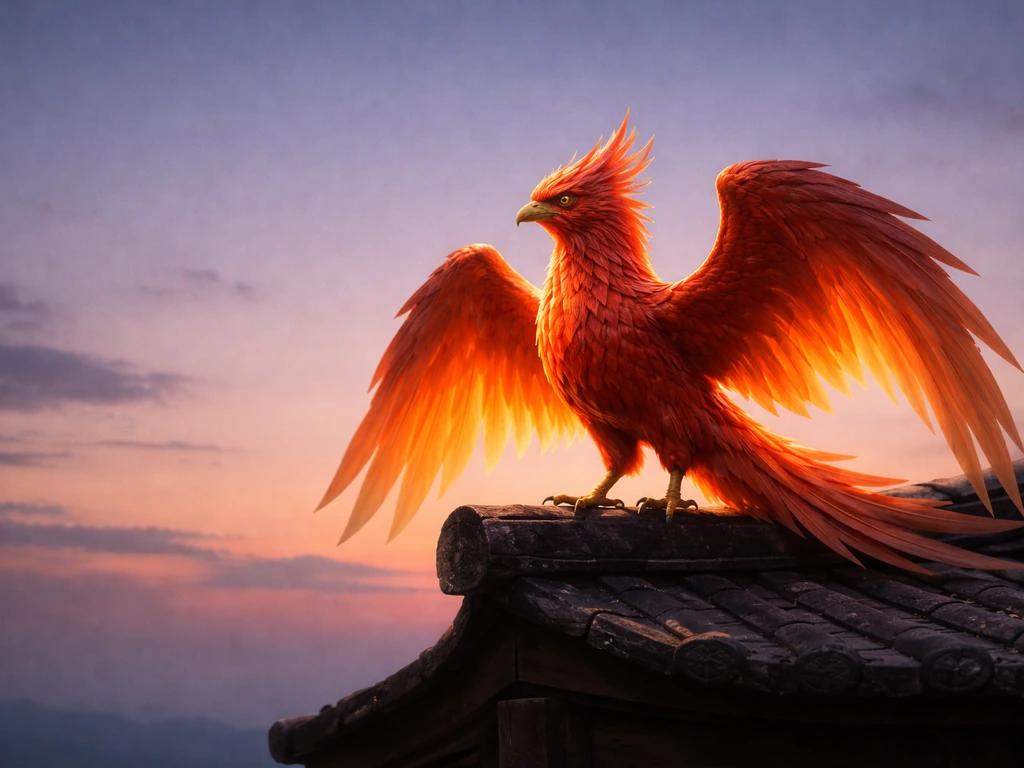
In Chinese and broader East Asian tradition, the Vermilion Bird (朱雀, Zhūquè, sometimes written Zhu Que or rendered in older romanizations as Chu-ch'üeh) is one of the Four Symbols (四象), a system of four mythic celestial creatures that correspond to the four cardinal directions. The Azure Dragon guards the east, the White Tiger guards the west, the Black Tortoise guards the north, and the Vermilion Bird guards the south. You will also see the full name 南方朱雀 (Nánfāng Zhūquè), which simply means "Vermilion Bird of the South."
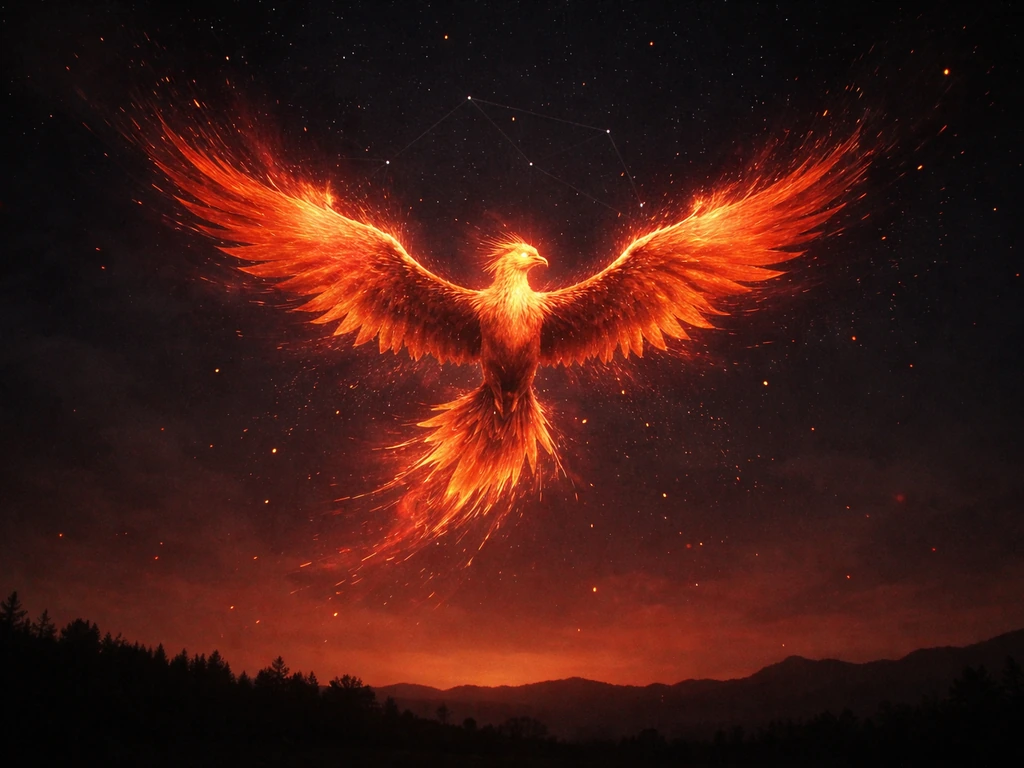
Each of the Four Symbols maps onto a season, an element, and a quadrant of the sky in traditional Chinese uranography (star lore). The Vermilion Bird specifically represents fire, south, and summer. In classical Chinese sky-mapping, the southern night sky was divided into seven lunar mansions: 井 (Jing), 鬼 (Gui), 柳 (Liu), 星 (Xing), 張 (Zhang), 翼 (Yi), and 軫 (Zhen). Together, these asterisms were thought to trace the shape of a great bird stretched across the southern quadrant. The Vermilion Bird is, at its core, a directional guardian and cosmological symbol, not a creature with a personal life story or a rebirth cycle.
What a phoenix actually is
The phoenix has its roots in ancient Egyptian and Classical Greco-Roman mythology, where it appears as a sun-associated fabulous bird with an extraordinary life cycle. The defining feature is immolation and rebirth: after living for an exceptionally long period, the phoenix dies (often by self-immolation) and rises again from its own ashes. That death-and-renewal cycle is the whole point of the phoenix motif, and it is what distinguishes it from other mythic birds. Later traditions, including Islamic mythology, developed parallel figures (the ʿAnqāʾ, the Sīmorgh) that comparative mythology scholars often list alongside the phoenix as cultural analogues.
It is worth noting that in Chinese tradition there is a separate phoenix-like creature: the 鳳凰 (Fènghuáng). Britannica describes the Fenghuang as a paired creature with the dragon, appearing in sources like the Shanhaijing (Classic of Mountains and Seas), and functioning as a symbol of virtue and imperial symbolism. The Fenghuang is the Chinese creature most closely analogous to the Western phoenix in cultural role, not the Vermilion Bird.
Are they the same thing or different?
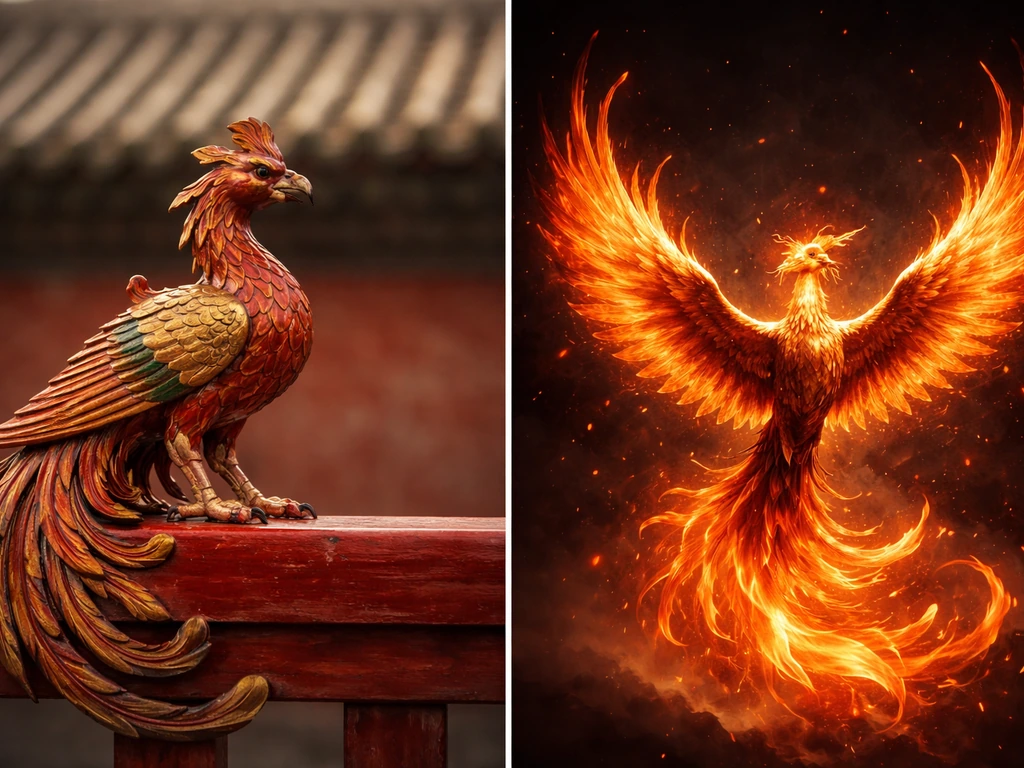
They are different, and the distinction matters. The Vermilion Bird (朱雀) is a directional guardian in a four-part cosmological system. It has no death-and-rebirth narrative, no personal life cycle, no immolation story. Its job is to represent the south, fire, and summer as part of a structured cosmological map. blank" rel="noopener noreferrer">A 2026 academic study in the Journal of East Asian Cultures does note that Zhuque (朱雀) is sometimes used interchangeably with phoenix-adjacent terminology in certain modern contexts, and comparative mythology surveys often list Zhuque and Fenghuang together as phoenix analogues from Chinese tradition. So the association is real enough that it causes genuine confusion. But being a loose cultural analogue is not the same as being the same creature.
| Feature | Vermilion Bird (朱雀) | Phoenix (Classical) |
|---|---|---|
| Cultural origin | Chinese / East Asian | Ancient Egyptian and Greco-Roman |
| Role | Directional guardian of the south | Sun-associated rebirth creature |
| Core symbolism | Fire, south, summer, sky quadrant | Immolation, death, renewal |
| Rebirth cycle? | No | Yes, central to the myth |
| Part of a system? | Yes, one of the Four Symbols | Stands alone as a mythic figure |
| Chinese analog to phoenix | No (Fenghuang/鳳凰 is closer) | Fenghuang is the closest Chinese parallel |
Why these two keep getting mixed up
There are a few practical reasons the names blur together. First, both creatures are red or fire-associated and bird-like in appearance, which is enough for casual sources to lump them into the same "legendary fire bird" category. Comparative mythology overviews frequently list Chinese mythic birds, including both Fenghuang and Zhuque, as phoenix analogues from East Asian tradition, which trains readers to treat them as interchangeable.
Second, translation is genuinely messy. English-speaking readers encounter the word "phoenix" used to translate at least two distinct Chinese concepts: 鳳凰 (Fenghuang) and, sometimes, 朱雀 (Zhuque). When one English word covers multiple source concepts, conflation is almost inevitable. Add in spelling variation (vermilion vs. vermillion, Zhu Que vs. Zhuque vs. Chu-ch'üeh) and the confusion compounds quickly.
Third, modern fantasy games, anime, and media often rework mythological creatures freely. A game or story might feature a "Vermilion Bird" with phoenix-style rebirth powers, or a "phoenix" drawn from Chinese iconography, flattening the original distinctions for narrative convenience. If you have encountered the Vermilion Bird in a game or fantasy novel, the author may have deliberately blended the traditions. This is similar to how Charizard or other fictional creatures draw loosely on dragon and firebird imagery without fitting neatly into any one mythological tradition. This is similar to questions like whether Charizard counts as a bird, which usually depends on whether you mean mythological imagery or biology.
Where this fits in a "what is a bird?" framework
From a biological classification standpoint, neither the Vermilion Bird nor the phoenix is a bird. This is not a technicality worth skipping over. In biology, a bird is a member of class Aves, defined by a shared set of characteristics: feathers, a beak without teeth, hollow bones, warm-bloodedness, and egg-laying with hard shells, among others.
This article's definition also helps clarify questions like whether Quill is a bird in a biological sense versus a mythological or fictional context is quill a bird. Taxonomy classifies species based on observable, physical, and genetic evidence using formal naming rules and type specimens.
In an ornithology taxonomy and education framework, taxonomy is used to classify biological species, and the concept of “species” is tied to reproductive isolation rather than mythic figures Taxonomy classifies species based on observable, physical, and genetic evidence using formal naming rules and type specimens. .
Mythological creatures do not have physical specimens, cannot be reproduced or observed, and have no place in biological classification. Calling a phoenix or a Vermilion Bird a "bird" in a biological sense is a category error, the same way that asking whether a bat or a pterosaur is a bird requires looking at anatomy and ancestry rather than appearance or popular names.
This matters because questions like this one are genuinely about definition. Someone asking "is the Vermilion Bird a phoenix? Questions like this often mix in game or anime creatures, so it helps to identify whether the source is referencing a Vermilion Bird, a phoenix, or a fictional wyvern is quematrice a bird wyvern. " is usually asking about mythological identity, but it is worth being clear: neither creature belongs to biology's bird category at all.
They are cultural constructs that look bird-like and have bird-like features by design, but they are not classified as birds any more than Pikachu or a fictional creature from any other tradition would be. If you are wondering “is Pikachu a bird,” the answer is no because it is a fictional creature, not a biological Aves species. Real birds are creatures like the hoopoe, the penguin, or the ostrich: biological organisms with taxonomic records.
The hoopoe is not a mythic symbol like the Vermilion Bird.
How to figure out which version you're dealing with
If you have seen "vermilion bird" or "phoenix" in a specific source and you want to know which concept is actually being used, here is a practical checklist.
- Check for the Four Symbols context. If the source mentions the Azure Dragon, White Tiger, and Black Tortoise alongside the Vermilion Bird, you are dealing with 朱雀 (Zhuque), the directional guardian, not a phoenix.
- Look for the Chinese characters. 朱雀 (Zhūquè) means Vermilion Bird (the guardian). 鳳凰 (Fènghuáng) means Fenghuang, the Chinese phoenix-analogue. If the source gives you the characters, the distinction is clear.
- Check for a rebirth or immolation story. If the creature in question dies by fire and rises from the ashes, or has a numbered lifespan cycle followed by renewal, that is the phoenix rebirth motif, not the Vermilion Bird role.
- Check for directional or seasonal symbolism. If the creature is associated with the south, summer, and fire as a cosmological guardian of a sky quadrant or cardinal direction, that points to the Vermilion Bird (朱雀).
- Look at the source's cultural context. A classical Chinese astronomical or cosmological text using this figure almost certainly means 朱雀. A Western mythological reference or a text in the Egyptian and Greco-Roman tradition means the phoenix. A modern fantasy game or anime may mean a blend of both.
- If you see "phoenix" used as a translation of a Chinese term, check which Chinese term is actually being translated. If it is 鳳凰, that is the Fenghuang. If it is 朱雀 being loosely called a phoenix, the translator made a simplifying choice that erases important distinctions.
The bottom line: the Vermilion Bird and the phoenix are related in the same loose way that many fire-associated, bird-shaped mythic creatures from different world traditions are related. They share visual and elemental family resemblance, and comparative mythology reasonably groups them as analogues. But they come from different traditions, serve different narrative roles, and are not the same creature. If you want the Chinese cosmological guardian of the south, you want 朱雀. If you want the death-and-rebirth firebird of ancient Mediterranean tradition, you want the phoenix. And if you want an actual bird, you want a biological species in class Aves.
FAQ
If the Vermilion Bird is not a phoenix, what is the closest Chinese counterpart to the phoenix idea?
In Chinese tradition, the creature most often treated as phoenix-like in cultural role is 鳳凰 (Fènghuáng), which is commonly paired with the dragon and used for virtue and imperial symbolism, rather than functioning as a directional fire guardian like 朱雀 (Zhūquè).
Why do some English sources translate 朱雀 (Zhuque) as “phoenix”?
Because translation decisions are not always consistent, and modern writers sometimes use “phoenix” as a broad label for fire-associated mythic birds, even though 朱雀 is primarily a cosmological directional symbol (south, fire, summer) without a rebirth narrative.
Does the Vermilion Bird ever get a rebirth or immolation story like the phoenix?
Not in the core role associated with the Four Symbols. The defining feature of the phoenix motif is a death-and-renewal cycle (immolation and rising again), whereas 朱雀 is typically described through its place in star lore and cardinal-direction guardianship.
Is the Vermilion Bird a real animal in any biological sense?
No. The Vermilion Bird is a mythic cosmological figure with no preserved specimens, breeding patterns, or genetic record, so it has no place in biological taxonomy as a member of class Aves.
How can I tell which “phoenix” a book or game is using when it mentions a Vermilion Bird?
Look for narrative cues: if the story emphasizes cyclical rebirth, self-immolation, or resurrection, it is drawing from phoenix-style motifs. If it emphasizes a directional guardian role, seasons, or sky-mapping, it is more likely using 朱雀 symbolism even if the writer labels it “phoenix.”
Are 朱雀 (Zhuque) and 朱雀鸟 (if I see it) the same thing as the Four Symbols Vermilion Bird?
Often they are used as variations in wording, but the key is the context. If the passage ties 朱雀 to south, summer, fire, or the Four Symbols framework, it is referencing the same cosmological concept, even if additional words like “bird” are added for readability.
What does “Vermilion” mean here, and does it affect how the creature is identified?
“Vermilion” refers to the reddish, fire-like color associated with the southern quadrant and fire element. It helps explain the visual association with phoenix-like imagery, but color alone is not proof of identity, since multiple cultures use red or fire bird motifs.
Could a modern artist be intentionally blending the phoenix and the Vermilion Bird?
Yes. Creative media frequently merges symbols from different traditions for storytelling convenience, so a single character might combine 朱雀-inspired iconography with phoenix rebirth powers. In that case, you can treat it as an adaptation rather than a strict mapping to one original myth.
Next Article
Is Venus a Bird? How Birds Are Defined and Verified
Clear answer: Venus is not a bird. Learn bird traits, taxonomy checks, and how to verify confusing name-based claims.