Taxonomy: how doves and pigeons relate scientifically
Both doves and pigeons are birds, meaning they belong to class Aves and share every defining bird trait: feathers, a beak, hollow bones, warm blood, and egg-laying. Within class Aves, Columbiformes is the order that contains the single family Columbidae, which holds roughly 300 to 350 living species. Every species in that family, whether you call it a dove or a pigeon, sits in exactly the same taxonomic family. Merriam-Webster's definitions for both words actually point to the same family name: Columbidae, order Columbiformes. That overlap is not a coincidence. It reflects the biological reality that the two terms describe the same group of animals.
If you want to dig a little deeper into whether a pigeon qualifies as a bird in the first place, the answer is unambiguous: Columbidae species check every box on the bird checklist. The "dove vs pigeon" confusion is purely a naming problem, not a classification problem.
How to tell them apart in the real world
Because the labels are informal, the best you can do is apply the conventions that most English speakers use. Here are the main cues that guide how people assign the two names in practice:
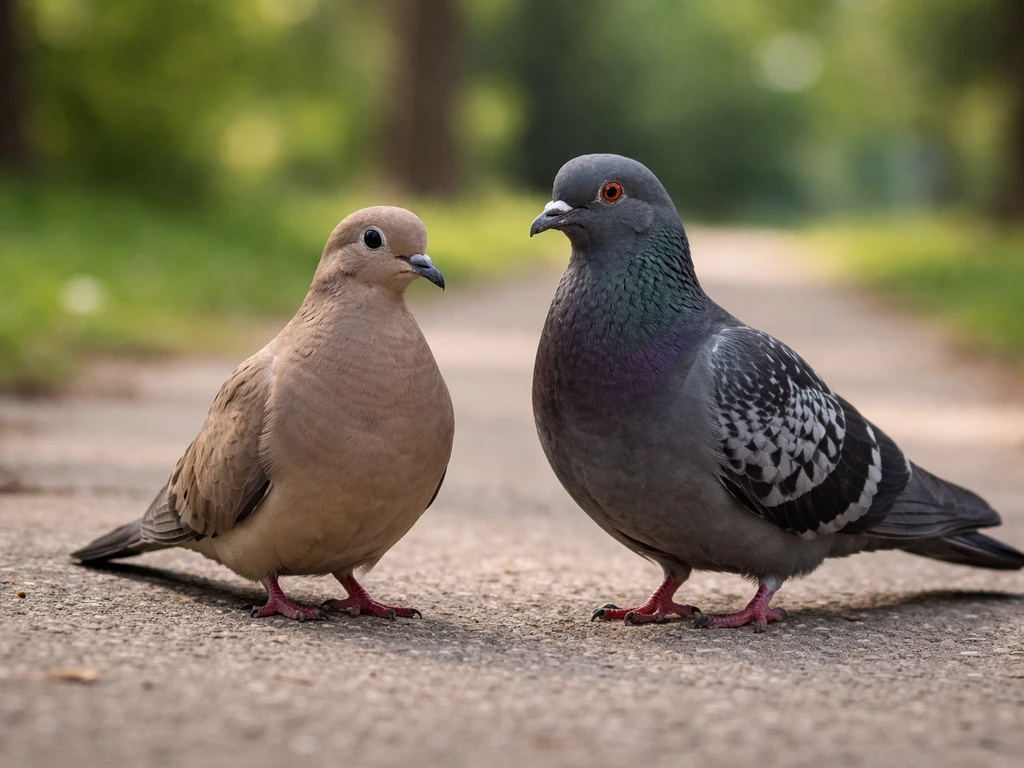
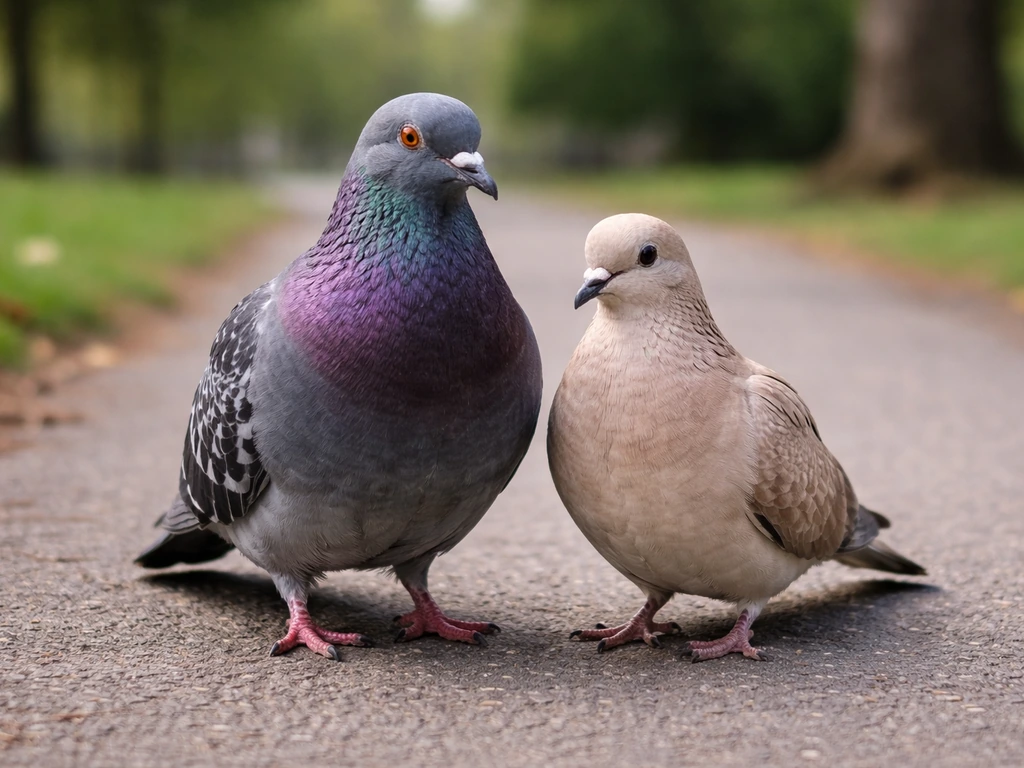
- Size: "Pigeon" is usually reserved for larger Columbidae, typically birds over 25 cm (about 10 inches) in length, while "dove" is used for smaller species, often under 25 cm.
- Tail shape: Doves frequently have longer, tapered or pointed tails. Pigeons tend to have shorter, fan-shaped tails.
- Body build: Pigeons look stockier, with a fuller chest and compact plumage. Doves look more slender and delicate.
- Color and pattern: This is unreliable as a naming guide, since both groups come in a wide range of colors, from the all-white "dove" used in ceremonies to the iridescent neck of a common city pigeon.
- Habitat and behavior: Rock pigeons (city birds) flock in large urban groups and are ground feeders. Mourning doves are often seen in pairs or small groups, perched on wires, and they produce that soft, mournful cooing call most people recognize.
None of these cues are absolute rules. They are tendencies, not definitions. A bird that looks "dove-sized" to one person may be called a pigeon by another depending on where they grew up and what names they learned first.
Common myths and why people get confused
The biggest myth is that doves and pigeons are biologically distinct groups. They are not. People assume that because the two words exist in English, they must refer to two different scientific categories, the same way "hawk" and "falcon" actually do refer to different families. That logic does not apply here. Both words map to the same family.
A second source of confusion is the cultural weight the word "dove" carries. White doves are released at weddings and peace ceremonies. The dove is a symbol of gentleness and purity in art and religion. That symbolism leads people to think doves must be a distinct, special kind of bird. In practice, those ceremonial white doves are almost always domesticated rock pigeons (Columba livia domestica), which most people would call a pigeon in any other context. The same animal gets two different names depending on the setting.
A third myth: that pigeons are "common" and doves are "rare" or "wild." The mourning dove (Zenaida macroura) is one of the most abundant birds in North America, with a population estimated in the hundreds of millions. It is anything but rare. Meanwhile, some pigeon species are genuinely endangered. Rarity has nothing to do with which label gets applied.
Where the confusion shows up: species examples and mixed labels
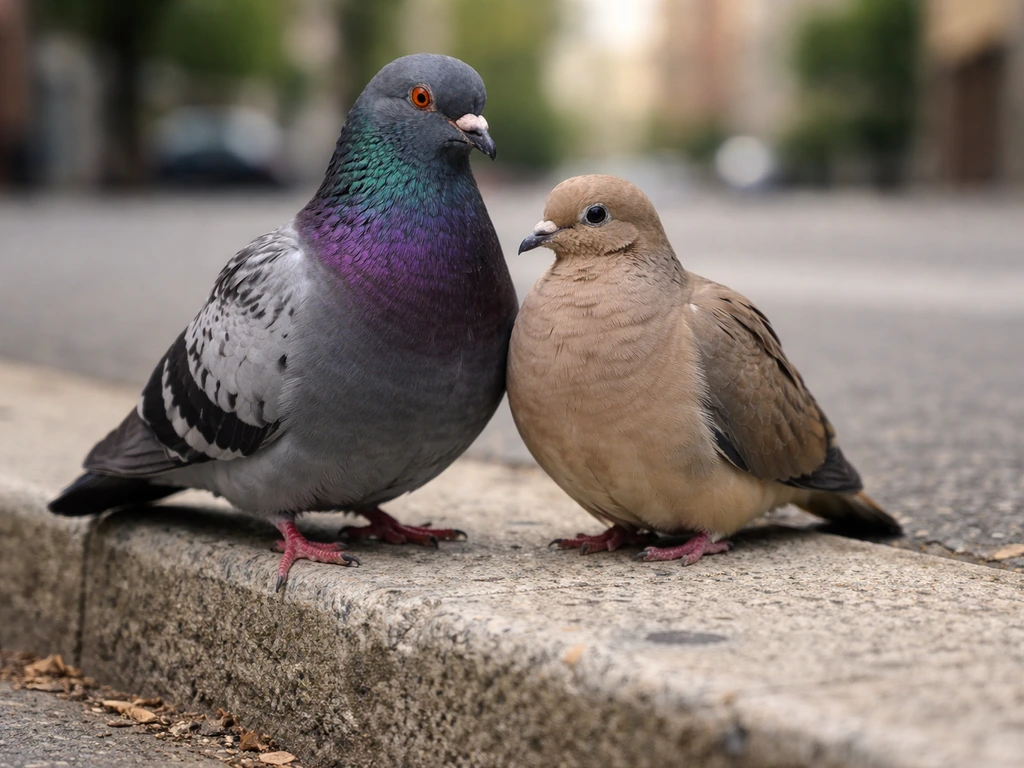
The rock pigeon (Columba livia) is the clearest example of label confusion. Its official common name uses "pigeon," but it is also formally called the "rock dove" in older literature and field guides. Both names refer to exactly the same species. Britannica specifically notes that the domestic pigeon is also called the rock dove, which illustrates how the two labels can flip on the same bird depending on the source. Britannica’s pigeon summary describes common street pigeons, or rock doves, as descendants of the Eurasian rock dove (Columba livia) domestic pigeon is also called the rock dove.
The mourning dove (Zenaida macroura) is reliably called a dove in North America, and its size and tail shape fit the informal conventions. But the Eurasian collared dove (Streptopelia decaocto) sits right in the gray zone: it is larger than a typical "dove" but still carries the dove label. The common ground dove (Columbina passerina), on the other hand, is tiny enough that nobody debates the "dove" label for it.
Then there is the question of whether a dove is actually an upland bird. If you have been wondering whether a dove counts as an upland bird for hunting or classification purposes, that category is a wildlife management and legal label, not a taxonomy term, and the answer depends on your region's regulations rather than the bird's biology.
For a side-by-side look at how the two labels compare across the features most people use to decide which word to apply, here is a practical summary:
| Feature | Typical "Dove" Usage | Typical "Pigeon" Usage |
|---|
| Scientific family | Columbidae | Columbidae |
| Typical size | Smaller, often under 25 cm | Larger, often over 25 cm |
| Tail shape | Longer, tapered or pointed | Shorter, fan-shaped |
| Body build | Slender, delicate | Stocky, full-chested |
| Common examples | Mourning dove, common ground dove | Rock pigeon, band-tailed pigeon |
| Same-species dual naming? | Yes (rock dove = rock pigeon) | Yes (rock pigeon = rock dove) |
Quick next steps: what to check on a bird you're seeing
If you are standing outside looking at a Columbidae bird and want to label it correctly, here is a practical checklist to work through:
- Check the size. Hold it mentally against a common reference: a robin is about 25 cm, a crow is about 45 cm. If the bird is robin-sized or smaller, "dove" is the more common label. If it is bigger and heavier, lean toward "pigeon."
- Look at the tail. A long, wedge-shaped or pointed tail points toward "dove." A short, rounded, or fan-shaped tail points toward "pigeon."
- Check your location and habitat. Rock pigeons dominate cities. Mourning doves are common in suburban and open areas across North America. Band-tailed pigeons live in western forests. Knowing what species are common in your region narrows the field fast.
- Look up the official common name. A quick search for the bird's appearance plus your region will usually surface its standard common name, which will tell you which label birders and field guides use.
- Check whether it is actually a perching bird. While most Columbidae do perch, if you are trying to place the bird in a behavioral category, it helps to know that pigeons are classified as perching birds in some organizational frameworks, which can help you cross-reference field guides organized that way.
- Do not rely on color alone. White birds in a ceremony, gray birds on a ledge, pinkish-brown birds on a wire: color will not reliably tell you whether to say dove or pigeon.
Bottom line: how to correctly describe them
Doves and pigeons are the same bird at the family level. Both terms refer to members of Columbidae, and no formal biological boundary separates them. When you call something a dove or a pigeon, you are using a common English naming convention based loosely on size and tail shape, not making a scientific distinction. The cleanest, most accurate way to describe any of these birds is to use its full species name when precision matters, such as "mourning dove" or "rock pigeon," and to treat "dove" and "pigeon" as interchangeable shorthand for the broader Columbidae family when precision does not.
This is the same kind of naming overlap that shows up elsewhere in bird taxonomy. It is worth remembering that a pigeon is both a bird and an animal, since some people genuinely wonder whether familiar urban birds count as "real" animals or fall into some other category. They do, definitively, and so does every dove. Both are birds, both are animals, and both belong to the same remarkably successful family that has spread across almost every habitat on Earth.
The next time someone points at a bird on a wire and asks whether it is a dove or a pigeon, the honest answer is: probably both, depending on which name you grew up with. But if you want to be precise, check the size, look at the tail, find the species name, and you will have a far better answer than the dove-versus-pigeon debate usually provides. And if you find yourself curious about other birds that attract this kind of classification confusion, comparing how a flamingo is classified as a bird works through the same taxonomy-first approach: start with the family, check the defining features, and the answer becomes clear. Just as the question of whether a flamingo is a bird or some other kind of animal gets resolved by looking at class Aves criteria, the dove-versus-pigeon question gets resolved by looking at family Columbidae.
For anyone who wants the cleanest single-sentence answer: a dove is a bird, a pigeon is a bird, and they are both members of the same family. The two words describe the same group of animals using different informal labels, and that is the whole story.