A duck is a bird, full stop. It belongs to class Aves, the same biological group as eagles, robins, and penguins. Ducks are not amphibians in any sense: they have feathers, lay hard-shelled eggs, and are warm-blooded, while amphibians have permeable moist skin, are cold-blooded, and hatch from gelatinous eggs into gilled larvae. If you have ever watched a mallard dabble at the edge of a pond and wondered whether its comfort in water makes it something other than a bird, the answer is no. Water-loving does not mean amphibian.
Is a Duck an Amphibian or a Bird? Clear Answer & ID Tips

Sarah Chen
26 Jul 2026
The bird traits every duck has
Ducks check every box on the standard bird diagnostic list used by ornithologists. These are not fuzzy characteristics open to interpretation; they are hard biological markers that separate class Aves from every other group of animals.
- Feathers: ducks have a full coat of feathers, including waterproof contour feathers and dense insulating down beneath them. No other living animal group grows true feathers.
- Beak (bill): ducks have a keratinized bill with no true teeth. The broad, flat shape is specialized for filtering water and mud, but structurally it is the same type of beak found on every other bird.
- Wings: duck wings are forelimbs modified into flight structures. Even species that dive more than they fly still have the same fundamental wing anatomy found across all birds.
- Warm-blooded (endothermic): ducks regulate their own body temperature internally. A mallard swimming through near-freezing water maintains a stable core temperature, something no amphibian can do.
- Hard-shelled eggs: duck eggs have a calcified, mineralized shell made primarily of calcium carbonate. This is fundamentally different from the soft, gelatinous, non-calcified eggs amphibians lay in water.
These five traits together are enough to confirm bird classification without any further analysis. A duck hatches as a chick, not a tadpole. It breathes air through lungs from day one. Its skin is covered in feathers, not exposed and permeable. Every one of those points directly contradicts amphibian biology.
Where ducks sit in the tree of life
Taxonomy works like a set of nested boxes, each one more specific than the last. Ducks sit inside class Aves, which contains all birds. Within Aves, they fall into order Anseriformes, the waterfowl order, which also includes geese and swans. Within Anseriformes, they belong to family Anatidae, the family that covers ducks, geese, and swans together. Inside Anatidae, ducks are further grouped under subfamily Anatinae (and related tribal divisions), while geese and swans sit under subfamily Anserinae.
To put that in plain terms: Aves is the broadest category (all birds), Anseriformes is the waterfowl club, Anatidae is the duck-goose-swan family, and Anatinae is where most of the ducks specifically land. The familiar mallard carries the scientific name Anas platyrhynchos, placing it in genus Anas, one of the core dabbling duck genera. This classification is consistent across every major taxonomic authority, including the IOC World Bird List, ITIS, and the NCBI Taxonomy Browser.
Why ducks are not amphibians, point by point
Amphibians (class Amphibia) are ectothermic tetrapods. Ectothermic means cold-blooded: they rely on external heat sources to regulate body temperature. Most amphibians (frogs, salamanders, caecilians) have moist, glandular, permeable skin that they actually use for gas exchange, absorbing oxygen directly through the skin surface. Many species start life as aquatic larvae with gills (think tadpoles) and undergo metamorphosis before becoming air-breathing adults. Their eggs are gelatinous and non-amniotic, laid in or near water without a protective calcified shell.
Ducks share none of these traits. A duck does not metamorphose. It does not breathe through its skin. It does not hatch as a gilled larva. Its eggs have hard, calcified shells. Research summaries on eggshell composition and mineralization (eggshell = predominantly calcium carbonate) confirm that avian eggshells are mineralized, composed mostly of calcium carbonate. It is warm-blooded. The only thing ducks genuinely share with many amphibians is a preference for wet environments, and ecological habitat has nothing to do with biological classification. A crocodile and a hippo both live in rivers; one is a reptile and the other is a mammal.
Duck vs amphibian: side by side
The table below puts the key differences in one place. If you are a student or teacher looking for a quick reference, this covers the main diagnostic points.
| Feature | Duck (Bird, class Aves) | Amphibian (class Amphibia) |
|---|---|---|
| Body covering | Feathers and scaly (keratinized) legs | Moist, smooth, permeable skin |
| Temperature regulation | Endothermic (warm-blooded) | Ectothermic (cold-blooded) |
| Egg type | Hard, calcified shell (calcium carbonate) | Soft, gelatinous, no hard shell |
| Development | Hatches as a chick; no larval stage | Many hatch as aquatic larvae (tadpoles); undergo metamorphosis |
| Respiration | Lungs only, from hatching onward | Many use cutaneous (skin) gas exchange; gills in larval stage |
| Reproduction environment | Nest on land or near water; eggs need to stay dry or lightly humid | Eggs typically laid in or near water; require moisture |
| Taxonomic class | Aves | Amphibia |
| Examples | Mallard, teal, Canvasback | Frog, salamander, caecilian |
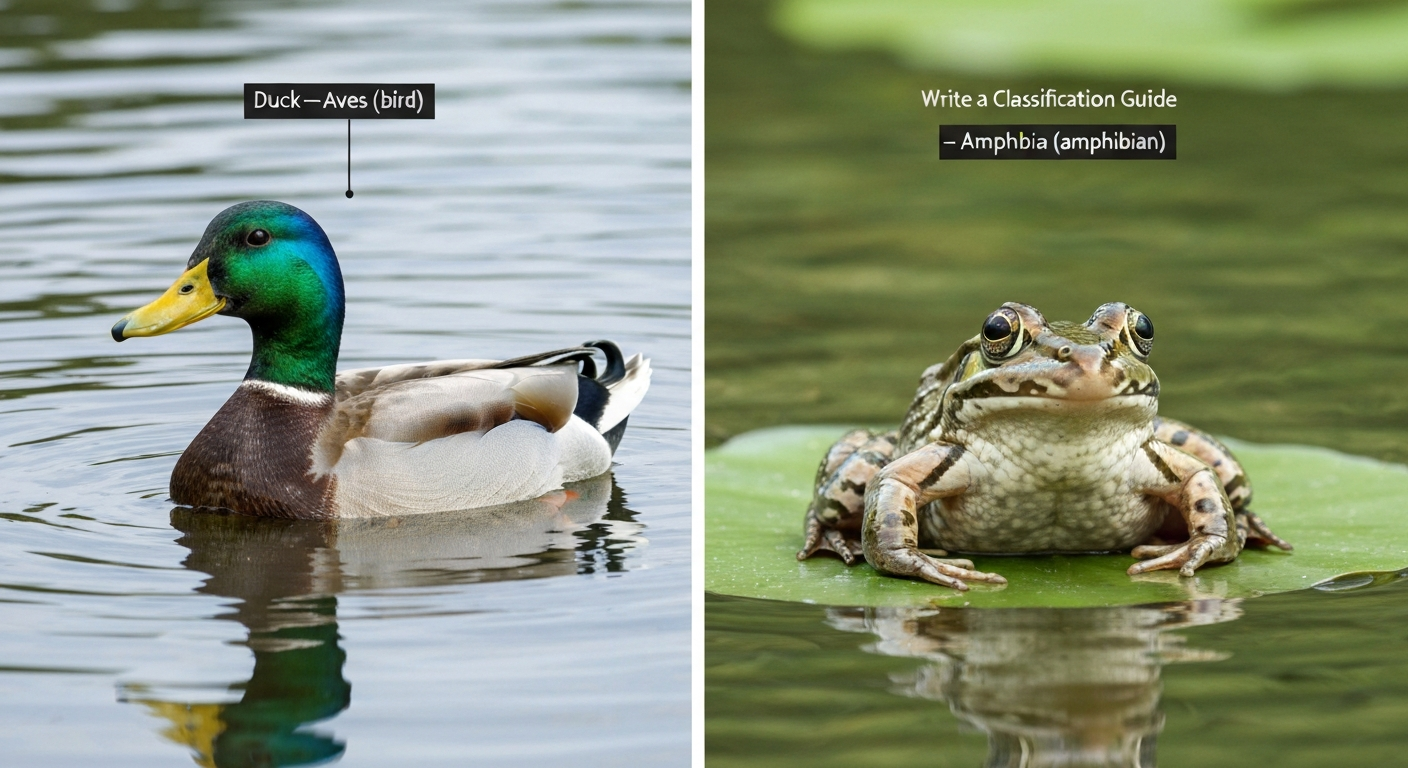
Image suggestion: a side-by-side photo pairing a mallard duck (Anas platyrhynchos) on a pond with a common frog on a lily pad, labeled with their respective class names (Aves and Amphibia). This visual contrast reinforces the taxonomic distinction immediately.
Is the Aflac mascot a duck or a goose?
The Aflac mascot is a duck, specifically modeled on a white domestic duck. It is not a goose. While ducks and geese are close relatives (both belong to family Anatidae), they are distinct groups within that family. Geese are generally larger, have longer necks relative to body size, and belong to subfamily Anserinae alongside swans. Ducks are typically smaller, with shorter necks, and most fall under Anatinae. The Aflac bird's proportions, bill shape, and overall silhouette are consistent with a domestic duck, not a goose. The confusion is understandable because both are white waterfowl, but taxonomically and visually they are different animals.
Are ducks wading birds?
Technically, no, though the distinction trips people up. 'Wading birds' is an ecological term (not a strict taxonomic one) describing long-legged birds like herons, egrets, storks, and ibises that forage by standing or walking through shallow water. Audubon, Wading birds (definition and examples) defines 'wading birds' as long‑legged birds (herons, egrets, storks, ibises) that forage by wading in shallow water blank" rel="noopener noreferrer">Audubon — Wading birds (definition and examples). Their long legs are the key adaptation: they stay above the water surface while hunting. Ducks are waterfowl adapted for swimming, with webbed feet and bodies built to float, not wade.
Within waterfowl, ducks divide broadly into functional groups based on how they feed. Dabbling ducks (mallard, teal, genera Anas and Mareca) tip forward at the surface to reach aquatic plants and invertebrates in shallow water. Diving ducks (Canvasback, genus Aythya) submerge completely to forage at depth. Sea ducks like the Common Eider (Somateria mollissima) work marine and coastal environments. None of these feeding styles qualifies as 'wading' in the ornithological sense. Some ducks do forage on mudflats in shallow margins, which can look like wading, but the anatomical equipment and foraging strategy are fundamentally different from a heron.
Is a coot a duck or something else entirely?
A coot is not a duck. The American Coot (Fulica americana) looks convincingly duck-like on the water, which is why the question comes up constantly in field guides and identification apps. But coots belong to family Rallidae (the rail family) under order Gruiformes, which is a completely different taxonomic branch from ducks. For a detailed comparison and identification tips, see Is a coot a duck or a bird. Ducks are in order Anseriformes, family Anatidae. Those two orders are not closely related.
You can tell a coot from a duck by looking at its feet. Ducks have webbed feet. Coots have lobed feet, with individual lobes on each toe rather than connected webbing. Coots also have a distinctive white frontal shield and bill, a slate-grey body, and behavioral quirks quite different from ducks. They are birds, absolutely, but they are rails wearing a duck disguise.
Are ducks birds of prey?
No. Birds of prey, or raptors, are defined by a specific set of anatomical and behavioral features: hooked beaks for tearing flesh, powerful taloned feet for seizing prey, and predatory hunting as a primary feeding strategy. Hawks, eagles, falcons, and owls are raptors. Ducks are herbivores and omnivores that filter aquatic plants, seeds, invertebrates, and small aquatic animals from water or mud. Their bills are broad and flat, built for sieving and scooping, not for gripping and tearing. A duck is as far from a raptor as a sparrow is. In fact, ducks are often prey for raptors like the Peregrine Falcon, which puts them firmly on the other side of that equation. See Is a duck a bird of prey for a concise Q&A on this specific question.
Are ducks 'birds' or 'fowl'?
Both terms apply, and understanding why clears up a common point of confusion. 'Bird' is the broad biological category: anything in class Aves is a bird. 'Fowl' is a more informal, historically agricultural term that can mean different things in different contexts. In the strictest ornithological usage, 'fowl' (or 'gamebirds') refers to order Galliformes: chickens, turkeys, pheasants, and quail. In everyday usage, 'waterfowl' refers to ducks, geese, and swans specifically (order Anseriformes), and 'fowl' broadly can cover any bird kept or hunted for food.
So when someone asks whether a duck is a bird or a fowl, the answer is: it is a bird that is also classified as waterfowl. 'Waterfowl' is not a separate category from 'bird'; it is a subset of birds. Calling a duck a 'fowl' is not wrong in everyday speech, but biologically, the term bird is always more precise and always correct.
Telling ducks and similar waterbirds apart in the field
One of the most useful skills for anyone starting out in bird identification is learning to separate ducks from the other waterfowl and waterbirds they share space with. Here are five species worth comparing:
| Species | Group | Key visible features | Family / Order |
|---|---|---|---|
| Mallard (Anas platyrhynchos) | Dabbling duck | Males have an iridescent green head, yellow bill, and chestnut chest; females are mottled brown with an orange-and-black bill | Anatidae / Anseriformes |
| Green-winged Teal (Anas crecca) | Dabbling duck | Small body; males show a chestnut head with a green eye patch; both sexes have a vivid green wing patch (speculum) visible in flight | Anatidae / Anseriformes |
| Canvasback (Aythya valisineria) | Diving duck | Distinctive sloping forehead profile; males have a rusty-red head and white body; rides lower in water than dabblers | Anatidae / Anseriformes |
| American Coot (Fulica americana) | Rail (not a duck) | Slate-grey body, white bill and frontal shield, lobed (not webbed) feet; bobs head while swimming | Rallidae / Gruiformes |
| Canada Goose (Branta canadensis) | Goose | Large body, black head and neck, white cheek patch; much larger than any typical duck species | Anatidae / Anseriformes |
| Mute Swan (Cygnus olor) | Swan | Very large white bird; orange bill with black knob at base; long S-curved neck | Anatidae / Anseriformes |
The practical takeaway: if the bird has webbed feet, a flat broad bill, and floats comfortably on the surface, you are almost certainly looking at a duck or a close waterfowl relative in family Anatidae. If the feet are lobed and the bill is white and chickenlike, that is a coot, not a duck. If the bird stands tall with long legs and wades rather than swims, you are looking at a heron or egret, not any kind of duck at all.
Where to go next
If this article answered your core question but left you curious about adjacent topics, there is more to explore on this site. The foundational page on what defines a bird walks through all the biological criteria that place ducks, penguins, ostriches, and every other species firmly in class Aves. For a short, direct answer, see the page is a duck a bird or fowl. Related pages cover whether the Aflac bird is a duck or a goose, what it means for a duck to be a wading bird, how a coot differs from a duck, whether ducks qualify as birds of prey, and the distinction between calling a duck a bird versus a fowl. Each of those pages adds a layer of detail to the picture built here, and together they give you a solid working understanding of how duck classification actually works.
FAQ
Is a duck an amphibian or a bird?
A duck is a bird (class Aves), not an amphibian.
Why are ducks classified as birds?
Ducks have key bird traits: feathers, a horny beak with no true teeth, endothermy (warm‑blooded), wings and a lightweight skeleton, and they lay hard, calcified eggs. Taxonomically they belong to class Aves, order Anseriformes, family Anatidae (ducks, geese, swans).
What biological features show ducks are not amphibians?
Amphibians are typically ectothermic (cold‑blooded), have moist, permeable skin, often pass through an aquatic larval (gilled) stage that metamorphoses into the adult, and lay gelatinous eggs. Ducks are warm‑blooded, feathered, have keratinized (scaly) legs and bills, develop as chicks (no tadpole stage), and lay hard‑shelled eggs—so they lack amphibian diagnostic traits.
Simple trait comparison: duck (bird) vs amphibian
Use this quick table to compare distinguishing traits: - Body covering: duck = feathers; amphibian = moist skin - Thermoregulation: duck = endothermic; amphibian = ectothermic - Reproduction: duck = hard, calcified eggs; amphibian = gelatinous eggs, often with aquatic larvae - Development: duck = chick (no metamorphosis); amphibian = typically larva → metamorphosis - Taxonomy: duck = Aves → Anseriformes → Anatidae; amphibian = Amphibia (Anura/Caudata/Gymnophiona)
Are ducks part of the family Anatidae and order Anseriformes?
Yes. Ducks, together with geese and swans, are placed in family Anatidae within the order Anseriformes. Major taxonomic authorities and databases (IOC World Bird List, ITIS, NCBI) list Anatidae under class Aves.
Is the Aflac mascot a duck or a goose?
The Aflac mascot is a duck. (Common public reference; the insurance company’s ads feature a duck.)