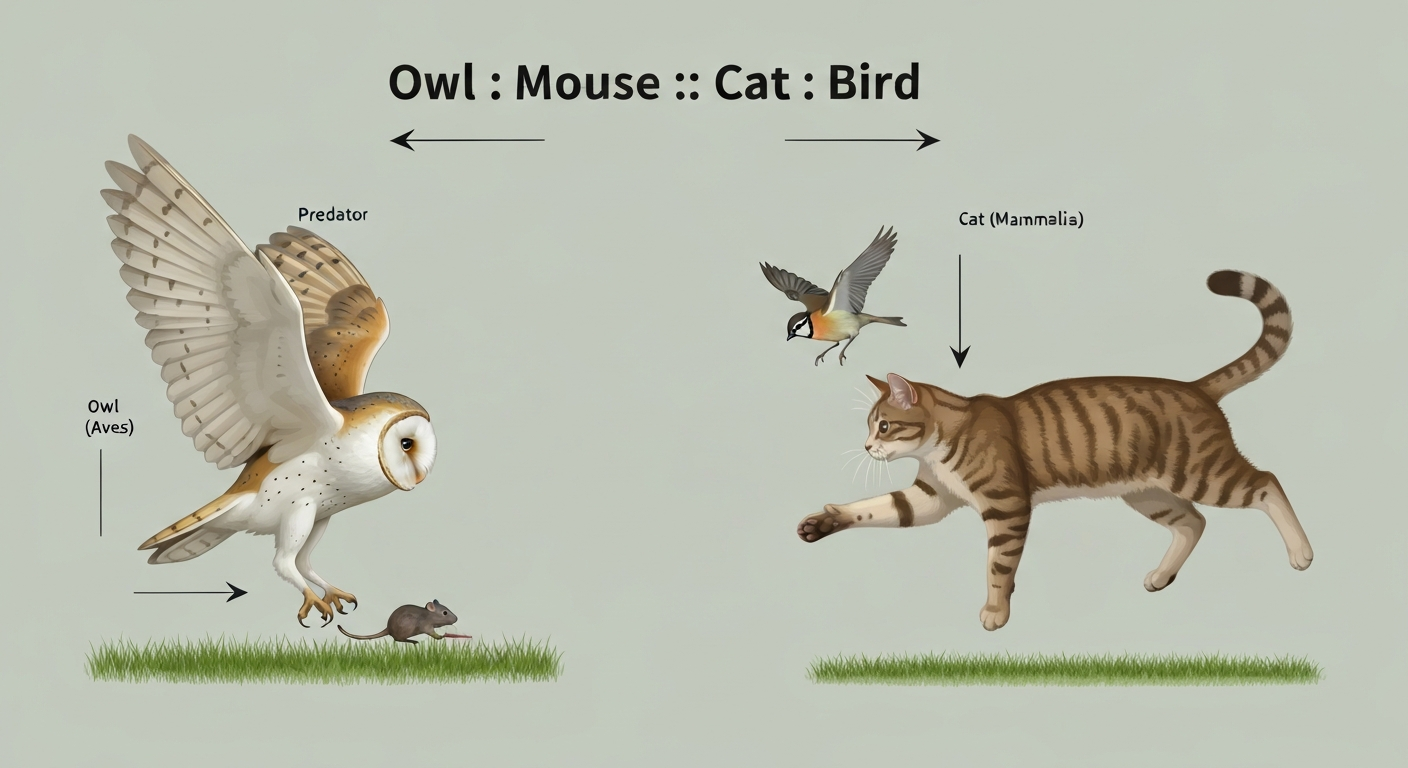
The analogy works as a predator–prey mapping: an owl hunts mice the same way a cat hunts birds. That's the intended comparison, and it's a fair one. What the analogy does not mean is that owls and cats belong to the same biological category, or that mice and birds do. Owls and cats are both predators, yes, but one is a bird (class Aves) and the other is a mammal (class Mammalia). Mice and birds are both prey, but they sit in completely different taxonomic classes. Once you untangle which kind of mapping is being made, relational versus categorical, the analogy makes sense and stops causing confusion.
Owl Is to Mouse as Cat Is to Bird: Is the Analogy Valid?

Sarah Chen
28 Jul 2026
Two completely different ways to read the analogy
When someone writes 'owl is to mouse as cat is to bird,' they are mapping a relationship, not grouping animals by type. The structure is: (predator) is to (prey) as (different predator) is to (different prey). Cognitive scientists call this relational mapping, you're matching the role each animal plays in the relationship, not comparing the animals themselves. Dedre Gentner's structure-mapping framework, developed in the early 1980s, formalized exactly this idea: a good analogy preserves relational structure, not surface similarity. An owl and a cat look nothing alike, and their prey don't either, but the predator–prey relationship is identical in both pairs.
The confusion arises when readers try to read the analogy as a taxonomic mapping, as if it's saying owls and cats share some category, or mice and birds do. That reading is wrong, and the analogy was never meant that way. If you want a taxonomic analogy, you'd say something like 'owl is to barn owl as cat is to domestic cat' (genus to species). The predator–prey version is about behavior and ecological role, not classification. Keeping those two types of mapping separate is the key to reading analogies like this correctly.
Birds vs. mammals: what the classes actually mean
Biologists separate animals into classes based on shared anatomical and genetic features. Birds belong to the class Aves. Mammals belong to the class Mammalia. These are not fuzzy groupings, they reflect deep evolutionary divergence, and the two classes have very different diagnostic features. BirdLife International maintains the authoritative global checklist for class Aves, covering over 10,000 recognized species. BirdLife International's HBW/BirdLife checklist is maintained on Taxonomy | BirdLife DataZone as the authoritative, regularly updated taxonomy for class Aves. The Animal Diversity Web at the University of Michigan provides the standard reference for Mammalia. Both classes fall within the broader group Vertebrata (animals with a backbone), which is one reason people sometimes conflate them, but within vertebrates, birds and mammals have been on separate evolutionary paths for hundreds of millions of years.
Taxonomy matters here because it's the most reliable way to answer questions about what an animal is. When someone asks whether a bat is a bird, or whether a penguin counts, the answer doesn't come from 'does it fly' or 'does it look bird-like', it comes from which class the animal belongs to, and what features determined that classification. In the analogy we're examining, the owl is in class Aves and the cat is in class Mammalia. That's not a minor distinction. It affects their anatomy, reproduction, physiology, and evolutionary history.
Key traits that separate birds from mammals
The diagnostic differences between class Aves and class Mammalia are well established. The table below lays them out side by side. A few of these features have exceptions worth knowing: monotremes (platypuses and echidnas) are mammals that lay eggs rather than giving birth to live young, but they still have fur and mammary glands. Similarly, some birds (like ostriches and penguins) can't fly, but they still have feathers, beaks, and lay hard-shelled eggs. The presence of feathers remains the single most reliable marker for identifying a living bird.
| Trait | Birds (Aves) | Mammals (Mammalia) |
|---|---|---|
| Body covering | Feathers (all living species) | Hair or fur |
| Reproduction | Lay hard-shelled eggs (oviparous) | Mostly live birth (viviparous); monotremes lay eggs |
| Jaw structure | Beak (keratinized, no functional teeth in modern species) | Teeth (incisors, canines, molars depending on diet) |
| Forelimbs | Modified into wings (even in flightless species) | Forelimbs varied: paws, hands, hooves |
| Mammary glands | Absent | Present (used to nurse young) |
| Bone structure | Hollow bones in most species, reducing weight | Dense bones in most species |
| Warm-blooded | Yes | Yes |
| Heart chambers | 4-chambered heart | 4-chambered heart |
Both birds and mammals are warm-blooded (endothermic) and have four-chambered hearts, two traits they share and that sometimes lead people to group them together loosely. But the differences in body covering, reproduction, and jaw structure are clear enough that there's rarely genuine ambiguity when classifying a living species.
The owl side of the analogy
Owls are birds, full members of class Aves, and they have every trait that comes with that classification: feathers, a beak, wings modified from forelimbs, and they lay eggs. The barn owl (Tyto alba), one of the most widely distributed owl species in the world, belongs to the family Tytonidae and is tracked by the U.S. Fish and Wildlife Service as a native bird species. Great horned owls, barred owls, and snowy owls are all similarly classified as birds in the order Strigiformes.
What makes owls the predator in the analogy is their diet, not their classification. Diet studies consistently show that owls eat primarily small mammals. A 2025 study of barn owl pellets (Caucasiana) found that mammals, overwhelmingly rodents and shrews, made up approximately 98.6% of prey biomass in that sample. A separate study of barred owls (Strix varia) in the Pacific Northwest found that about 64.8% of prey items by number were mammals, with birds making up roughly 2.9%. So owls absolutely eat mice, and they do so far more than they eat other birds. The owl–mouse pairing in the analogy is biologically accurate.
The mouse side, and what cats actually hunt
The house mouse (Mus musculus) is a rodent, order Rodentia, family Muridae, firmly in class Mammalia. The Mammal Diversity Database treats Mus musculus as a rodent (family Muridae) in class Mammalia (Mus musculus • House Mouse | ASM Mammal Diversity Database). It has fur, gives birth to live young, nurses them with milk, and has the typical mammalian dentition including incisors that grow continuously. It is the quintessential small mammal prey species in the owl analogy, and rightly so.
On the cat side, the analogy pairs domestic cats (Felis catus, class Mammalia, order Carnivora) with birds as prey. This is empirically supported. A landmark 2013 study by Loss, Will, and Marra estimated that free-ranging domestic cats in the United States kill between 1.3 and 4.0 billion birds annually, alongside 6.3 to 22.3 billion mammals. A 2019 study using animal-borne cameras on free-roaming owned cats in Auckland, New Zealand, found that 62.2% of observed cats engaged in predation events during observation periods. Birds, including house sparrows, finches, and other small passerines, are among the most frequently taken prey. So the cat–bird pairing is also biologically grounded.
It's worth noting that cats hunt both birds and small mammals, which means the analogy slightly simplifies cat behavior by pairing cats exclusively with birds. But for the purpose of the relational mapping, the pairing holds: cats are significant predators of birds, just as owls are significant predators of mice.
Quick identification checklist: is it a bird?
If you're trying to determine whether an animal in the analogy (or anywhere else) is a bird or a mammal, run through this checklist. A 'yes' on the first item is enough to confirm bird status for any living species.
- Does it have feathers? If yes, it's a bird. No living non-bird animal has feathers.
- Does it have a beak with no functional teeth? Strong indicator of a bird.
- Do its forelimbs form wings, even if it can't fly? Consistent with class Aves.
- Does it lay hard-shelled eggs? Consistent with birds (and some reptiles, but not mammals except monotremes).
- Does it have fur or hair? If yes, it's a mammal, not a bird.
- Does it nurse young with milk? Definitive mammal trait — no bird does this.
Borderline cases that trip people up
Several animals commonly confuse people when they try to apply these categories, and they're worth addressing directly because they come up in analogy-style reasoning too.
Penguins and ostriches
Penguins and ostriches are birds. Neither can fly in the conventional sense, but both have feathers, beaks, lay eggs, and have forelimbs modified into wings (a penguin's 'flipper' is anatomically a wing). Flightlessness does not disqualify an animal from class Aves. These two species come up frequently because people associate 'bird' with 'flying animal,' but flight is not a defining feature of the class.
Bats
Bats fly, but they are mammals. They have fur, give birth to live young, and nurse them with milk. Their wings are formed from a membrane of skin stretched over elongated finger bones, structurally completely different from a bird's feathered wing. Bats belong to the order Chiroptera within class Mammalia. This is a classic borderline-seeming case: the animal flies, so it seems bird-like, but taxonomy says otherwise.
Pterosaurs
Pterosaurs were flying reptiles that lived alongside dinosaurs. They are neither birds nor mammals. They had leathery wings and are classified in their own group (order Pterosauria) within reptiles. Modern birds evolved from theropod dinosaurs, a separate lineage entirely. Pterosaurs went extinct at the end of the Cretaceous period, roughly 66 million years ago.
A brief note on evolution: where birds and cats came from
Birds evolved from theropod dinosaurs, the same lineage that includes Velociraptor and Tyrannosaurus. The earliest well-known transitional fossil is Archaeopteryx, which had both dinosaur features (teeth, clawed wings) and bird features (feathers). Over time, modern birds lost their teeth and developed the keratinized beaks we see today. Cats, as mammals, trace their ancestry through early placental mammals that diversified after the mass extinction 66 million years ago. The domestic cat (Felis catus) is descended from the African wildcat (Felis lybica), domesticated roughly 10,000 years ago in the Near East. These two evolutionary paths, bird and mammal, diverged from a common amniote ancestor hundreds of millions of years ago, which is why the anatomical differences between an owl and a cat are so fundamental. If you're asking "what does bird cat evolved into", note that birds and cats evolved along separate branches from a common amniote ancestor, so they did not evolve into one another, see the evolutionary history above for details.
How language analogies like this connect to other common questions
Analogies in the format 'A is to B as C is to D' appear frequently in standardized tests, vocabulary exercises, and everyday reasoning. The owl–mouse–cat–bird version is a predator–prey analogy, but other formats test different kinds of relationships. For example, the analogy 'cat is to fur as bird is to feathers' is a characteristic-feature analogy: each animal is paired with its defining body covering. See the characteristic-feature example 'cat is to fur as bird is to' for the same mapping format. A similar feature–possessor example is 'bird is to feather as dog is to fur.'. Similarly, 'dog is to kennel as bird is to cage (or nest)' maps an animal to its shelter. A common phrasing is 'dog is to kennel as bird is to aviary (or cage or nest),' which maps an animal to its shelter. Understanding which type of relationship is being mapped, predator–prey, feature–possessor, animal–habitat, is the first step to answering any analogy correctly. The animals involved may be the same across these examples, but the logic changes completely depending on the relationship being tested.
Related questions about animals and categories sometimes involve apparent contradictions, like asking whether a dog is a bird, or whether beagles count as bird dogs. These questions touch on different uses of the word 'bird': the biological class Aves versus informal terms like 'bird dog,' which refers to a hunting breed trained to find game birds, not a dog that is biologically a bird. For more on the terminology, see are beagles bird dogs, which explains how 'bird dog' is a hunting term rather than a biological classification. Language borrows animal names loosely, and that looseness is often the root of the confusion that analogies like this one generate.
So does the analogy hold up?
Yes, as a predator–prey analogy, 'owl is to mouse as cat is to bird' is valid and biologically grounded. Owls are documented hunters of mice and other small rodents. Cats are documented hunters of birds. The relational structure, predator hunts prey, is identical in both pairs. Where the analogy fails is if you try to extract a taxonomic claim from it. It does not mean owls and cats are the same kind of animal, and it does not mean mice and birds belong to the same class. Owls are birds, cats are mammals, mice are mammals, and the birds that cats hunt are members of class Aves. The analogy maps a relationship, and on that level, it works cleanly.
FAQ
SEO title and meta description (≤160 chars) for the article
Title: "‘Owl is to mouse as cat is to bird’ — Predator vs. Taxonomy Explained"; Meta description: "Is 'owl : mouse :: cat : bird' a valid analogy? Clear short answer, biological explanation (Aves vs Mammalia), examples, checklist, and common confusions."
Short answer: is the analogy "owl is to mouse as cat is to bird" valid biologically and semantically?
Short answer: Valid as a predator–prey (relational) analogy — both map a predator to a common prey — but invalid as a taxonomic mapping. Owls and birds are Aves; mice and cats are mammals (Mammalia). The analogy works if you mean "an owl commonly eats mice, just as a cat commonly eats birds," not if you mean they belong to the same biological categories.
Intro: how to explain this to general readers and students
Explain two senses of analogies: relational (who eats whom) versus taxonomic (which group an animal belongs to). The phrase is natural when describing predator–prey relationships, but it is misleading if interpreted to imply similar biological classification. Use concrete traits and examples to avoid confusion.
Biological classification: what are the key taxonomic facts readers should know?
Birds belong to class Aves; mammals belong to class Mammalia. Owls and sparrows are birds (Aves). Mice and cats are mammals (Mammalia). These classes are distinct in modern taxonomy and diagnosis (see BirdLife, Animal Diversity Web).
Key distinguishing traits (feathers vs fur, eggs vs live birth, beaks vs teeth, wings vs forelimbs)
Major diagnostic differences: Feathers (birds) vs hair/fur (mammals); oviparity with shelled eggs (most birds) vs mostly live birth (most mammals; monotremes are exceptions); beaks/keratinous bills and no functional teeth in most living birds vs toothed jaws in mammals; wings are modified forelimbs with flight feathers (birds) vs mammalian forelimbs with digits and claws. Also: birds have air sacs, unique respiratory systems, and different skull/neck structure.
Concrete examples to use in the article (species-level)
Owls: barn owl (Tyto alba), barred owl (Strix varia). Mouse: house mouse (Mus musculus). Cat: domestic cat (Felis catus). Common birds: house sparrow (Passer domesticus), rock pigeon (Columba livia). Use these to show predator diets and taxonomic placement.
Next Articles
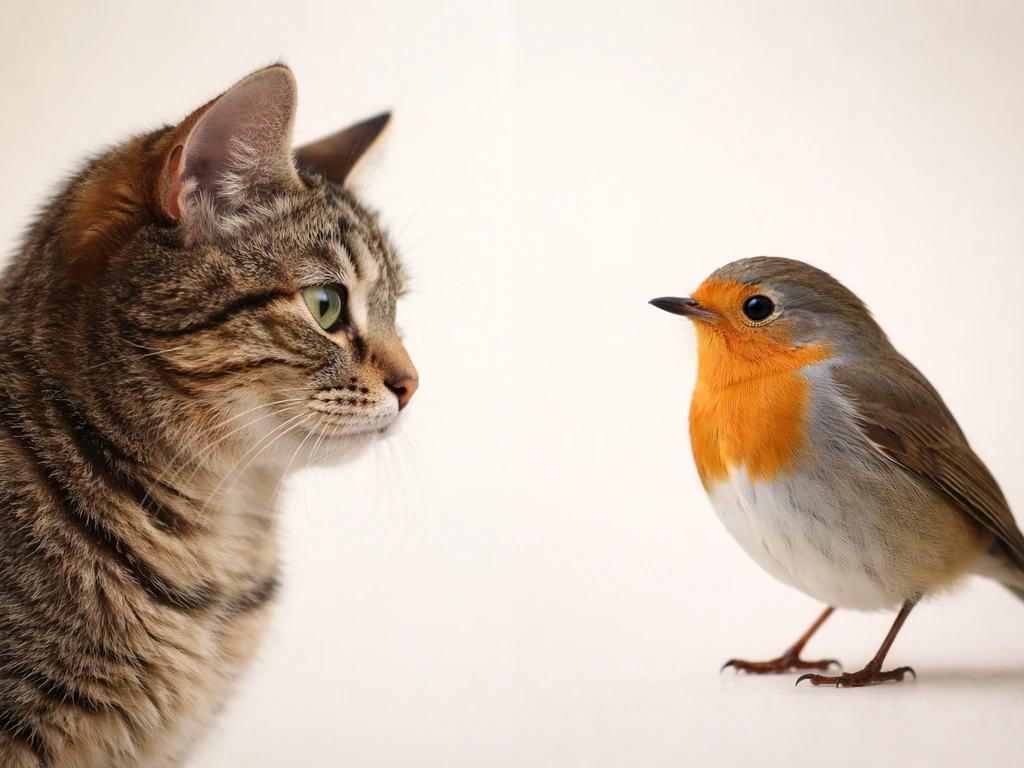
Cat Is to Fur as Bird Is to Feathers: How to Tell
Birds are to feathers as cat is to fur. Learn what makes a bird in taxonomy, plus penguins vs bats, pterosaurs.
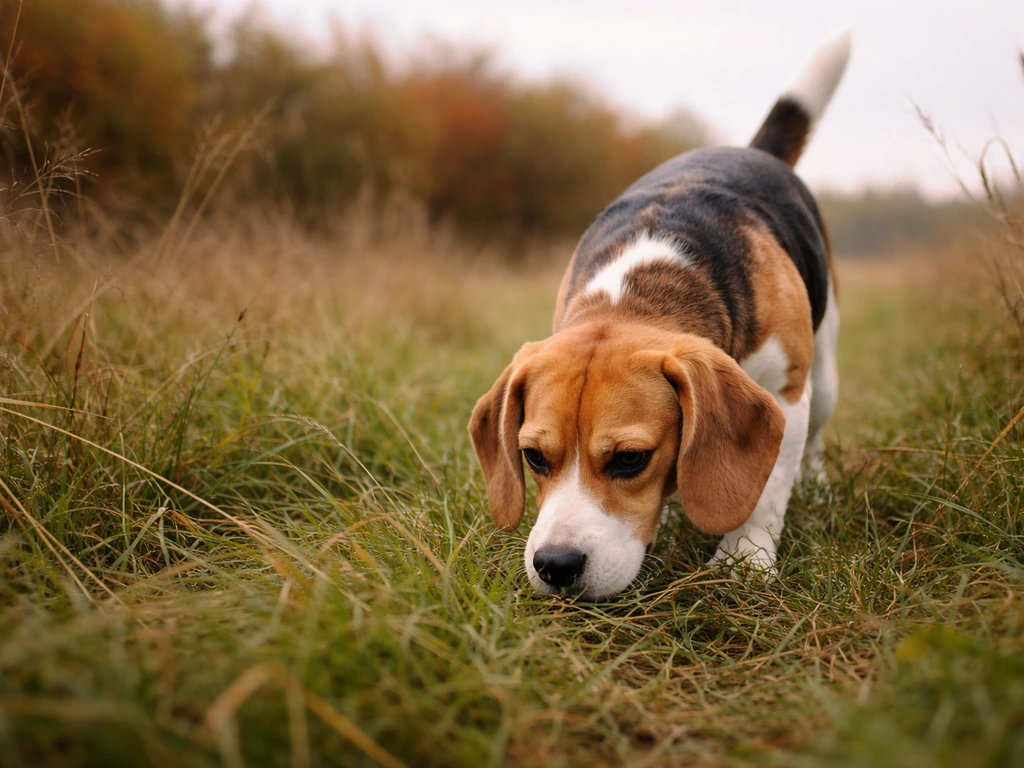
Are Beagles Bird Dogs? What to Expect and How to Train
Verdict on are beagles bird dogs, their scent-tracking strengths, limits for pointing and retrieves, plus starter traini
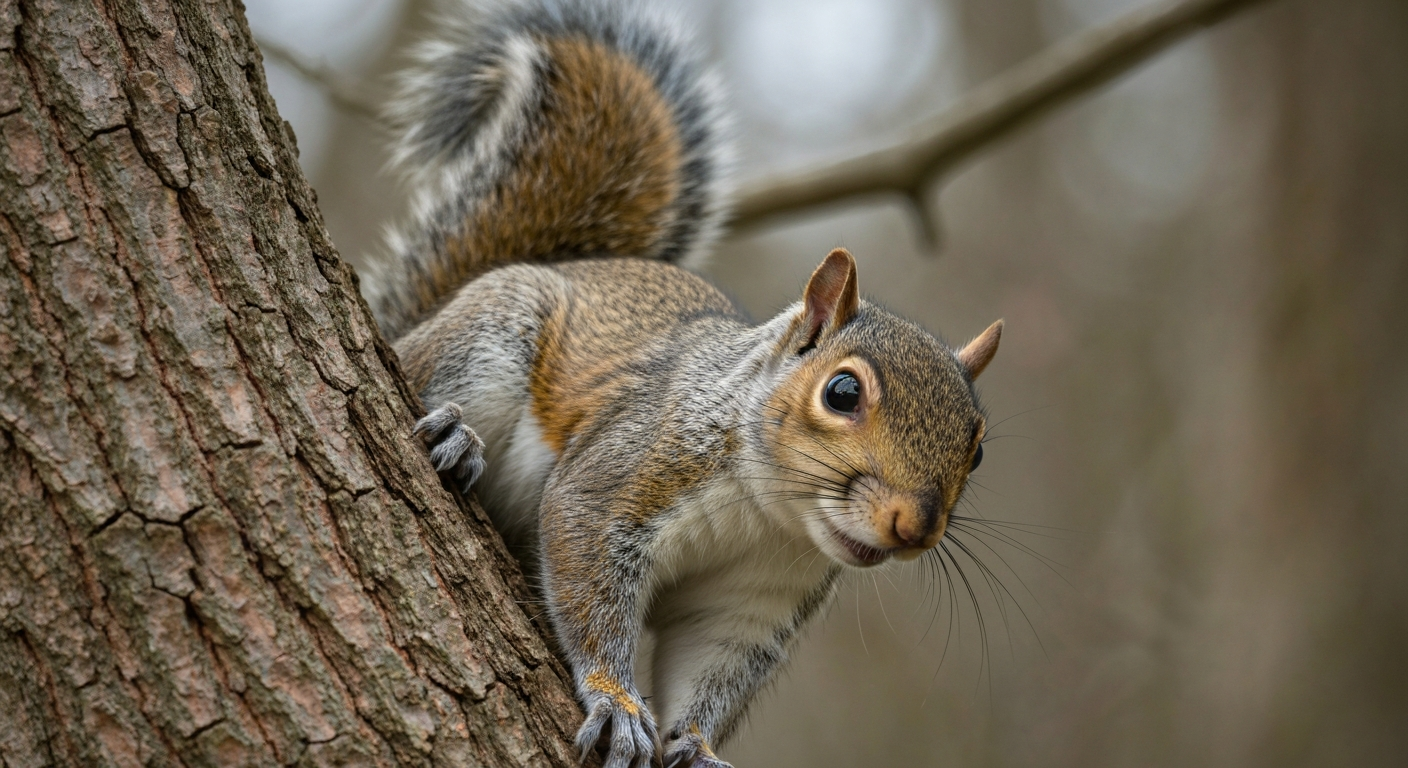
Is Squirrel Animal or Bird? Clear Answer and Classification
Squirrels are mammals, not birds, class Mammalia, order Rodentia. Quick traits, comparison table, checklist & FAQ.