A kiwi is both a bird and an animal. IOC World Bird List, Taxonomic updates (including Apteryx epithet discussion) notes that Taxonomy note: the IOC World Bird List has documented a proposed nomenclatural change for the great spotted kiwi based on syntype/hybrid analysis (a proposal to resurrect the epithet Apteryx maxima for that taxon); national and conservation agencies (DOC, museums) may still use Apteryx haastii, this illustrates active, recent taxonomic discussion blank" rel="noopener noreferrer">IOC World Bird List — Taxonomic updates (including Apteryx epithet discussion). Those two categories are not opposites: birds belong to class Aves, which sits inside the animal kingdom (Kingdom Animalia). So asking whether a kiwi is a bird or an animal is a little like asking whether a labrador is a dog or a mammal. The answer is yes to both. Taxonomically, the kiwi belongs to genus Apteryx, order Apterygiformes, class Aves, and it ticks every defining criterion for birdhood, even though it cannot fly.
kiwi is bird or animal: clear answer and ID checklist

Birds are animals too: how classification actually works
Biological classification arranges living things in nested groups from broadest to most specific. At the widest level sits Kingdom Animalia, which includes every animal on the planet: insects, fish, mammals, reptiles, and yes, birds. Class Aves (birds) is simply one branch within that kingdom. This means every bird is an animal by definition, but not every animal is a bird. When people ask whether something is a bird or an animal, they usually mean to ask whether it is a bird or some other kind of animal, and that is a perfectly reasonable thing to wonder.
The full classification ladder for the kiwi looks like this: Kingdom Animalia, Phylum Chordata, Class Aves, Order Apterygiformes, Family Apterygidae, Genus Apteryx, with five living species beneath that. Every rung of that ladder places it firmly in the animal kingdom and firmly in the bird class simultaneously.
How the Bird Classification Guide can help you
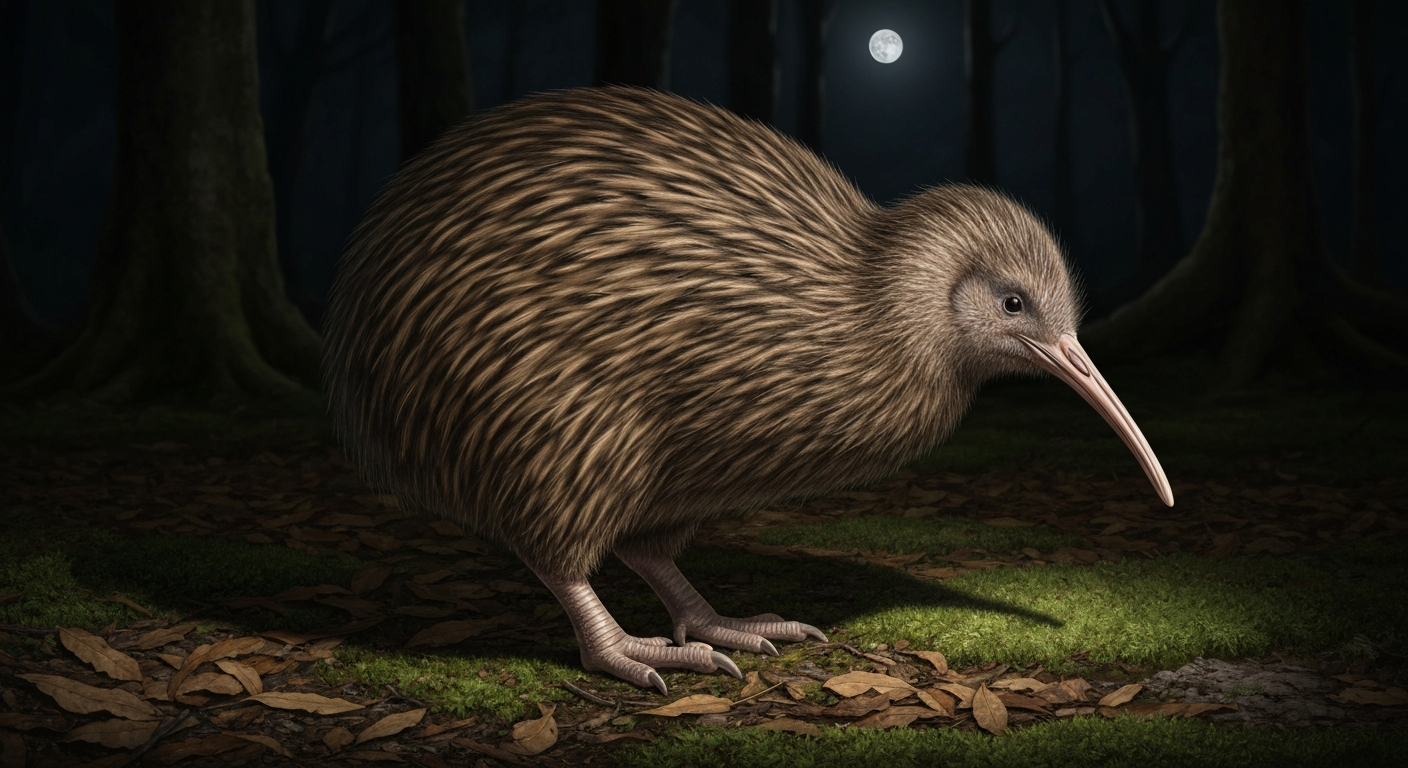
If you landed here because a kiwi confused you, you are in good company. The kiwi looks nothing like the birds most people picture: it is nocturnal, shaggy, has a long probing bill, tiny hidden wings, and dense marrow-filled bones rather than the hollow ones many flying birds have. The Bird Classification Guide is built exactly for moments like this. Whether you are a student working through a biology assignment, a curious traveller who just saw a kiwi at a wildlife centre, or someone who spotted a confusing animal and needed a fast answer, the goal here is to give you a clear biological framework you can apply to any creature, not just the kiwi.
Later sections of this site cover other animals that trip people up in similar ways, including the kangaroo (definitely not a bird) and other flightless or unusual creatures. If you have been wondering whether flightlessness disqualifies a bird from being a bird, keep reading.
What actually makes a kiwi a bird
Flight is not the defining characteristic of a bird. The defining characteristics are a specific set of anatomical and physiological traits, and the kiwi satisfies all of them.
Feathers
Feathers are unique to birds across all living animals. No mammal, reptile, or fish has them. Kiwi feathers are hair-like and loose in texture, which gives the bird its famously shaggy appearance, but they are structurally feathers. That single fact alone places the kiwi inside class Aves.
Beak and bill structure
Kiwis have a horny, toothless beak, which is standard avian anatomy. What sets them apart is their exceptionally long bill with nostrils positioned at the tip rather than near the base. This is a sensory adaptation: kiwis sniff out earthworms and invertebrates in leaf litter at night. No other bird has this nostril placement. It is unusual, but it is still a beak, not a snout or a jaw.
Egg-laying
Like all birds, kiwis are oviparous, meaning they lay eggs with hard shells. What is remarkable about kiwi eggs is their size relative to the female's body: a kiwi egg can account for roughly 15 to 20 percent of the female's body weight, one of the largest egg-to-body ratios of any bird in the world. A proportionally equivalent egg for a human female would weigh around 10 to 13 kilograms. Egg-laying is a key trait separating birds from most mammals (with the exception of monotremes like the platypus).
Skeletal features
Most flying birds have pneumatized (air-filled) bones to reduce weight for flight. Kiwis, having evolved a fully terrestrial lifestyle, have dense, marrow-filled bones instead. They also have vestigial wings, tiny and hidden beneath their feathers, and a reduced or absent keel on the sternum. In flying birds, the keeled sternum anchors powerful flight muscles. Since kiwis do not fly, that keel is no longer needed. This is an adaptation, not a disqualification: the furcula (wishbone, formed from fused clavicles) and other avian skeletal markers are still present. Bone structure varies considerably across bird species, and flightlessness alone does not remove a species from class Aves.
Sensory adaptations
Kiwis are primarily nocturnal and rely heavily on smell and touch rather than vision, which is unusual in birds. Their bill tip contains sensory pits called Herbst corpuscles that detect vibrations in the soil. Their eyesight is relatively poor. These are behavioural and sensory adaptations to a night-foraging ground life, but they do not change the bird's taxonomy. Adaptation to an environment changes how an animal operates, not what class it belongs to.
Taxonomic placement in Apteryx
The NCBI Taxonomy Browser, the Integrated Taxonomic Information System (ITIS), and the IOC World Bird List all place genus Apteryx within class Aves, order Apterygiformes, family Apterygidae. This is the formal scientific consensus, not a matter of opinion or debate. The kiwi is a bird by every authoritative biological classification system currently in use.
Kiwi taxonomy: genus Apteryx and where it sits in the bird family tree
Kiwis belong to a group called ratites, which are large, flightless birds that diverged early in avian evolutionary history. Other ratites include ostriches, emus, rheas, and cassowaries. Ratites lack a keeled sternum, which is why they are sometimes called flat-breasted birds. Genomic research has confirmed that flightlessness evolved independently multiple times across bird lineages, including in the ratite group, so there is no single ancestral 'flightless bird'. See the peer-reviewed study 'Distinct developmental pathways underlie independent losses of flight in ratites' for phylogenomic evidence that flightlessness arose independently multiple times across bird lineages Distinct developmental pathways underlie independent losses of flight in ratites (peer-reviewed, PMC). Kiwis represent their own distinct flightless lineage within this broader group, and their DNA firmly places them in class Aves.
One active area of taxonomic discussion worth noting: the great spotted kiwi has historically been listed as Apteryx haastii, but some recent nomenclatural analyses have proposed resurrecting the older epithet Apteryx maxima for this taxon. New Zealand's Department of Conservation and museum collections may still use Apteryx haastii. This kind of active revision is normal in taxonomy and does not change the species' status as a bird. It just reflects ongoing scientific refinement of species names.
The five kiwi species and their conservation status
All five recognised kiwi species are endemic to New Zealand, meaning they exist nowhere else on Earth. Primary threats include introduced mammalian predators such as stoats, dogs, and cats, as well as habitat loss and small population sizes. New Zealand's Department of Conservation runs active recovery programs including predator control, translocations, and captive management. Below is a quick reference to each species and its current conservation standing.
| Species | Scientific Name | IUCN / BirdLife Status |
|---|---|---|
| North Island brown kiwi | Apteryx mantelli | Vulnerable |
| Southern brown kiwi (tokoeka) | Apteryx australis | Vulnerable |
| Okarito kiwi (rowi) | Apteryx rowi | Vulnerable |
| Great spotted kiwi | Apteryx haastii (syn. A. maxima) | Vulnerable |
| Little spotted kiwi | Apteryx owenii | Near Threatened |
Conservation statuses reflect assessments by IUCN and BirdLife International and can change as population management actions take effect. Some kiwi populations have been downlisted in recent years following successful predator control programmes, which is an encouraging sign.
Quick checklist: is it a bird or something else?
When you need to quickly decide whether an animal is a bird, run through these questions. If the answer to the first three is yes, you almost certainly have a bird. The later items help confirm and rule out look-alikes.
- Does it have feathers? (Only birds have feathers. If yes, it is a bird.)
- Does it have a horny, toothless beak? (Most birds do; some extinct birds had teeth, but all living birds have beaks.)
- Does it lay hard-shelled eggs? (Birds are egg-layers, though so are reptiles and monotreme mammals, so this alone is not enough.)
- Does it have a wishbone (furcula)? (This fused collarbone is a defining avian skeletal feature.)
- Does it breathe with an air-sac respiratory system? (The avian respiratory system with air sacs is unique among vertebrates.)
- Does it have wings (even if vestigial or non-functional)? (All birds have wing structures, even if they cannot fly.)
- Is it warm-blooded and does it nurse young on milk? (If yes to milk, it is a mammal, not a bird, regardless of any other trait.)
- Does it have fur or hair? (Fur or hair means mammal, not bird. Kiwi feathers look hair-like but are structurally feathers.)
Applying this checklist to the kiwi: it has feathers (yes), a beak (yes), lays hard-shelled eggs (yes), has a wishbone and avian respiratory system (yes), has vestigial wings (yes), does not nurse young on milk (correct, it is not a mammal), and has no fur (its shaggy coat is feathers, not hair). Result: bird. If you searched "is kaur a bird", this guide's short answer is yes, it is a bird.
Common misconceptions and borderline cases
The kiwi is not the only animal that makes people question their classification instincts. Here are the cases I see come up most often, treated as genuine knowledge gaps rather than trick questions.
Flightless birds: ostriches, penguins, and the kiwi itself
Flight is not a requirement for birdhood. Ostriches are the world's largest birds and are completely flightless, yet they have feathers, lay eggs, have beaks, and sit firmly in class Aves. Penguins cannot fly through air but are excellent swimmers, and they too have feathers, lay eggs, and have all the anatomical markers of birds. The kiwi is in exactly the same position. Flightlessness has evolved independently at least a dozen times across bird history, including in rails, some ducks, and several island species. Losing the ability to fly is an adaptation, not a reclassification.
Bats: mammals that fly
Bats can fly, but they are mammals. They have fur, give birth to live young, and nurse those young on milk. They have no feathers and no beak. The ability to fly does not make an animal a bird: it makes it a flier. Bats are the only naturally flying mammals, and their wings are formed from skin membranes stretched between elongated finger bones, completely different in structure from a bird's feathered wing.
Pterosaurs: flying reptiles, not birds
Pterosaurs were flying reptiles that lived alongside dinosaurs and went extinct at the end of the Cretaceous period, roughly 66 million years ago. They are not birds. They were not ancestors of birds. They flew using skin-membrane wings similar in structure to bat wings, not feathered wings. Some species were covered in a hair-like filament called pycnofibres, which is not the same as feathers. Pterosaurs belong to a separate reptile lineage from the one that eventually gave rise to birds.
The bird-dinosaur relationship
Modern birds are the living descendants of theropod dinosaurs, specifically the maniraptoran branch. Technically, birds are avian dinosaurs. Key evidence includes feathered theropod fossils discovered in China and the transitional fossil Archaeopteryx, which has both dinosaur and bird features. This means that when a kiwi stands in a New Zealand forest probing for worms, it is, in the most literal biological sense, a dinosaur. Specifically, it is a highly derived, feathered, flightless, nocturnal avian dinosaur. That framing tends to make the kiwi considerably more interesting to students.
Could a kiwi ever be mistaken for a mammal?
It is easy to see why someone might initially think so. The kiwi is round, low to the ground, covered in something that looks like coarse brown hair, active at night, and it sniffs around in leaf litter for food much like a hedgehog or a small mammal would. But look closely: those are feathers, not fur. There is a beak at the front of that snout. And it is hatching from a remarkably large egg. No mammal does any of that combination. The kiwi is a vivid reminder that bird diversity extends far beyond robins and sparrows.
If you want to work through similar classification questions for other animals that commonly confuse people, such as the kangaroo or other creatures searchers have mistakenly placed in the bird category, other pages on this site walk through exactly the same framework applied to different animals.
FAQ
Is a kiwi a bird or an animal?
Short answer: A kiwi is both — it is a bird (class Aves) and, because birds are animals, it is also an animal. Taxonomically the kiwi belongs to the genus Apteryx within the family Apterygidae and is placed in class Aves (birds).
Why do we say birds are a type of animal?
Brief explanation of biological classification: - Biological classification is hierarchical: Kingdom → Phylum → Class → Order → Family → Genus → Species. - Kiwi classification (example): Kingdom Animalia → Phylum Chordata → Class Aves → Order Apterygiformes/Family Apterygidae → Genus Apteryx → species. - Class Aves (birds) sits inside Kingdom Animalia, so every bird is an animal but not every animal is a bird.
What specific traits make a kiwi a bird?
Key traits that identify kiwi as birds: - Feathers: kiwi have hair-like feathers unique to birds. - Beak: a horny bill (kiwi bills are long with nostrils at the tip). - Egg-laying: kiwi lay eggs (not live young); kiwi eggs are proportionally very large. - Skeletal/soft-tissue features: presence of avian structures such as a furcula (wishbone) and avian-style palate and respiratory anatomy adaptations (though kiwi bones are not strongly pneumatized and keel/sternum is reduced due to flightlessness). - Taxonomic placement: formally classified in Aves (ornithological checklists and taxonomic databases place Apteryx among birds).
Which kiwi species exist and what are their conservation statuses?
Recognized extant kiwi taxa (common names and typical conservation notes): - North Island brown kiwi (Apteryx mantelli) — Vulnerable to Endangered depending on population and local assessment; threats include predators and habitat loss. - Southern brown kiwi / tokoeka (Apteryx australis) — Conservation status varies by population; some populations are Threatened. - Okarito / rowi (Apteryx rowi) — Endangered; small range and intensive recovery management. - Great spotted kiwi (often listed as Apteryx haastii or discussed as Apteryx maxima in recent taxonomic work) — Vulnerable/Threatened; status varies by assessment. - Little spotted kiwi (Apteryx owenii) — Near Threatened to Vulnerable in some assessments; small, managed populations exist (including translocations). Notes: Exact status can change with new assessments and management successes. For current IUCN/BirdLife listings and national DOC updates, consult BirdLife/IUCN factsheets and New Zealand Department of Conservation pages.
How can I tell a bird from a non-bird? (Quick checklist)
Simple checklist to distinguish birds from non-birds: - Feathers present? (Yes → bird) - Horny beak without teeth? (Yes supports bird ID) - Lays eggs with hard shells? (Yes supports bird ID) - Has a furcula (wishbone) or other avian skeletal features? (Yes supports bird ID) - Has wings (even if reduced) or wing structures? (Yes supports bird ID) - Is covered in fur or has mammary glands and live young? (Yes → mammal, not bird) If most bird-traits are present (especially feathers), the animal is a bird.
What about flightless birds and other confusing cases like bats or extinct pterosaurs?
Common misconceptions and borderline cases: - Flightless birds (kiwi, ostrich, emu, cassowary, penguins): loss of flight does not remove them from class Aves. Flightlessness is an evolved trait in several bird lineages. - Mammals that fly (bats): bats are mammals (class Mammalia), not birds — they have fur and produce live young and mammary glands. - Pterosaurs (extinct): flying reptiles that are NOT birds; they belong to other archosaur groups, lived alongside dinosaurs, and are not classified as modern birds. - Birds are living avian dinosaurs: modern birds evolved from theropod dinosaurs; technically birds are the only living lineage of dinosaurs. This explains similarities to some fossil taxa.
Is Kaur a Bird? Quick Answer, Confusions, and Facts
Is Kaur a bird? Clear answer: Kaur is a human surname/title, not a bird, quick ID tips and common confusions.