Nero is not a bird in any official or scientific sense. No bird species, genus, or standardized English common name called "Nero" appears in any major ornithological checklist, including the IOC World Bird List (v15.2), eBird/Clements, ITIS, GBIF, or the Catalogue of Life. If you encountered "Nero" labeled as a bird, the most likely explanations are: an individual pet bird given that name, a fictional character from the manga/anime Black Clover whose bird form turns out not to be a real bird, or a simple mislabeling. The name itself comes from Latin/Italian meaning "black," which is why it appears in Romance-language bird descriptions (like "picchio nero" for Black Woodpecker), but that is a word in a common name, not a bird called Nero.
Why Is Nero a Bird? Clear Answer, Checklist & Verification

Sarah Chen
24 Jul 2026
Why someone might call Nero a bird
There are a few distinct routes that lead people to associate the name Nero with birds, and none of them point to a recognized bird species.
A real pet bird named Nero
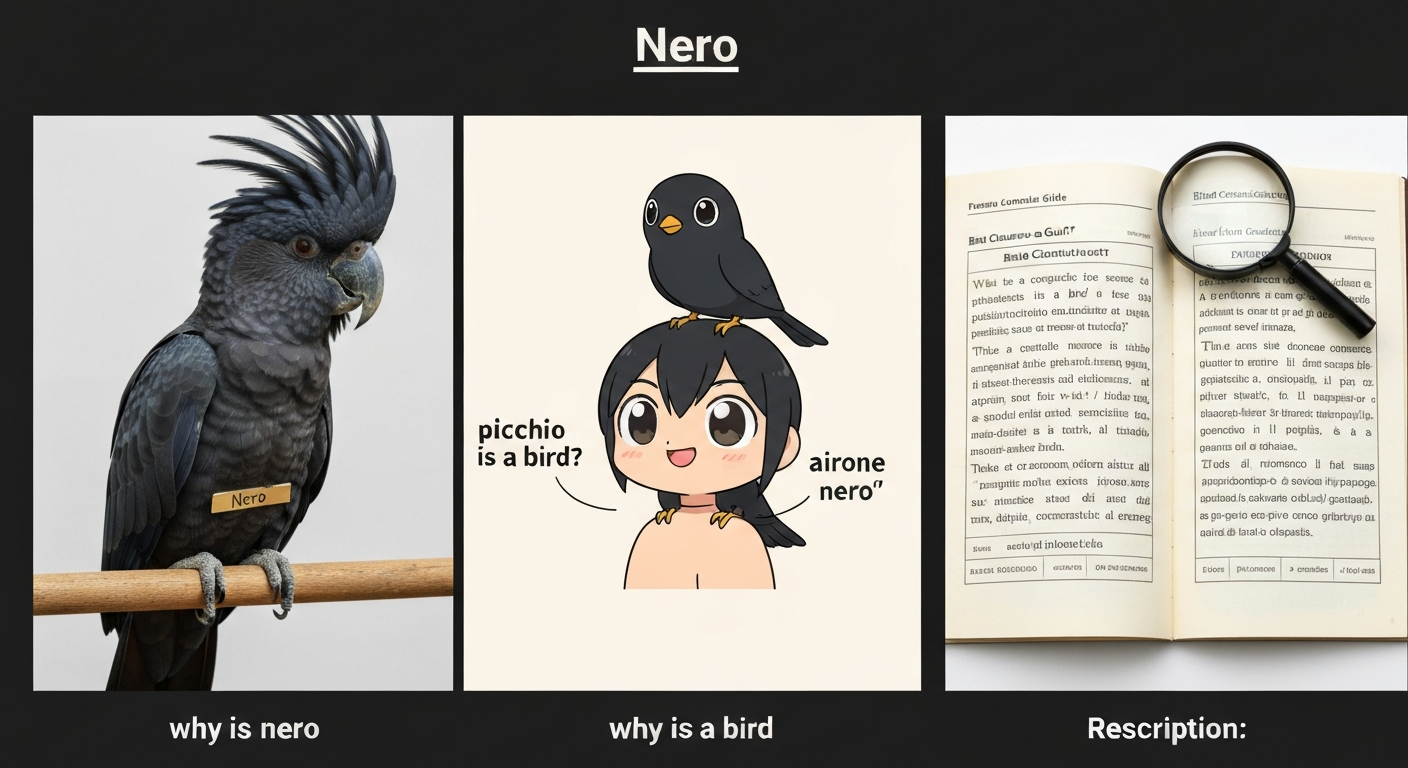
Individual birds kept in captivity are named by their owners just like cats and dogs. Sugar Creek Bird Farm, for example, has a resident Black Palm Cockatoo (Probosciger aterrimus) named Nero. That bird is real and genuinely belongs to class Aves, but "Nero" is its personal name, not its species. If you saw a photo or post about this bird, it would be accurate to say Nero is a bird in that specific context, while the name itself carries no avian classification.
A fictional character that appears as a bird
In the manga and anime series Black Clover, Nero is introduced as a small bird that follows the protagonist Asta. For much of the story, readers and viewers treat Nero as an ordinary bird mascot. The twist is that Nero is actually Secre Swallowtail, a human woman who transformed herself into a bird using forbidden magic. Entertainment reporting (Black Clover Cosplay / Nero coverage, ComicBook.com) summarizes the Black Clover reveal that Nero is Secre Swallowtail, a human who transformed into a bird Black Clover Cosplay / Nero coverage — ComicBook.com (entertainment reporting). So the character is visually a bird for a long stretch of the story, which is why fans commonly ask "why is Nero a bird?" The canon answer is that it was a magical transformation, not genuine avian biology.
The word "nero" appearing in bird names
In Italian, "nero" simply means "black." GBIF records show the word appearing inside Romance-language common names for birds: "airone nero" (Black Heron), "picchio nero" (Black Woodpecker), and similar phrases. A translation tool, an image tag, or a non-English source could easily surface "nero" in a bird context without that word being the actual name of a bird. That kind of coincidence is a frequent source of confusion.
Mislabeling in datasets or image tags
In machine-learning contexts, "NERO" appears as an acronym (Non-Equivariance Revealed on Orbits) and as various product names, not as a recognized bird category in standard image datasets like ImageNet or OpenImages. If an algorithm or tag produced "Nero" as a bird label, that would be an error in the labeling pipeline rather than a real classification.
A checklist for deciding whether any named thing is a bird
Whenever you encounter a name and want to know whether it refers to a bird, run through these steps in order. The first question that returns a clear "no" stops the process.
- Does it appear on an authoritative bird checklist? Check the IOC World Bird List (ioc-worldbirdlist.org), eBird/Clements, or the Catalogue of Life for the exact name as a species, genus, or accepted English common name.
- Is it a living or extinct organism at all? If the name belongs to a fictional character, a username, a brand, or a word in another language, it cannot be a bird species regardless of appearance.
- If it is a real organism, does it belong to class Aves? Confirm this via ITIS or GBIF by searching the scientific name and checking the taxonomic path.
- Does the organism have feathers? Feathers are unique to birds; no other living animal group has them.
- Does it have a keratinous beak, two wings, two legs, and lay hard-shelled eggs? These are the core physical markers of extant birds.
- Does its skeleton include a furcula (wishbone), fused clavicles, and a lightweight structure consistent with avian anatomy?
- Is there genomic or phylogenetic evidence placing it within crown-group Aves? For borderline or fossil cases, this step is essential.
- If all checks pass: the thing is a bird. If any check fails: note the reason (fictional, wrong kingdom, wrong class, wrong anatomy) and record that as your answer.
The biological criteria ornithologists actually use
Classification into class Aves is not a judgment call. Ornithologists use a set of anatomical, physiological, and genetic markers that collectively define what a bird is. Understanding these makes it easy to evaluate any animal, including borderline cases.
- Feathers: the single most diagnostic feature of birds. No other living vertebrate group produces feathers. They serve flight, insulation, and signaling.
- Beak/bill: extant birds have a keratinous bill without teeth (teeth were lost in the avian lineage, though fossil toothed birds existed). The shape varies enormously but the structure is consistent.
- Forelimbs modified as wings: even flightless birds like ostriches and penguins have forelimbs derived from the ancestral wing structure, with characteristic fused wrist/hand bones (carpometacarpus).
- Oviparity with hard-shelled eggs: birds lay amniotic eggs with a calcified shell, and incubate them externally.
- Lightweight skeleton: avian bones are often hollow (pneumatized), and the skeleton includes a furcula (wishbone formed by fused clavicles) and, in flying species, a keeled sternum (carina) that anchors flight muscles.
- Avian respiratory system: birds have a unique flow-through lung system supported by air sacs, allowing highly efficient gas exchange.
- Genetics and phylogeny: modern birds form the crown group of theropod dinosaurs. Phylogenomic studies (including the large-scale Jarvis et al. whole-genome analysis) place all living birds within a well-supported tree. Scientific names follow the International Code of Zoological Nomenclature (ICZN), which uses binomial nomenclature and the principle of priority to govern valid names.
Applied to "Nero": a Black Palm Cockatoo named Nero has every one of these features. The Black Clover character in bird form is drawn to resemble a small bird, but there is no real organism to classify. The Italian word "nero" embedded in a common name like "picchio nero" is just a descriptor, not a taxon.
How taxonomy and naming authorities decide what counts as a bird
The scientific name of a bird is governed by the ICZN, which requires a binomial (genus + species), a type specimen, and adherence to priority rules. But the English common names people actually use day-to-day are maintained by community checklists, not the ICZN. The IOC World Bird List and the eBird/Clements checklist are the two most widely used authorities, and both are updated annually. If a name does not appear in these lists as a recognized species or accepted English name, it is not an official bird name regardless of how widely it circulates.
Searching the IOC list (v15.2) and GBIF Backbone Taxonomy for "Nero" returns no bird taxon. ITIS records entries using "nero" as a specific epithet, but those belong to insects (Coleoptera, Hemiptera) and other non-avian groups. NCBI Taxonomy shows "nero" appearing in microbial strain names and gene identifiers, again with no connection to class Aves. The absence across all four databases is definitive: there is no bird officially named Nero.
Common borderline cases that confuse people
Part of why bird classification questions keep coming up is that several well-known animals push against intuitions about what a bird looks like. Here are the ones that generate the most confusion, resolved quickly.
| Animal | Is it a bird? | Key reason |
|---|---|---|
| Penguin | Yes | Has feathers, lays hard-shelled eggs, forelimbs are modified wings (flippers). Flightlessness does not remove it from Aves. |
| Ostrich | Yes | Largest living bird. Flightless ratite with feathers, beak, and avian skeleton. Related to emus, kiwis, and rheas through independent losses of flight. |
| Bat | No | Mammal (order Chiroptera). Has fur, not feathers; gives birth to live young; nurses with milk. Powered flight evolved independently from birds. |
| Pterosaur | No | Extinct flying reptile (archosaur). Membranous wings, no feathers (some had pycnofibers), distinct anatomy. Not on the avian line. |
| Non-avian dinosaur | No | Dinosaurs gave rise to birds, but the vast majority of dinosaur lineages are not birds. Only the theropod lineage leading to crown-group Aves counts as birds. |
The penguin and ostrich cases are worth emphasizing: people sometimes assume that because a bird cannot fly, it is not really a bird. Flight is not a defining feature of the class. Distinct developmental pathways underlie independent losses of flight in ratites, peer‑reviewed study (PMC) documents multiple independent losses of flight within the ratite lineage Distinct developmental pathways underlie independent losses of flight in ratites — peer‑reviewed study (PMC). Feathers, the modified forelimb structure, the keeled or modified sternum, and the genetic placement within Aves are what matter. Both penguins and ostriches pass every biological test.
Why ordinary words, job titles, and usernames get mistaken for bird names
Search engines and social platforms often serve up questions like "is reading a bird?" or "is plumber a bird?" This happens for a few predictable reasons. First, many genuine bird names are also common English words: Robin, Martin, Swift, Jay, Crane, and Bunting are all bird genera or species names as well as surnames or everyday words. That overlap trains people to wonder whether any unfamiliar word might be a bird name. Second, some words resemble genus names in spelling or sound: "Sett" looks like it could be a Latin epithet, and "Unread" has an unusual structure that might prompt the same curiosity. Third, username culture means people encounter strings like "nero," "sett," or "unread" as account handles without context, and if the account posts bird content, the name gets associated with birds by proximity.
The consistent answer is that a word or title needs to appear in an authoritative ornithological checklist as a species name, genus name, or accepted English common name before it qualifies as a bird name. For a direct example about job titles, see is job a bird. Job titles like "plumber" and common verbs like "reading" or "unread" do not appear in any such list. For a step‑by‑step check of the job title plumber, see is plumber a bird. The checklist in the section above is the fastest way to settle these questions.
Applying the checklist: reading, job, plumber, sett, and unread
These five words come up as sibling questions on this site, and it is worth walking through the checklist with each one to show how consistent the method is.
| Name/word | On an official bird checklist? | A real organism? | Verdict |
|---|---|---|---|
| Reading | No | No (it is a gerund/town name) | Not a bird. No species or accepted common name called "Reading" exists in IOC, eBird, or GBIF. |
| Job | No | No (common English noun/proper name) | Not a bird. Does not appear in any ornithological checklist as a taxon or common name. |
| Plumber | No | No (occupational title) | Not a bird. The word describes a trade, not an animal. |
| Sett | No | No (a badger den or paving stone) | Not a bird. "Sett" is an English common noun; it names a badger's burrow, not any avian species. |
| Unread | No | No (adjective/status indicator) | Not a bird. It is a digital-interface term with no place in any taxonomy. |
In every case, the checklist stops at step one: none of these words appears on an authoritative bird checklist. That is all you need to know. The same logic applies to Nero. It is not on any official bird checklist as a taxon or standard English name, which means that regardless of the reason someone called it a bird (a pet's name, a fictional character, a translated color word), Nero is not a bird in any biological or taxonomic sense. See the related discussion "is Sett a bird" for the same checklist-based approach applied to the name Sett.
How to verify any bird name yourself
If you want to check a name you have not seen addressed here, the fastest approach is to search the IOC World Bird List directly at ioc-worldbirdlist.org using the name as a search term. Cross-reference with GBIF (gbif.org) using the Backbone Taxonomy filter set to class Aves. If neither returns a matching taxon, run the name through eBird's species search. Three consecutive misses across those databases is essentially conclusive: the name is not a recognized bird. For fictional or pop-culture cases, the additional step is to look up the character or mascot in a fan wiki and check whether the source material involves real-world biology or purely fictional creature design. The Black Clover Nero case is a good model: the wiki confirms the character is a transformed human, not a biological bird, which is the authoritative answer for that context.
FAQ
Direct answer: Why is Nero a bird?
Most likely "Nero" is not an official bird species name. Authoritative global bird checklists (IOC, eBird/Clements, ITIS/GBIF, NCBI) contain no bird taxon with the scientific or standardized English name exactly "Nero." The label "Nero" does appear as a personal name for individual pet or mascot birds (e.g., a cockatoo named Nero) and as a fictional avian character (e.g., Nero in Black Clover). So whether "Nero" is a bird depends on context: it can be an individual bird’s name or a fictional bird, but it is not a recognized bird species name in ornithological taxonomy.
Why would someone label "Nero" a bird?
Common reasons: (1) It's the given name of a pet or captive bird (owners/stores name birds Nero). (2) It's a fictional bird character (manga/anime, stories). (3) It's a translation/vernacular fragment—'nero' means 'black' in Italian and appears inside local common names (e.g., 'airone nero'). (4) Mislabeling or tagging error in images or datasets. (5) Confusion with similar tokens used in other domains (acronyms, usernames).
Reproducible checklist to decide whether an entity called "Nero" is a bird
Use this stepwise test: 1) Context check — where did you see the name (pet listing, fiction, database, image tag)? 2) Taxonomic lookup — search IOC World Bird List, ITIS, GBIF, Catalogue of Life, and NCBI for "Nero" as genus/species/English name. 3) Physical/biological evidence — does the entity have feathers, a keratinous beak, two legs and two wings (forelimbs modified as wings), lay hard-shelled eggs, and show avian skeletal features (furcula/pygostyle)? 4) Media check — inspect photos/video for feathers and bill; beware look-alikes (mammal/bat fur vs feathers). 5) Source reliability — prefer museum, atlas, checklist, peer-reviewed or reputable field-guide sources over forums. 6) If still unsure, consult a local ornithologist or submit images/audio to a trusted ID service (eBird, iNaturalist, Cornell Lab). If the name appears only as a personal/pet name or in fiction, treat it as an individual name, not a species name.
How to search authoritative databases for "Nero"
Search these resources: IOC World Bird List (worldbirdnames.org) for standardized English and scientific bird names; ITIS (itis.gov) and GBIF (gbif.org) for taxonomic records; NCBI Taxonomy for sequence-linked taxa; eBird/Clements for widely used checklists. Use exact-token and wildcard searches; also search for "nero" as a specific epithet (second word) or as part of vernacular names (common in Romance languages meaning 'black'). These sources currently show no bird taxon named exactly "Nero."
Which biological criteria define birds (quick summary)?
Key avian characters used by ornithologists: presence of feathers (unique to Aves), forelimbs modified as wings, a keratinous bill (no teeth in living birds), oviparity with hard-shelled eggs, specialized avian skeleton (furcula/wishbone, pygostyle, often a keeled sternum in flying species), and an avian respiratory system with air sacs. Modern phylogenetics places birds as crown-group theropod dinosaurs; genomic studies underpin higher-level classification.
Common borderline cases — are these birds or not?
- Penguins (Spheniscidae): Birds. Flightless, wings modified into flippers. - Ratites (ostrich, emu, kiwi): Birds. Flight lost secondarily in these lineages. - Bats (Chiroptera): Not birds; mammals with membranous wings. - Pterosaurs: Not birds; extinct flying archosaurs (reptiles), separate from crown birds. - Non-avian dinosaurs: Not birds, though birds evolved from theropod dinosaurs; some fossil theropods had feathers but are not classified as crown-group Aves unless within the modern bird clade.
Next Articles
Is Job a Bird? How Birds Are Classified and Checked
Get a clear answer on whether job is a bird, plus beginner guide to bird traits, taxonomy, and lookups for similar anima
Is Reading a Bird a Bird? How to Tell What It Is
Learn if a thing called reading a bird is actually a bird, with clear checks and fixes for penguins, ostriches, bats
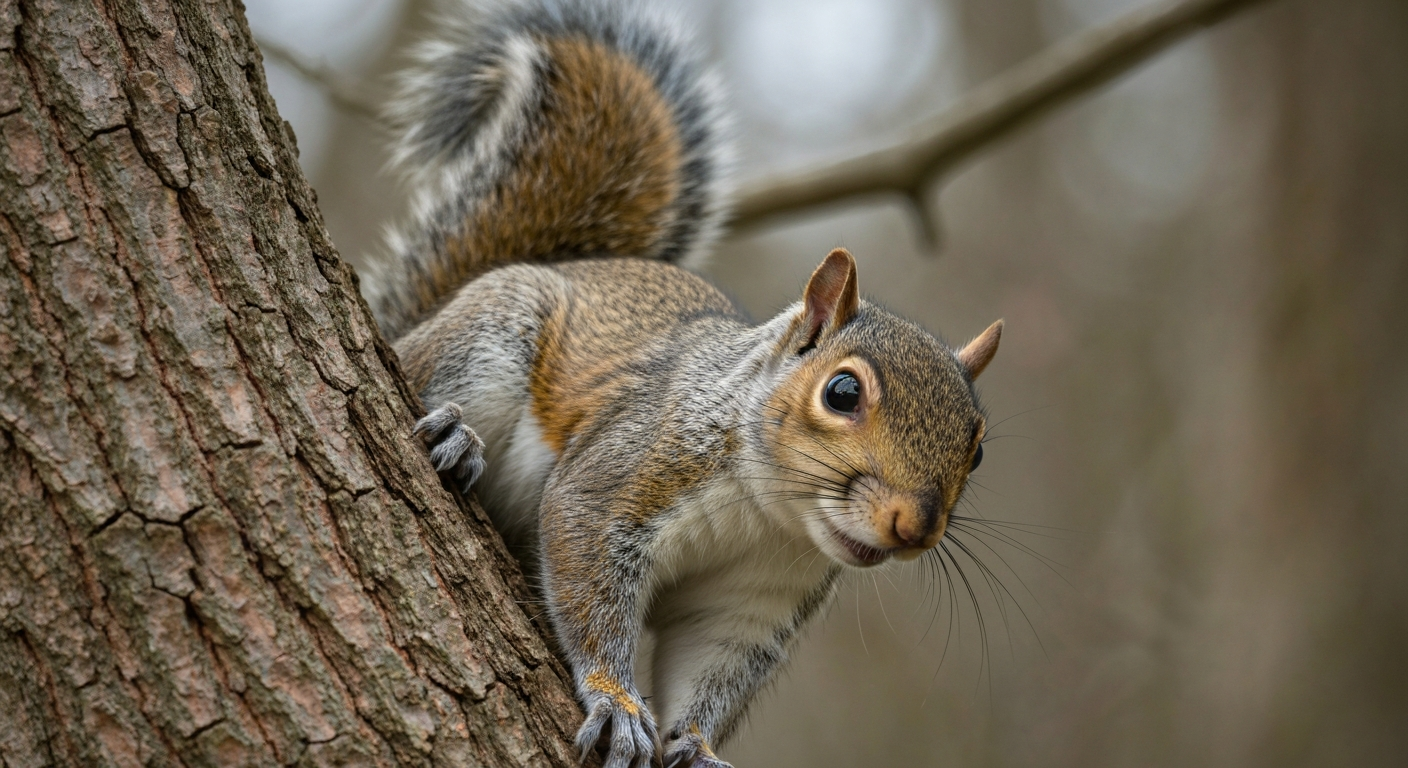
Is Squirrel Animal or Bird? Clear Answer and Classification
Squirrels are mammals, not birds, class Mammalia, order Rodentia. Quick traits, comparison table, checklist & FAQ.