
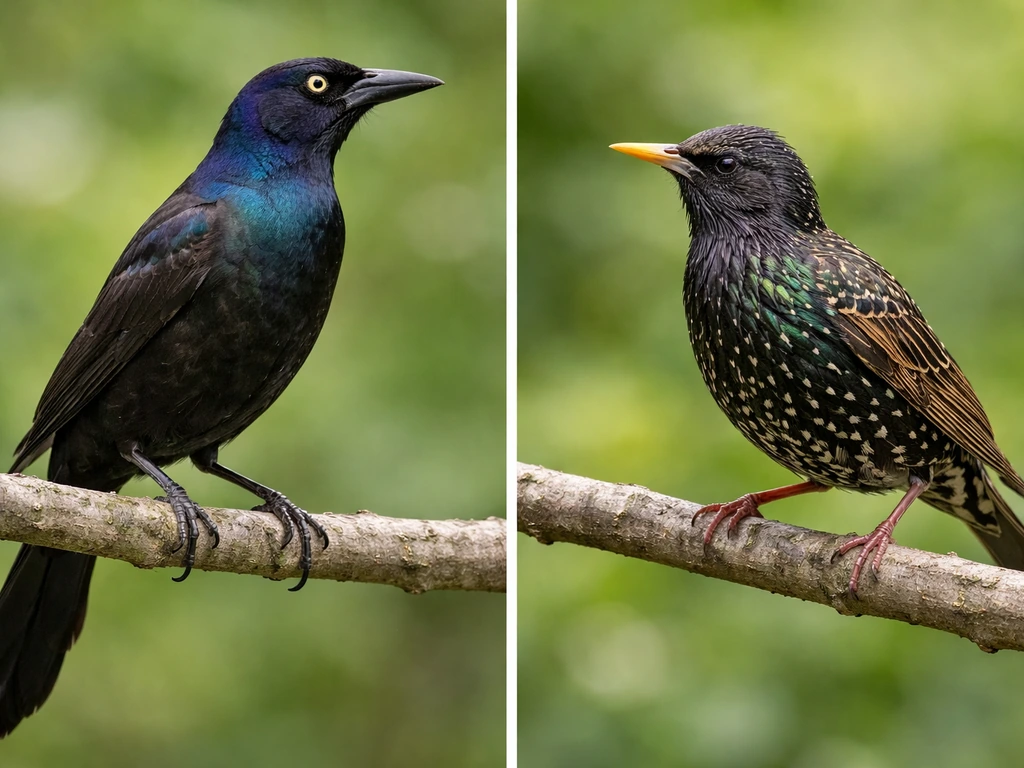
Grackles and starlings are not the same bird. You might also wonder, “Is there a bird called Sagittarius,” but the birds discussed here are grackles and starlings. They are not even closely related. Grackles belong to the family Icteridae (the blackbirds and orioles), while starlings belong to the family Sturnidae. They look vaguely similar at a glance because both are dark, glossy, and highly social birds that show up in backyards and parking lots across North America, but once you know what to look for, telling them apart takes about three seconds.
Are Grackles and Starlings the Same Bird? Key ID Tips

Sarah Chen
23 Jun 2026
Why people mix them up in the first place
Both birds are roughly blackbird-sized, both have iridescent dark plumage that can flash green or purple in good light, and both travel in noisy flocks around human-modified landscapes. If you spot a group of dark, chattering birds on your lawn or at a feeder, it is genuinely reasonable to wonder which one you are looking at, especially if you are new to backyard birding.
Magmar is not a commonly used name for a bird in backyard birding, so it is worth double-checking the species or source you saw is magmar a bird. The European Starling (Sturnus vulgaris) was introduced to North America via releases in New York City's Central Park in the late 19th century, so it has had well over a century to spread across the continent and integrate into the same neighborhoods where Common Grackles (Quiscalus quiscula) have always lived.
Overlapping ranges, overlapping habitats, and overlapping behavior create the perfect conditions for confusion.
Field marks: how to tell them apart on the spot
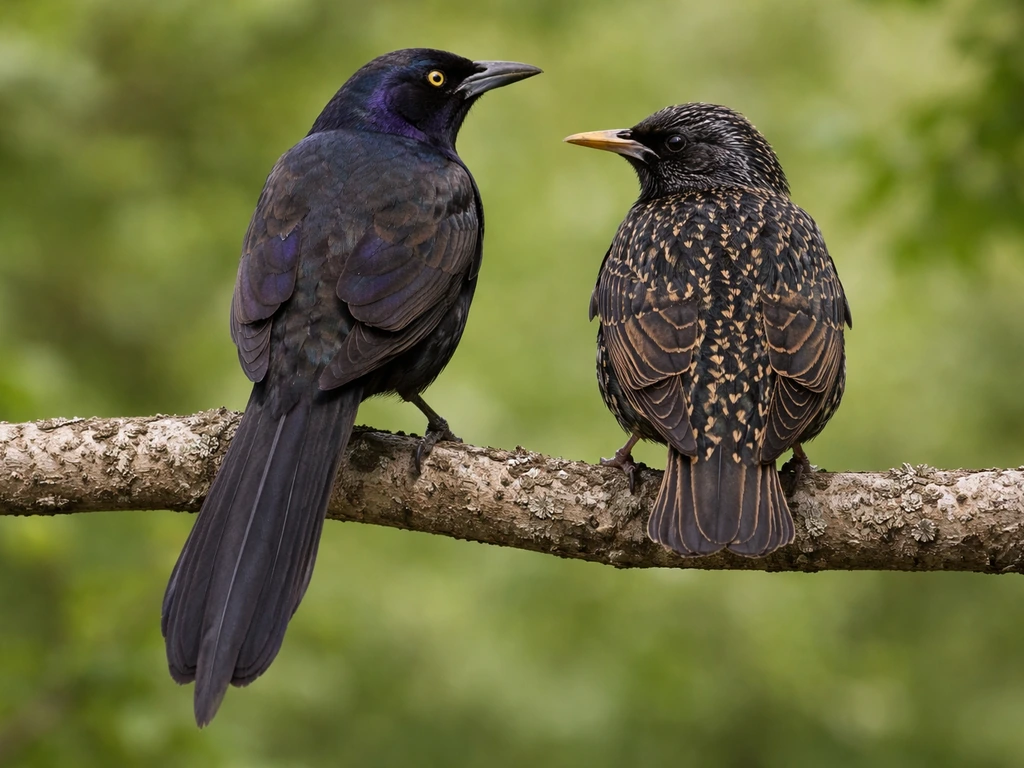
Shape is your fastest tool here. Before you even think about color or pattern, look at the body proportions and tail. Grackles are lanky, long-legged birds with a notably long tail and a heavy, long bill. Starlings are chunky and compact with a short tail and a long, slender, almost spear-like bill. Those two silhouettes are genuinely different, and once you have seen both side by side, you will not mix them up again. A common question people ask is, “is a rocket a bird,” and the answer is no.
Tail shape
The Common Grackle's tail is one of its most diagnostic features. It is long and, when seen head-on or from below, shows a distinctive crease or keel down the middle, giving it a slightly V-shaped or boat-tailed look. The European Starling's tail is short and squared off. In flight, starlings show triangular, pointed wings and that short tail, which gives them a stocky, dart-like silhouette. Grackles look more like a stretched-out blackbird with an obvious trailing tail.
Bill shape
The bill is another quick separator. A grackle's bill is thick, long, and heavy, built for prying and probing. A starling's bill is long and slender with a pointed tip, almost like a spike. In breeding season, starlings develop a bright yellow bill that is very hard to miss. Grackles keep a dark bill year-round.
Plumage and iridescence
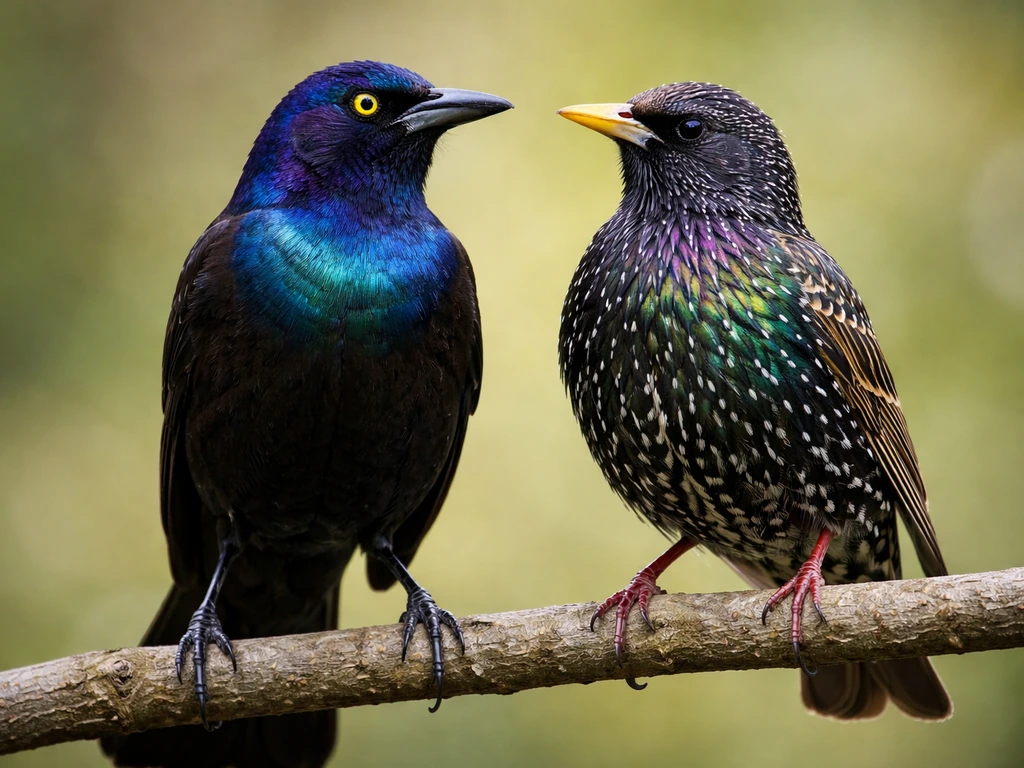
Both birds have iridescent plumage, but the patterns differ. A Common Grackle in good light shows an abrupt division between the gloss color of the head and the body, with the head often appearing blue-green and the body showing a bronzy or purplish sheen. This two-toned iridescence is a reliable ID clue when the light hits right. European Starlings in breeding plumage are a glossy purplish-green all over with no sharp color division. In winter, starlings look dramatically different: they develop extensive white and buff spots (called spangles) across their body, giving them a speckled appearance that no grackle ever shows. A spotted dark bird in your yard in November is almost certainly a starling.
| Feature | Common Grackle | European Starling |
|---|---|---|
| Body shape | Lanky, long-legged | Chunky, compact |
| Tail | Long, creased/keeled | Short, squared |
| Bill | Heavy, long, dark | Slender, pointed; yellow in spring |
| Iridescence | Two-toned: blue-green head, bronzy body | Uniform purplish-green in spring |
| Winter plumage | Stays glossy dark | Heavy white/buff spots all over |
| Wings in flight | Long, broad | Short, triangular, dart-like |
| Size | ~12 inches, noticeably larger | ~8.5 inches, smaller and stockier |
Behavior and habitat clues
Common Grackles are familiar on suburban lawns, where they stride deliberately across the grass searching for insects, grubs, and seeds. They walk with a purposeful, upright posture on those long legs. They do well in human landscapes that mix scattered trees with open ground, including forested neighborhoods, parks, and agricultural edges. Nesting happens colonially, typically high in conifers, though they sometimes use cavities and birdhouses.
European Starlings live even more tightly around people: lawns, open fields, parking lots, building ledges, and urban parks are all fair game. Audubon Field Guide notes that European Starlings use cities, parks, farms, open groves, and fields, breeding around buildings and settlements, and are usually scarce in extensive wild forest, scrub, or desert areas [live even more tightly around people: lawns, open fields, parking lots, building ledges, and urban parks are all fair game. ](https://www. audubon.
org/field-guide/bird/european-starling). Their diet is broad, covering invertebrates like grasshoppers, beetles, caterpillars, earthworms, and spiders, plus fruits, grains, and seeds. They nest in cavities, which puts them in direct competition with native cavity-nesting species like bluebirds and woodpeckers. The most dramatic starling behavior is the murmuration: massive, synchronized flocks of thousands of birds that swirl in coordinated aerial patterns.
Grackles flock too, but they do not produce that kind of fluid, shape-shifting aerial display.
Quick ID checklist when both could be present
If you are standing in your yard or parking lot right now looking at a dark bird and trying to decide, work through this sequence:
- Look at the tail. Is it long and extending well behind the body, or is it short and stubby? Long tail points to grackle.
- Look at the bill. Is it thick and heavy, or thin and spike-like? Thick and heavy is grackle; thin and pointed is starling.
- Check the overall shape. Does the bird look long and lanky with long legs, or compact and chunky? Lanky is grackle; compact is starling.
- Check for spots. Any white or buff speckles on the body? That is a starling in winter plumage, full stop.
- Watch it walk. Grackles stride deliberately on long legs. Starlings often move in a quick, waddling walk.
- Listen. Grackles make a loud, squeaky, gate-hinge-like call. Starlings are extraordinary mimics and produce a wide variety of whistles, clicks, and imitations of other birds.
The taxonomy: what they actually are
Both grackles and starlings are birds, meaning they belong to the class Aves, have feathers, lay eggs, and share the core features that define birds. If you are also wondering whether a “star” is a bird, it is not, because stars are celestial objects rather than animals is a star a bird. But beyond that shared classification, they diverge significantly.
The Common Grackle (Quiscalus quiscula) is in the family Icteridae, which is a New World family that also includes meadowlarks, red-winged blackbirds, and Baltimore Orioles. The European Starling (Sturnus vulgaris) is in the family Sturnidae, an Old World family most diverse in Europe, Asia, and Africa.
These two families are not each other's closest relatives, and the similarity in appearance is a case of convergent evolution (where unrelated animals independently develop similar traits) combined with the fact that being dark, glossy, and gregarious is a successful lifestyle for a bird living around humans.
The name similarity does not help either. In some parts of the world, certain Asian starlings are informally called grackles, including birds like the Common Hill Myna, which is sometimes marketed as a "grackle" in the pet trade. But in North America, when someone asks about grackles versus starlings, they are almost always comparing Quiscalus quiscula against Sturnus vulgaris, and those are clearly distinct species in distinct families. In general, the right question is not whether something is a mart bird, but which species it actually matches in the grackle versus starling comparison Quiscalus quiscula.
How to lock in your ID today
The most useful thing you can do right now is grab your phone and take a photo or short video. Aim for two things: a clear view of the tail and a clear view of the bill. A side-on shot captures both. If the bird is on the ground, a photo showing its overall body proportions (length, leg length, posture) is extremely helpful. If you are in winter, note whether the bird has any spotted or speckled patterning.
Once you have a photo, open the Merlin Bird ID app from the Cornell Lab of Ornithology. It is free, and you can either upload your photo or use the Sound ID feature if the bird is calling. Merlin factors in your location and the current date, which matters because starlings are present year-round while grackle populations shift seasonally depending on where you are. For a more detailed reference, the All About Birds website (also from the Cornell Lab) has side-by-side identification pages for both species with photos at multiple angles and in multiple seasons.
- Photograph the tail from the side (the single most useful shot)
- Photograph the bill close up if possible
- Note the overall body size and posture
- Record the date and your location (city and state at minimum)
- Note the season and whether the bird has spots or glossy uniform plumage
- Run the image through Merlin Bird ID or check All About Birds for a side-by-side comparison
The tail is the shortcut. A long, creased tail means grackle. A short, squared tail on a chunky dark bird means starling. Everything else, including bill shape, body proportions, and seasonal plumage, just confirms what the tail already told you.
FAQ
Can I tell a grackle and a starling apart if they are far away or partially hidden?
Yes, use silhouette first. Even at distance, a grackle’s long tail with a central crease or keel stands out, while a starling’s tail looks short and squared off. If the bill is visible, grackles look thick and heavy, starlings look slender and pointed.
What season is easiest for identifying a starling?
Winter. European starlings often show obvious white and buff “spangles” in winter plumage, creating a speckled look that is very unusual for grackles. In other seasons you can still rely on the tail and bill shape, but the winter pattern is a strong shortcut.
If the bird has a shiny purple or green look, does that mean it is definitely one species?
Not by shine alone. Both birds can flash green or purple iridescence, so color can mislead. Focus on structure, especially tail length and the bill tip shape (heavy and long for grackles, long and slender for starlings).
How do I separate them when they are in the same flock near a feeder or lawn?
Expect mixed, noisy groups, then pick one individual and commit to a “two-feature check”: tail silhouette and bill shape. Try to get one clear side-on view, since head-on angles can make the tail crease harder to see.
Are grackles and starlings ever mistaken for the same thing online or in pet listings?
Yes. Some Asian birds can be marketed with “grackle” in their common name, even though they are not the North American species people usually mean. If you are using an ID photo, rely on the bird’s real traits and location, not the nickname used by a seller.
Do grackles ever make murmuration-like displays like starlings?
Grackles form flocks, but they do not produce the same large, coordinated aerial swirling patterns. If you see thousands of birds moving in tight, synchronized shape-shifting patterns, that strongly points to European starlings.
What if I only get a clear photo of the bill but not the tail?
Bill shape can still get you most of the way. A grackle’s bill is thick and heavy, built for probing, while a starling’s bill is long, slender, and pointed. Still, if possible, try for at least a partial tail view because it is the fastest reliable clue.
I found a dark bird but it might be something else. Which ID tool detail matters most?
Use location and date. Merlin’s results can change by season because grackle presence varies regionally, while European starlings occur year-round in many places. If you can, add a sound recording too, since call type can resolve tricky cases when plumage is similar.
Do grackles and starlings use birdhouses the same way?
Both will take advantage of cavities, but starlings are especially aggressive about cavity nesting and can outcompete native cavity nesters. If you manage birdhouses, consider starling-safe entrance hole sizes for native species, and expect starlings to be the main competitive threat.
What is the most common beginner mistake when trying to identify them?
Over-relying on color. Their dark, glossy, iridescent appearance can look the same in quick views. The reliable sequence is tail silhouette first, bill shape second, and only then confirm with seasonal spotting or the two-tone look on grackles.