If you just spotted something in the sky and you're not sure whether it's a bird, a bat, or something else entirely, here's the short answer: look for feathers, a beak, and a steady, rhythmic wingbeat. If you can see those three things, it's almost certainly a bird. If you can't get close enough to check, the shape of the wings and the flight pattern are your next best clues. This guide walks you through the full decision process, from a five-second first look to a confident identification you can actually trust.
Is It a Bird or a Plane? Quick Checklist to Identify

Sarah Chen
15 Apr 2026
Fast first impressions: bird-like vs plane-like cues
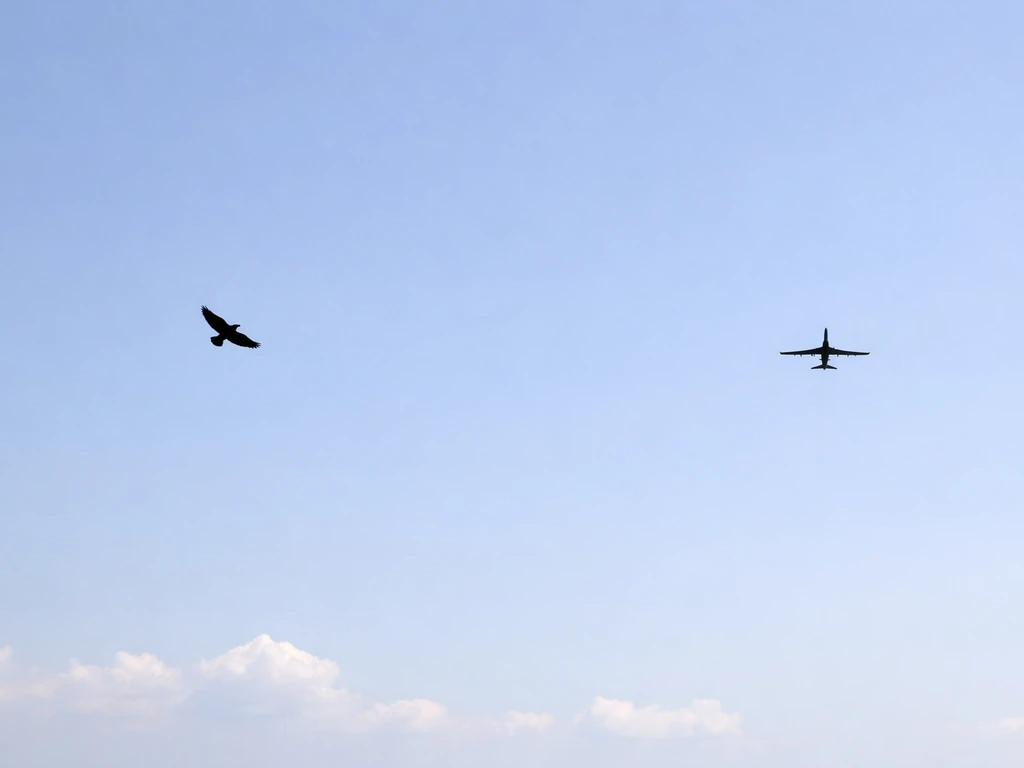
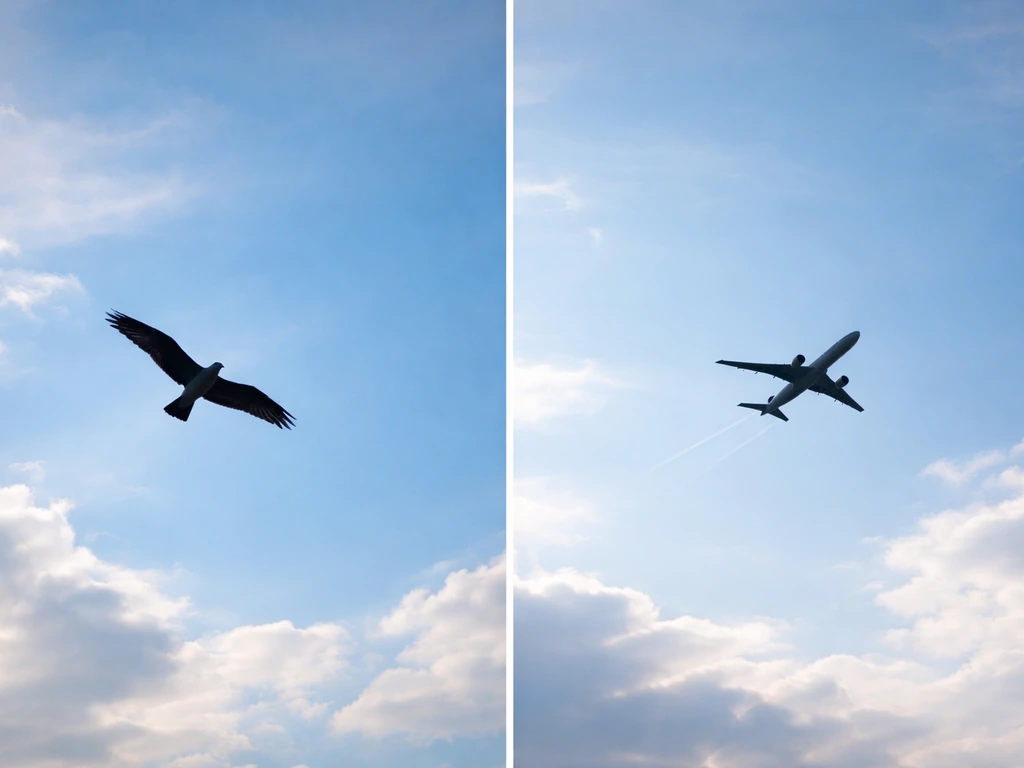
The classic "is it a bird, is it a plane?" moment happens in a split second, and your brain is already processing the right cues, you just need to know what to pay attention to. The two most immediate questions to ask yourself are: Is it moving its wings, and is the overall shape organic or rigid?
A plane holds its wings completely still during cruise, has a fixed, symmetrical silhouette, and moves in a perfectly straight line at constant speed. A bird's wings flex, fold slightly, and beat with a rhythm that changes based on conditions. Even large soaring birds like hawks will make subtle adjustments with their wingtips that no aircraft can replicate. The tail tells you a lot too: a bird's tail fans out, folds, or tilts actively, while a plane's tail is locked in position.
Size and context matter right away. A tiny flickering silhouette at dusk over a pond is almost never a plane. A blinking light moving in a straight line at high altitude is almost never a bird. U.S. aviation regulations define position light characteristics, including flashing red and white patterns with defined flash-frequency ranges A blinking light moving in a straight line at high altitude. Start with those extremes and work inward. For everything in the middle, the sections below give you the tools to sort it out quickly.
Bird basics: the traits that make something a bird
Birds belong to the class Aves, and they share a set of defining biological features that no other living animal group has all at once. In plain language, a bird is a warm-blooded (endothermic, meaning it maintains its own body temperature through metabolism), feathered, egg-laying vertebrate with a toothless beak. Britannica describes birds (class Aves) as having defining traits including feathers, a toothless beak, warm-blooded physiology, and a four-chambered heart Britannica describes birds as having traits including feathers, a toothless beak, warm-blooded physiology, and a four-chambered heart. That combination is the checklist that separates birds from everything else.
- Feathers: the single most reliable marker. No other living animal has feathers. Even if a bird's colors aren't visible from a distance, feathered wings have a soft, layered texture and a characteristic flutter that bare membrane wings don't.
- Toothless beak: birds have a horny beak rather than teeth. This is consistent across all roughly 10,000 living bird species.
- Warm-blooded: birds regulate their own body temperature, which is why they can be active in cold conditions that ground cold-blooded animals.
- Hard-shelled eggs: all birds lay eggs, though you obviously won't observe this mid-flight.
- Lightweight skeleton: birds have hollow bones that reduce body weight for flight, giving their bodies a proportional look that's noticeably different from a heavy-bodied mammal of the same wingspan.
- Four-chambered heart: shared with mammals but not with most reptiles, supporting the high-energy demands of flight.
From a distance, feathers and beak are the two you can actually use for identification. If you see something flying with clearly feathered wings, it's a bird. Full stop. Penguins are birds because they have feathers and lay eggs, even though they can't fly. Ostriches are birds for exactly the same reason. The flight capability is not the defining trait, the biology is.
Lookalikes in the sky: bats and other non-birds often mistaken for birds
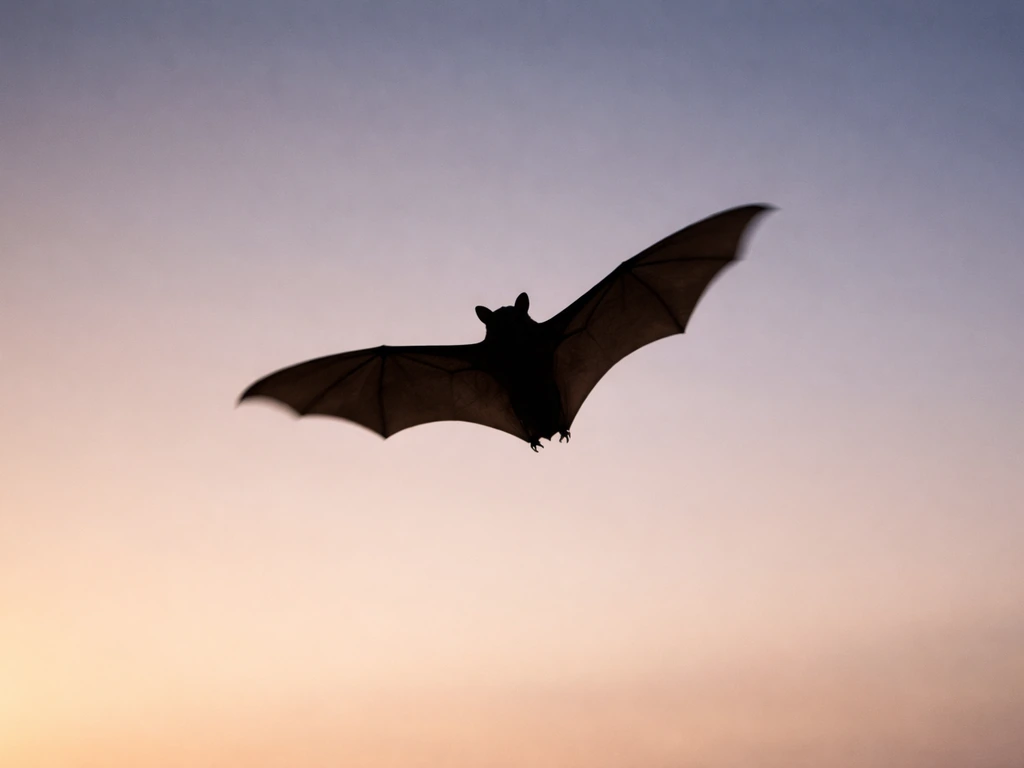
The most common real-world source of "is it a bird?" confusion isn't a plane at all. It's a bat. Bats are mammals, not birds, and the anatomical difference is fundamental: a bat's wing is a thin membrane (called a patagium) stretched across dramatically elongated finger bones. A bird's wing is more like an elongated arm with a single main digit at the tip, covered in feathers. When you see a bat in flight, its wings look almost transparent at the edges and flex in a loose, floppy way that feathered wings never do.
The confusion is most common at dusk, when both bats and birds are often active simultaneously. At low light, both can appear as dark flickering silhouettes against the sky. The key visual difference is the flight pattern: bats tend to have an erratic, highly variable zigzag motion as they chase insects, while most birds maintain a more consistent heading with a recognizable wingbeat cadence. If something is darting unpredictably back and forth over a field at sunset, bat is the smarter first guess than bird.
One bird that genuinely earns the confusion is the chimney swift. Swifts have a short neck, a cylindrical "flying cigar" body, very narrow half-crescent wings, and a barely visible tail, and they forage at dusk with fast, erratic-looking flight. Chimney swifts and bats even use the same chimneys. The swift's silhouette is distinctive once you know it, but for a beginner, it can absolutely look non-bird-like at first glance. Other aerial insectivores like swallows, martins, nightjars, and flycatchers all forage in flight and can create similar confusion, but all of them are birds.
The other common aerial lookalike worth knowing: large insects. A big moth or dragonfly at close range can momentarily read as a small bird, especially in peripheral vision. They're much smaller than even the tiniest birds in most regions, and their wing motion is mechanically different, but if you're just getting started with outdoor observation, it's worth filing that possibility away.
Borderline cases and misconceptions (pterosaurs, flightless birds, and ancient confusions)
Pterosaurs come up constantly in conversations about "what is a bird," and the answer is simple and firm: pterosaurs were flying reptiles, not birds, not dinosaurs in the strict clade sense, and not ancestors of birds. They existed on a completely separate branch of the evolutionary tree. Birds are actually theropod dinosaurs, meaning they descended from a specific group of bipedal dinosaurs, not from pterosaurs. Pterosaurs went extinct approximately 66 million years ago along with the non-avian dinosaurs, so if someone claims to have seen a living pterosaur, they are almost certainly looking at a large bird, a bat, or a misidentified flying object. There are no living pterosaurs.
The confusion between pterosaurs and large birds is partly driven by the fact that some pterosaurs had very large wingspans (Quetzalcoatlus had an estimated wingspan of around 10 to 11 meters) and partly by the way wing shapes overlap visually when you're looking at a distant silhouette. In practice, if you see something large soaring overhead and you wonder if it might be a pterosaur, the honest answer is: it's a bird. A vulture, an eagle, a large heron, or a pelican are all common sources of "that looked prehistoric" reactions from people who haven't seen them before.
Flightless birds (penguins, ostriches, emus, kiwis) are another genuine misconception category. People sometimes assume that if something can't fly, it can't be a bird. That's wrong. Flight is a behavior, not a defining biological trait of birds. All of those animals have feathers, lay hard-shelled eggs, and have beaks, which puts them squarely in class Aves. You obviously won't see a penguin in the sky, but it's worth understanding the rule so you don't accidentally exclude real birds from consideration based on flight capability alone.
Behavior and flight patterns: how birds differ from planes
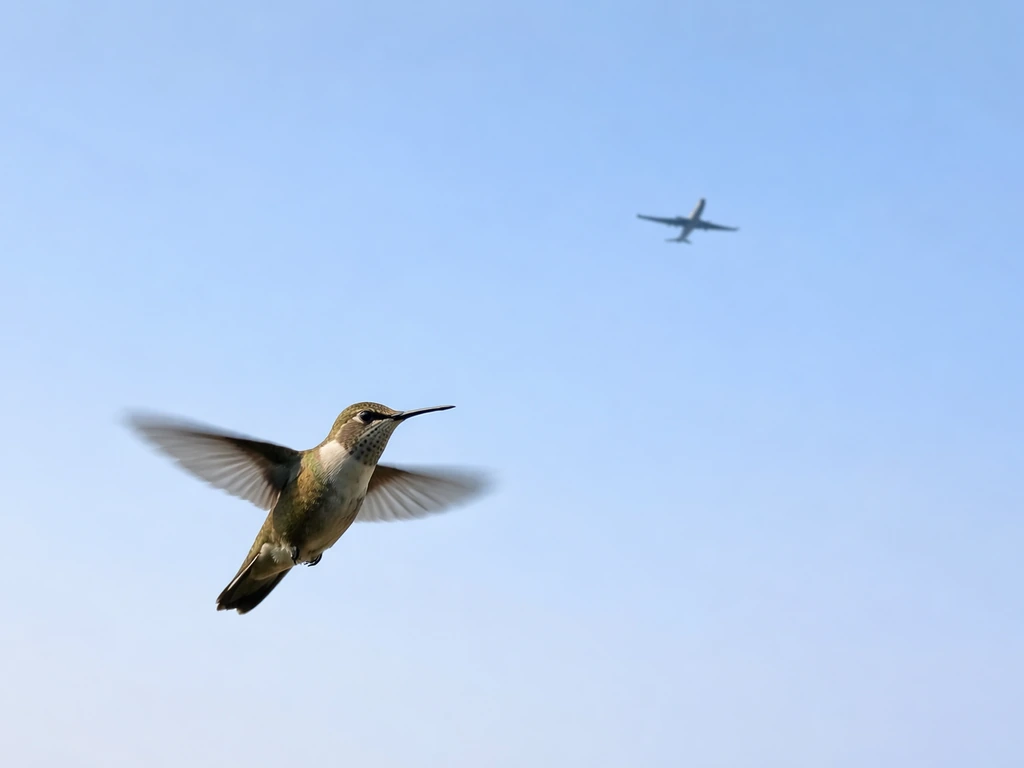
Birds and planes are both heavier-than-air flying objects, but their flight behavior is completely different once you know what to watch for. A plane produces continuous thrust from engines, holds its wings rigid, and follows a predictable, usually straight or gently curving flightpath. A bird generates lift and thrust through active wingbeats, adjusts its speed and direction constantly, and can perform maneuvers no fixed-wing aircraft can do without powered controls.
Wingbeat cadence is one of the most useful behavioral cues. Different bird species have recognizable rhythms: a great blue heron beats its wings slowly and deeply, a crow flaps with a steady mechanical regularity, and a hummingbird moves its wings so fast they blur. Once you start paying attention to cadence, silhouette, and overall proportions together, you can often narrow a bird to a family or genus even at a distance. Audubon's field guides emphasize this: look at the overall shape first, then watch the wingbeat rhythm before zooming in on finer details.
Birds also change their flight effort based on conditions. In thermals (columns of rising warm air), many large birds like hawks, vultures, and eagles will soar in wide circles with barely a wingbeat, using the rising air to gain altitude for free. No plane does this unpowered. In headwinds, birds lean into the wind, slow down, and often make visible postural adjustments. Formation flying (the classic V-shape seen in geese and pelicans) is another behavior unique to birds: it's an energy-efficiency strategy where each bird in the formation takes advantage of the air disturbed by the bird ahead. A formation of commercial aircraft maintaining spacing on approach to an airport looks nothing like a goose V.
The phrase "is it a bird, is it a plane?" actually has its roots in Superman lore. The origin of "is it a bird, is it a plane" dates to the 1940s radio serial, where bystanders would shout the line as Superman streaked across the sky. The joke worked precisely because something moving that fast and that high was ambiguous, and the line captures exactly the real identification challenge: at a distance, context and movement are everything.
Quick verification checklist and what to do next
Here's a fast decision framework you can run through in real time when you see something in the sky and aren't sure what it is:
- Are the wings moving? If yes, you're not looking at a plane (planes in cruise don't flap). If no, it could be a gliding bird, a soaring bat, or an aircraft.
- What's the wing shape? Feathered wings have a soft, layered edge. Membrane wings (bats) look thinner and more translucent. Rigid metal or composite wings (aircraft) have hard, sharp edges.
- What's the wingbeat pattern? Regular and rhythmic = likely a bird. Erratic and variable = possibly a bat. Absent entirely at cruise = almost certainly a plane.
- What's the body proportions? Birds have a head, neck, and tail you can distinguish. Bats have a compact body with most of the mass in the wings. Planes have a fuselage that's obviously longer than the wingspan in most cases.
- What time is it and where are you? Daytime over a forest or field, probably a bird. Dusk over water, could be a bat or a swift. High altitude with a blinking light at night, almost certainly an aircraft.
- Can you hear anything? Birds often vocalize in flight. Aircraft make engine noise. Bats are largely silent to human ears (their echolocation is ultrasonic).
If you're still not sure after running through that list, take a photo or short video even if the quality is poor. A blurry image that shows wing shape or flight posture can still be enough to confirm an ID. Once you have something recorded, the fastest next step is a bird ID app. Merlin Bird ID from the Cornell Lab of Ornithology is free, works for all skill levels, and lets you filter by your location and the time of year, so it's pulling from species that are actually likely where you are right now. It also has a photo ID feature that can match your image against known species.
For a deeper dive into what you saw, how a bird is different from a plane in biological and behavioral terms is worth reading if you want to understand the underlying rules, not just apply them. If you want to document your sighting formally (which is useful if you think you spotted something unusual), eBird lets you log checklists with description and media. Even a rough narrative description of what you saw, the size, the wingbeat pattern, the location and time, is genuinely useful for verification and can help others confirm or clarify the record.
One thing worth keeping in mind: a lot of the "is it a bird" confusion comes from seeing something familiar in an unfamiliar context, or from not yet having a mental template for what certain common species look like in flight. A turkey vulture soaring overhead looks prehistoric and enormous if you've never seen one. A common nighthawk hunting at dusk looks almost bat-like. The "is it a bird" question has been asked in pop culture as a joke, but as a genuine identification challenge it's completely reasonable, and the tools above are exactly what experienced birders use too, just faster and more automatically after practice.
A quick comparison: bird vs bat vs plane
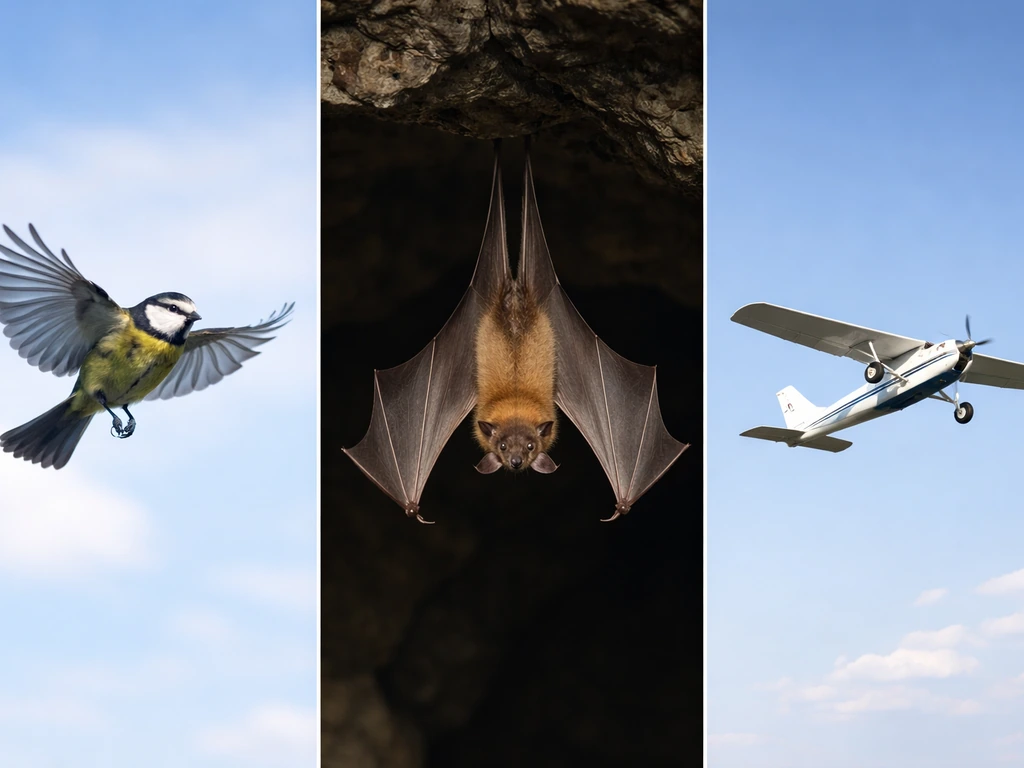
| Feature | Bird | Bat | Plane |
|---|---|---|---|
| Wing material | Feathers on a modified arm/hand | Thin membrane across elongated fingers | Rigid metal or composite |
| Wingbeat | Regular, rhythmic cadence (species-specific) | Erratic, highly variable | None (fixed wings in cruise) |
| Body plan | Distinct head, neck, torso, tail | Compact body, wings dominate silhouette | Fuselage clearly longer than wingspan in most types |
| Active at night? | Some species (owls, nightjars) | Yes, most species | Yes, with navigation lights |
| Sound | Often vocalizes | Silent to human ears | Engine noise audible |
| Flight path | Adjusts constantly, can soar or glide | Erratic when hunting insects | Straight or gently curving, constant speed |
The pop culture version of this question, the "is it a bird, is it a plane, it's Superman" exclamation, is fun, but the underlying identification puzzle it captures is real and happens every day to outdoor observers everywhere. The biology side of the answer (feathers, beak, warm-blooded, eggs) is clear and well-established. The practical side (wingbeat cadence, wing shape, context and timing) takes a little practice but comes quickly once you know what you're looking for.
The next time you catch yourself squinting at something overhead and thinking "wait, what is that?", run through the checklist above before it disappears. Feathers or membrane? Rhythmic or erratic? Head and tail visible? Those three questions will get you to the right answer most of the time, fast enough to actually matter while the thing is still in view. And if you want to go further, the Superman saying "is it a bird" framing is a reminder that even fictional superhero mythology has always treated this as a genuinely hard visual problem, which means you're in good company when you're not immediately sure.
If you come across a reference to "is it a bird is it a plane scooter" in online discussions, that's a separate cultural reference, but the "is it a bird, is it a plane" scooter connection circles back to the same core idea: something moving fast overhead that's hard to immediately classify. The biological answer, though, hasn't changed. If it has feathers and a beak, it's a bird. Everything else needs a second look.
FAQ
What if the wings look still, can it still be a bird?
Not necessarily. Many birds can glide with wings held mostly still between wingbeats, especially in thermals, so “mostly still” should be a prompt to check tail position and wing posture changes rather than a quick rejection. If you see any cyclic movement, slight tip adjustments, or tail fanning or tilting, treat it as a bird candidate.
How can I tell a bird from a drone or helicopter?
Yes. If the object follows a constant straight line, holds a fixed silhouette, and moves at a speed and brightness that does not fluctuate with wing motion, it is more likely a small plane, helicopter, or drone. Birds can fly fast, but their motion usually includes heading corrections and wingbeat cadence changes, which are hard for aircraft to mimic without visible control surface movement.
Do blinking lights always mean it’s a plane?
Look for engine-like artifacts and rigid geometry. Drones often show a stable orientation (no natural wingbeat) and can hold altitude or make tight, abrupt turns while keeping the same “rigid” body shape. If you can see blinking LEDs that keep a consistent pattern relative to the object, that is a strong non-bird clue.
What should I look for at dusk when bats and birds both seem possible?
Bats and birds are hardest to separate when the silhouette is small. Use flight variability: bats usually change direction more abruptly and often display a zigzag or fluttery chase pattern. Also, bats typically appear darker and more “edge-thin,” with wings that look like a continuous membrane rather than a feathered outline.
Could a bird be mistaken for a large moth or dragonfly?
Yes, certain birds can briefly resemble insects or even “darts” in peripheral vision. If the motion is extremely tight, rapid, and close to the ground, a large insect is plausible, but birds will often transition into a more stable glide or show identifiable wing-shape beats when you track them for 5 to 10 seconds.
If the lighting is too poor to see feathers, how do I decide between a bird and a bat?
If you cannot see feathers or a beak, rely on the “wing-to-body” structure. Bird wings look like an arm with a feathered outline that creates a distinct top and underside, and the body often tilts with wing effort. A bat wing typically reads as a stretched membrane with a softer, less defined edge, and the flight often looks more like a pumping, flapping sheet than an articulated wing.
Is it worth getting closer to identify what I’m seeing?
Assume it is not safe to “confirm” by approaching. Instead, document from a distance: note approximate size relative to known objects, wind direction if you can, the number of wingbeats before a change in heading, and whether the tail stays fixed or actively moves. A short zoomed video is often more reliable than a still photo for motion cues.
Can I identify the exact bird in a few seconds, or should I just label it “bird”?
Species identification is different from “bird vs plane.” For bird v. plane, the quick cues are tail and wing behavior. For species, you need consistent features: wingbeat cadence plus overall silhouette (neck length, wing shape, tail shape) plus context (habitat, time of day). If you only have 10 seconds, aim for a bird family-level guess or “likely bird,” not a precise species.
How do I handle situations where it’s too far to see the tail?
When the object is far, use cadence and proportion, not just speed. A plane’s motion tends to be smoother and more uniform in speed, and its silhouette stays fixed. Many birds vary effort, slow in thermals, and change wingbeat depth, so watch for those “effort changes” and any circling behavior.
What if I see a V-shape in the sky, is that always birds?
Yes, but with a caveat. Some birds fly in formation, yet aircraft also form up, so the deciding factor is flexibility. Birds will tilt, adjust spacing dynamically to air disturbance, and show consistent wingbeat or soaring posture. Aircraft formation is typically governed by steady control and rigid geometry, with little to no “wing effort” visible in the same way birds show it.