No, a griffin is not a real bird. It is not a real animal at all. A griffin is a mythological creature, a composite beast from ancient and medieval legend, and it has no standing in biological taxonomy. There is no species, no fossil record, no verified specimen. If you searched 'is a griffin a bird' hoping to settle a debate or fact-check something, the short answer is: griffin is mythology, not biology.
Is a Griffin a Bird? What Real Taxonomy Says

Sarah Chen
19 Apr 2026
What a Griffin Actually Is
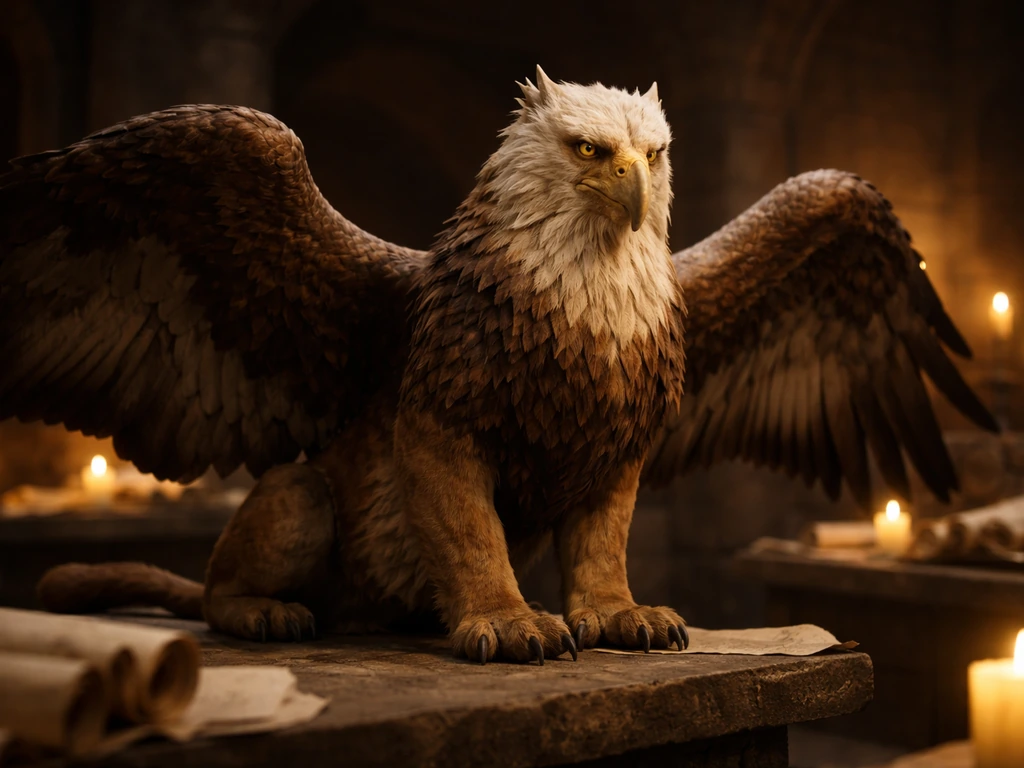
The griffin comes from ancient mythology and was carried forward through medieval European culture. The standard description is a composite creature: the body of a lion combined with the head, wings, and claws of an eagle. Britannica describes it as a mythological creature of uncertain origin, with its 'precise nature or place in cult and legend' remaining unclear even to scholars. The Cleveland Museum of Art sums up the typical artistic depiction as 'the body of a lion and the head, wings, and claws of an eagle.' That is the griffin in a nutshell: half big cat, half raptor, entirely imaginary.
Griffins appear in ancient Near Eastern art, Greek mythology, and medieval bestiaries. The 7th-century scholar Isidore of Seville described the griffin in his bestiary as a feathered, four-footed creature with an eagle's head and wings on a lion's body. But a bestiary description is a cultural document, not a biological one. Medieval bestiaries mixed real animals with legendary ones freely, so appearing in one does not make a creature real any more than a dragon appearing in a story makes dragons real.
One popular idea suggests that griffin myths were inspired by fossils of Protoceratops, a horned dinosaur whose remains are found in Central Asia. It is an interesting hypothesis, but a 2024 research paper directly challenged it, stating there is 'no hard evidence' supporting any connection between Protoceratops fossils and the origin of griffin legends. So even that potential link to something real does not hold up under scrutiny.
Is a Griffin a Real Bird? The Clear Answer

A griffin is not a real bird because it is not a real organism of any kind. No taxonomy authority, no zoological database, and no scientific institution recognizes 'griffin' as a valid biological taxon. The International Code of Zoological Nomenclature (ICZN), which governs how animals are formally named and classified in science, has no entry for griffin as an accepted species or genus. The ICZN FAQ explains that the Code governs how animal taxa are formally named and provides a universal framework for scientific names The International Code of Zoological Nomenclature (ICZN), which governs how animals are formally named and classified in science. The word does appear in science, but only as a cultural reference: for example, the dinosaur Hagryphus gets its name from an Egyptian god and the word 'griffin,' but that is a naming homage, not evidence that griffins are real animals.
To be classified as a bird in biology, an organism needs to exist first. Griffin exists in art, literature, heraldry, and folklore. It does not exist in the fossil record, in any verified specimen, or in any living population. That alone disqualifies it from any biological classification, bird or otherwise.
What 'Bird' Actually Means in Taxonomy
In biology, a bird is a living or fossil organism classified in the class Aves. That classification is not based on looks or wings alone. Birds share a specific set of derived traits that evolved along a particular evolutionary lineage. Understanding those traits is what lets you evaluate whether any animal, real or claimed, qualifies as a bird.
The key diagnostic traits of Aves include feathers (a defining feature found in no other living animal group), toothless beaked jaws, hard-shelled eggs, a strong but lightweight skeleton with hollow bones, a four-chambered heart, high metabolic rate, and a unique respiratory system that uses air sacs for flow-through breathing. Modern birds typically have 9 to 11 air sacs connected to their lungs, which allows a continuous one-directional airflow rather than the in-and-out breathing of mammals. That respiratory system is one of the most distinctive things about birds physiologically.
Equally important is lineage. Birds are theropod dinosaurs, a fact now firmly established by fossil and phylogenetic evidence. They did not just happen to look like dinosaurs: they are dinosaurs, descended from feathered theropod ancestors. Features like feathers, wishbones, hollow bones, and likely air sacs were already evolving in theropod lineages before birds as we recognize them even appeared. So bird classification depends on both physical traits and evolutionary ancestry, not just on having wings or looking vaguely avian.
Applying Bird Criteria to the Griffin
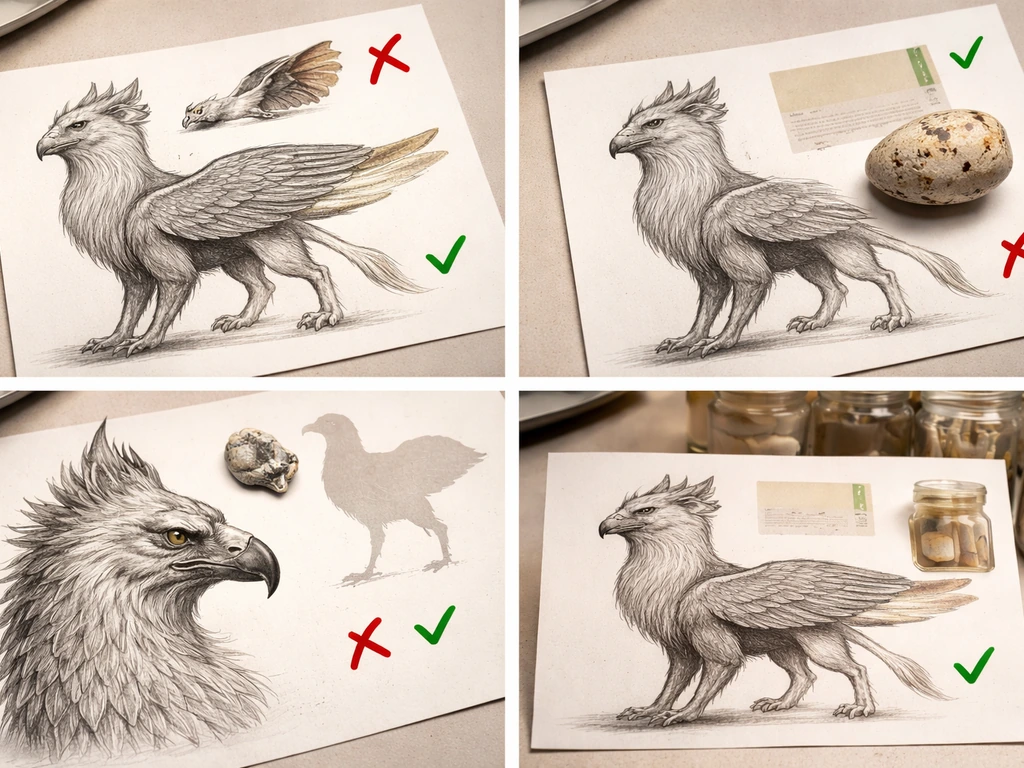
Let's actually run the griffin through the checklist, because it is a useful exercise for understanding what the criteria mean in practice. If you are wondering about a different “not-a-bird” riddle, Oyasumi Punpun is often discussed under the same idea of what counts as real versus symbolic.
| Bird Criterion | What Real Birds Have | Does the Griffin Qualify? |
|---|---|---|
| Physical existence | Verified specimens, fossils, or living individuals | No. No specimen, fossil, or verified sighting exists. |
| Feathers | True feathers, a derived trait from theropod evolution | Described with feathers in myth, but no evidence of actual feathers in a real organism. |
| Correct lineage | Descended from theropod dinosaurs (class Aves) | No lineage. Not a real organism with an evolutionary history. |
| Avian skeleton | Lightweight hollow bones, wishbone (furcula) | No skeletal evidence. Entirely imaginary anatomy. |
| Avian respiratory system | Air sacs enabling flow-through breathing | No physiological evidence of any kind. |
| Valid taxonomy | Accepted species/genus under ICZN | Not recognized as a taxon by any scientific authority. |
The griffin fails every single criterion, and it fails the most fundamental one first: physical existence. So if you are asking, “Is guff a bird?”, the answer depends on whether there is any real organism behind the claim. If you are asking, “Is guff from fortnite a bird,” the same logic applies as with griffins: the claim needs real, verifiable biological evidence before it can be treated as a bird classification. A creature has to be real before its traits can be evaluated. Even if you took the medieval bestiary description at face value and assumed the griffin had feathers and wings, you still could not classify it as a bird because there is no actual organism to examine, no DNA, no fossils, no anatomy. Myth descriptions cannot substitute for biological evidence.
Griffins vs. Real Animals People Commonly Mix Up
The griffin question fits into a broader pattern of confusion between mythological creatures and real animals, especially real animals that seem too strange to be true. Knowing how scientists verify whether something is real is what separates myth from biology.
The Dodo: Once Called Mythical, Now Confirmed Real
The dodo is one of the clearest examples of how a real animal can be dismissed as mythological and then confirmed through evidence. Early skeptics doubted the dodo existed at all. What changed was physical evidence: bones discovered in an ancient marsh in Mauritius in 1865 enabled scientific reconstruction, and combined with historical accounts and specimens, the dodo became unambiguously confirmed as a real extinct bird. The griffin has none of that. No bones, no specimens, no historical naturalist account describing a live or dead one with measurable anatomy. The contrast could not be sharper.
Pterosaurs: Real, Flying, and Not Birds
Pterosaurs are another common source of confusion. They had wings, some were enormous, and they flew alongside dinosaurs. But pterosaurs were not birds. They lacked the feathers and the specific theropod lineage that define Aves. They are a separate reptile group entirely. This is relevant to the griffin question because the griffin's eagle-wing component might make people instinctively think 'bird,' but having wings is not enough. A griffin, if it existed, would still need to meet the lineage and anatomical criteria to qualify as Aves, and an eagle-lion hybrid would not automatically pass that bar.
Borderline Real Birds: Penguins and Ostriches
Penguins and ostriches confuse people for different reasons: penguins cannot fly and spend most of their lives in water, while ostriches are enormous and flightless. But both are genuine birds because they have feathers, lay hard-shelled eggs, have the correct skeletal anatomy including hollow bones and a wishbone, and sit firmly within the theropod evolutionary lineage. These animals show that 'bird' is not synonymous with 'flying creature with a beak.' It is a specific biological classification. A griffin, by contrast, is not even in the game.
Other Mythological Comparisons
Similar questions pop up with fictional or pop-culture creatures, like whether Gigan (the kaiju from Toho films) could be classified as a bird, or whether a gull is a bird (yes, straightforwardly). The same logic would apply to Gigan too: if no real, verifiable organism exists, it cannot be classified as a bird. The logic for evaluating all of them is the same: does a real, verifiable organism exist, and does it share the traits and lineage of class Aves? For mythological composites like the griffin, the answer collapses at step one.
How to Verify Claims Like This Yourself
If you come across a similar claim, whether it involves a creature from mythology, a game, or a legend, the fastest way to evaluate it is to ask three questions in order: Does a verified physical specimen or fossil exist? Does it have the key diagnostic traits of the group it is being claimed for (in this case, feathers, avian skeleton, correct lineage for birds)? Is it recognized as a valid taxon by scientific authorities under established nomenclature rules? For the griffin, the answer to all three is no. That is how you know, with confidence, that a griffin is not a bird. That same three-question check is why people ask whether a griffin is a bird.
Mythology is fascinating and worth studying on its own terms. But when it comes to biological classification, the evidence bar is high for good reason. Real animals leave traces: bones, DNA, eggs, impressions in rock. Griffins have left only images and stories. In taxonomy, that counts for nothing, and that is not a dismissal of mythology. It is just how science works.
FAQ
Are griffins ever mentioned in scientific databases or museum catalogs as real species?
No. In biology, organisms must have an identified, examinable biological entity (specimen, fossils, or living material) before they appear in taxonomic or museum holdings as a species. “Griffin” may show up in archives as a cultural motif or in discussions of fantasy art, not as a validated organism.
Could a “griffin-like” animal exist someday and still be considered a bird?
Only if it meets the bird criteria used in classification. That means evidence of feathers, bird-like skeletal and respiratory traits, and placement within the theropod lineage that includes Aves. A lion-body, eagle-head hybrid from a hypothetical population would still need real anatomy and phylogenetic evidence, not just a mix of features.
What about griffins shown in medieval art, do they count as evidence of a real animal?
Artwork is evidence of cultural beliefs, symbolism, and storytelling, not of biology. Even if artists copied something they had seen, you still need physical evidence (bones, eggs, DNA, or trackways) to establish a real species. Without that, classification cannot proceed.
Is there any fossil creature that might have inspired the “lion and eagle” look of griffins?
Possibilities exist as hypotheses, but hypotheses are not the same as proof. For the specific idea involving Protoceratops, the research summarized in the article notes there is no hard evidence tying that dinosaur to griffin origins. At best, inspiration theories explain resemblance, not taxonomic reality.
If griffins had feathers in a story, would that automatically make them birds?
No. In taxonomy, feathers alone do not qualify an organism as a bird, because many non-bird animals can have feather-like structures and because Aves is defined by a particular evolutionary lineage. To call something a bird, you also need the core diagnostic traits and phylogenetic placement, plus real, verifiable biological material.
How can I tell whether a “mythological creature” claim is actually about biology or just culture?
Check whether the claim names a real specimen, fossil, or genetic evidence, and whether it is supported by recognized taxonomic naming (ICZN for animals). If the discussion stays at descriptions, folklore, or composite visuals without physical evidence, it is culture, not biology.
Why do people confuse griffins with real birds more than they confuse dragons with real animals?
Often because griffins combine a familiar raptor element (wings, claws) with another recognizable animal (lion). The confusion is about appearance, but bird classification depends on feathers plus avian internal traits and ancestry. Dragons and griffins are both myths, but griffins more closely mimic avian-looking features in art.
Could “griffin” be used in science as a name for something real, without meaning the creature itself exists?
Yes. “Griffin” can appear in names as a homage or reference, similar to how some dinosaur names draw from mythology or deities. In those cases, the term is about naming inspiration, not an assertion that a griffin organism is real.
Next Article
Is Squirrel Animal or Bird? Clear Answer and Classification
Squirrels are mammals, not birds, class Mammalia, order Rodentia. Quick traits, comparison table, checklist & FAQ.