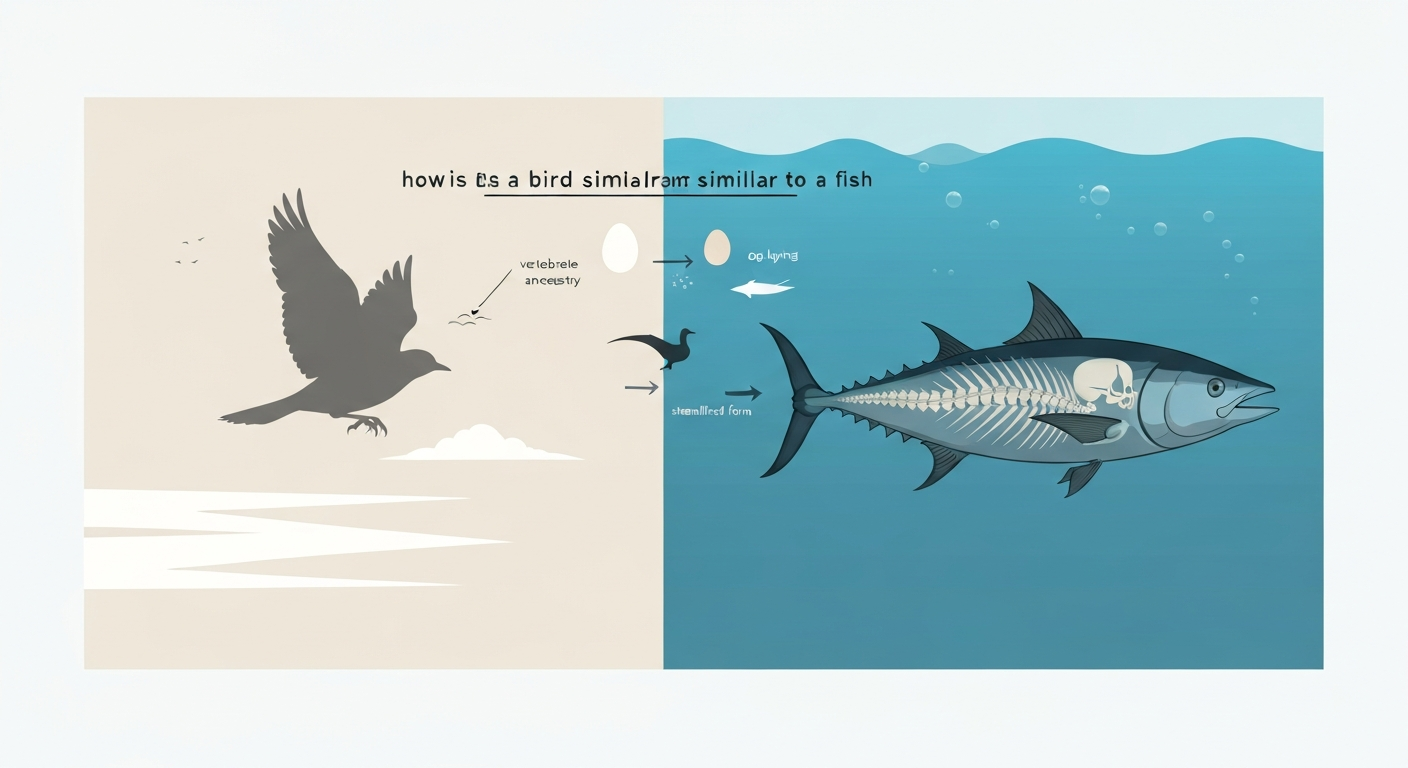
Birds and fish are both vertebrates, meaning they share a fundamental body plan: a backbone, a skull, segmented muscles, and embryonic gill arches. They also both reproduce by laying eggs in the vast majority of species, and many have streamlined body shapes that help them move efficiently through a fluid medium, whether that's water or air. Those are real, biology-backed similarities, not superficial ones. But beyond that shared vertebrate ancestry, the two groups diverge sharply, with different breathing systems, different skin coverings, and very different internal temperatures.
How Is a Bird Similar to a Fish? Key Traits and Differences

Sarah Chen
29 Jul 2026
Both are vertebrates, and that matters more than it sounds
The single most important similarity between birds and fish is that both belong to the phylum Chordata and, more specifically, are vertebrates. That puts them in the same large branch of the animal tree of life, separated from invertebrates like insects, worms, and mollusks. Being a vertebrate means sharing a core set of features: a notochord during embryonic development, a dorsal hollow nerve cord running along the back, pharyngeal (throat) arches early in development, segmented trunk muscles, and an adult vertebral column.
Birds sit in Class Aves, a single, well-defined group that contains all living bird species. blank" rel="noopener noreferrer">NCBI Taxonomy Browser maintains curated entries for Aves and major fish clades (e.g., Actinopterygii) and is a standard sequence‑database taxonomy reference used in phylogenomic work. "Fish," by contrast, is not one unified biological group. FishBase, Classification explanation notes that “fish” is a paraphyletic assemblage spanning major clades (Actinopterygii, Sarcopterygii, Chondrichthyes) and provides the working classification FishBase — Classification explanation. It's a convenient shorthand for a paraphyletic assemblage spanning ray-finned fishes (Actinopterygii, which includes most familiar species like tuna and salmon), cartilaginous fishes (Chondrichthyes, including sharks and rays), and lobe-finned fishes (Sarcopterygii). That last group is actually the evolutionary source of all tetrapods, including birds. In other words, if you trace bird ancestry back far enough, you land on a lobe-finned fish-like ancestor. Transitional fossils like Tiktaalik, dating to around 375 million years ago, show the morphological bridge between sarcopterygian fishes and the first land-walking vertebrates.
So when you ask how a bird is similar to a fish, you're partly asking about deep evolutionary heritage. The similarities are real because both lineages ultimately came from the same ancient vertebrate stock.
Traits birds and fish actually share
Egg-laying
All living bird species are oviparous, meaning they reproduce by laying eggs. This is universal across Class Aves with no exceptions. Most fish species are also oviparous, though fish show more reproductive variety overall: some are ovoviviparous (eggs hatch internally), and others give live birth. For a quick analogy, consider the phrase "bird is to egg as" when comparing reproductive modes across vertebrates to highlight how egg-laying characterizes birds relative to many other groups. Still, egg-laying is the dominant mode in both groups, and the shared trait is genuine, even if birds are far more consistent about it.
Streamlined body forms
Both groups frequently evolve streamlined, tapered body shapes that reduce drag in a fluid medium. In fish, a fusiform (torpedo-shaped) body reduces water resistance. In birds, especially fast fliers and diving species, the body is similarly compressed and tapered. This is partly shared ancestry and partly convergent evolution at work, and the functional logic is the same: moving through a fluid (water or air) rewards shapes that minimize resistance.
Adaptations for moving through a fluid medium
Both birds and fish are, in biomechanical terms, built to generate thrust and lift within a fluid. Fish use body undulations and fin movements to generate propulsive forces through water. Birds use their wings to generate lift and thrust through air. The physics are governed by different fluid densities (water is about 800 times denser than air), but the underlying engineering challenges, drag reduction, thrust generation, and maneuvering, are analogous. That's why comparing bird flight mechanics to fish swimming mechanics is a legitimate scientific exercise, not just a poetic one.
Where birds and fish part ways
Despite the shared vertebrate foundation, birds and fish differ in several fundamental ways that define each group.
| Feature | Birds (Class Aves) | Fish (multiple classes) |
|---|---|---|
| Gas exchange | Lungs with air sacs; unidirectional airflow through parabronchi | Gills with filaments and lamellae; counter-current water-blood exchange |
| Skin covering | Feathers made of beta-keratin | Scales (placoid, cycloid, ctenoid, etc.) with different tissue origin |
| Thermoregulation | Endothermic (warm-blooded); maintain high, stable body temperature | Mostly ectothermic (cold-blooded); body temperature tracks environment |
| Locomotion | Wings for flight or swimming; hindlimbs for walking/running | Fins and body undulation for swimming; no functional limbs |
| Egg structure | Hard or leathery shelled eggs, incubated on land or in nests | Mostly small, unshelled or soft eggs deposited in water |
| Habitat | Primarily terrestrial and aerial; some aquatic | Primarily aquatic (fresh or salt water) |
| Reproduction mode | All species oviparous | Oviparous, ovoviviparous, or viviparous depending on species |
Lungs vs. gills
This is the most functionally significant difference. Fish breathe through gills, which are highly efficient branchial organs that extract dissolved oxygen from water using a counter-current exchange system, where water and blood flow in opposite directions across the gill filaments to maximize oxygen uptake. Birds breathe air through a rigid lung system supported by a network of air sacs that produce an almost unidirectional flow of air across the gas-exchange surfaces (parabronchi). This avian system is remarkably efficient for an air-breathing animal, but it cannot extract oxygen from water. The two systems are not interchangeable.
Feathers vs. scales
Feathers are defining features of birds and are found in no other living animal group. They are made primarily of corneous beta-keratins and develop from follicles in the skin. Fish scales are dermal structures with completely different histology and origin. There are multiple scale types across fish clades (placoid, cycloid, ctenoid, ganoid), but none are feathers or evolutionarily related to feathers in a direct, structural sense. Research does show that feather and scale development share some ancient regulatory genetic toolkit, but the end structures are distinct.
Thermoregulation
Birds are endothermic: they generate internal metabolic heat and maintain a consistently high body temperature regardless of the environment. Most fish are ectothermic, meaning their body temperature closely tracks the surrounding water temperature. There are fascinating exceptions: tunas and lamnid sharks (like the mako and great white) have evolved regional endothermy, where vascular counter-current heat exchangers (retia mirabilia) warm specific tissues like swimming muscles and eyes. The opah (Lampris guttatus) even shows a degree of whole-body heat conservation. These are remarkable convergences, but they don't change the general rule that fish thermoregulation and bird thermoregulation operate on fundamentally different principles.
Convergent evolution: when birds start to look like fish
Some birds have evolved body plans and behaviors that superficially resemble fish far more than a robin or a parrot does. This is convergent evolution at work: two unrelated lineages independently arriving at similar solutions to similar problems.
Penguins are the clearest example. Over millions of years, penguin wings evolved into stiff, narrow flippers optimized for underwater propulsion rather than flight. Their bones became denser than those of most birds (reducing buoyancy), their body became hydrodynamically streamlined, and their swimming kinematics produce thrust in a way that genuinely parallels the locomotion of fast-swimming fish. Research measuring penguin kinematics and hydrodynamics shows their underwater performance is comparable to many marine vertebrates. From a purely functional standpoint, a swimming penguin and a tuna are solving the same engineering problem.
Wing-propelled diving birds more broadly, including alcids like puffins and murres, show similar trends: compact, dense bodies, reduced wing area relative to body size, and wings that serve double duty for flight in air and propulsion underwater. Kingfishers and gannets take a different approach, diving from the air and using momentum rather than active underwater flapping, but their streamlined bodies and pointed bills are shaped by the same physics of water entry.
Albatrosses present another kind of parallel. Their narrow, high-aspect-ratio wings are optimized for dynamic soaring over the ocean, minimizing energy expenditure over enormous distances. Long-distance pelagic fish like tuna have similarly streamlined bodies and narrow, stiff tail fins (lunate caudal fins) optimized for efficient, sustained thrust. The fluid-dynamic logic connects them, even though one moves through air and the other through water.
When bird-fish analogies work, and when they mislead
Analogical comparisons between birds and fish show up in everyday language and in learning contexts. Think of it like a language analogy: flock is to bird as army is to soldier. Some of those analogies are genuinely useful. Others can quietly push you toward wrong conclusions if you take them too literally.
The analogy "fish is to water as bird is to air" captures something real: most fish are adapted to an aquatic medium and most birds are adapted to an aerial one. It works as a quick conceptual shorthand for how each group is suited to its primary environment. But it breaks down with diving birds. Penguins, for instance, spend the majority of their lives in water and are, by most behavioral and morphological measures, more aquatic than aerial. The analogy also oversimplifies the fish side: some fish, like lungfish and mudskippers, can operate at least briefly outside water.
Similarly, the analogy "fish is to water as bird is to tree" is useful for illustrating habitat relationships in a simple way but fails for ground-nesting birds, cliff-nesting seabirds, and species like ostriches that never use trees at all. It's a memory device, not a biological rule.
The aquarium analogy, where a fish's tank is compared to a bird's cage or aviary, works as a functional parallel (a contained home environment maintained by a keeper) but says nothing about biology. As a quick memory aid, consider the phrase "fish is to aquarium as bird is to aviary," which captures the parallel between typical captive environments for the two groups. Using that kind of analogy to reason about animal needs or classification would be misleading, since the environmental requirements of fish and birds differ enormously.
The strongest and safest comparison point is the one grounded in taxonomy: both groups are vertebrates, and that shared status predicts a specific set of shared developmental and anatomical features. When you go beyond that foundation and use behavioral or environmental analogies, keep them conscious and limited.
Borderline cases and classification clarifications
A few animals consistently confuse people when it comes to bird-versus-fish or bird-versus-other-animal comparisons. Here's where each one actually sits.
Penguins
Penguins are unambiguously birds. They have feathers, lay eggs, breathe air with lungs, are endothermic, and belong to Class Aves (order Sphenisciformes). Their flipper-like wings and aquatic lifestyle make them look convergently fish-like, but no feature of their biology moves them out of Aves. They are a compelling example of how far within the bird class body plans can vary.
Diving seabirds (puffins, gannets, cormorants)
Like penguins, these are fully birds. Their diving specializations, dense plumage, streamlined bodies, and underwater agility make them functionally fish-like in some respects, but they breathe air, have feathers, and reproduce as birds do. Cormorants are notable for having less waterproofing in their feathers than most waterbirds, which is why you see them perching with wings spread to dry, but that's a bird behavior, not a fish one.
Ostriches
Ostriches are birds, full stop. They cannot fly and they don't live near water, which makes them feel far removed from both the typical bird image and any fish comparison. But they have feathers, a beak, lay eggs, breathe with lungs, and are endothermic. The "fish is to water as bird is to air" analogy fails most visibly here: an ostrich lives on dry savanna and sprints at up to 70 km/h on land. Classification is about biology, not about how well an animal fits a simple analogy.
Bats
Bats are not birds. They are mammals (order Chiroptera) that evolved powered flight independently of birds. Their wings are formed by a membrane of skin stretched over elongated finger bones, not by feathers. They give birth to live young and nurse them with milk. The only similarity to both birds and fish is the shared vertebrate status.
Pterosaurs
Pterosaurs were flying reptiles that lived alongside (but were not) dinosaurs, and they are not birds and not fish. They were archosaurs, related to the lineage that gave rise to both dinosaurs and birds, but they went extinct at the end of the Cretaceous period approximately 66 million years ago. They had no feathers (though some had pycnofibers, a different filamentous covering), and they are not ancestral to modern birds. Modern birds are, however, descended from a specific lineage of theropod dinosaurs.
Species that illustrate the similarities and differences
A few well-chosen species make the abstract comparisons concrete.
- Emperor penguin (Aptenodytes forsteri): The most hydrodynamically specialized bird alive. Swims at depths exceeding 500 meters using flipper-like wings, with bones denser than most birds to control buoyancy. A textbook case of convergent evolution toward fish-like aquatic performance, while remaining 100% bird by every biological definition. [Image caption suggestion: Emperor penguin underwater, showing flipper stroke and streamlined body posture comparable to a large fish.]
- Atlantic puffin (Fratercula arctica): Uses its wings for both aerial flight and underwater propulsion, making it a living demonstration of dual-medium adaptation. The wings are a structural compromise: smaller than ideal for efficient air flight, but effective underwater. [Image caption suggestion: Puffin diving, wings angled back, showing the compact body and dense plumage that enable underwater maneuverability.]
- Common kingfisher (Alcedo atthis): Dives bill-first from a perch, relying on a streamlined body and specialized plumage to minimize water-entry splash and drag. A useful example of a non-swimming bird that is nonetheless shaped by the physics of water entry. [Image caption suggestion: Kingfisher entering water at high speed, body arrow-straight, illustrating aerodynamic and hydrodynamic streamlining.]
- Wandering albatross (Diomedea exulans): Has the longest wingspan of any living bird (up to 3.5 meters) and soars over open ocean for years without landing. Its narrow, high-aspect-ratio wings are analogous in fluid-dynamic logic to the lunate tail fin of a tuna. [Image caption suggestion: Wandering albatross in dynamic soaring posture, wings nearly perpendicular to ocean surface, illustrating efficient lift generation over water.]
- Atlantic bluefin tuna (Thunnus thynnus): A fish that has evolved regional endothermy, keeping core muscles and eyes warmer than the surrounding seawater using vascular retia. A reminder that the ectotherm-versus-endotherm divide between fish and birds is real but not absolute. [Image caption suggestion: Atlantic bluefin tuna in open water, showing the lunate tail fin and torpedo body that parallel the aerodynamic adaptations of long-distance birds.]
The bottom line on birds and fish
Birds and fish share genuine biological common ground: vertebrate ancestry, predominantly egg-based reproduction, streamlined bodies in many species, and the biomechanical challenge of moving efficiently through a fluid. Those are not trivial parallels. They trace back to over 500 million years of shared vertebrate heritage. But the differences, especially lungs versus gills, feathers versus scales, and endothermy versus ectothermy, are just as real and just as important. When you use an analogy comparing birds to fish, whether it's about environment, habitat, or behavior, it can be a useful thinking tool, but the biology is always more specific than any simple analogy can fully capture.
FAQ
Concise direct answer: How is a bird similar to a fish?
Birds and fish are both vertebrate animals (members of phylum Chordata) and therefore share basic body‑plan features (a vertebral column, segmented musculature and embryonic chordate structures). They also share several life‑history and form‑function similarities: all living birds lay shelled eggs (oviparity), many fish lay eggs as well, both groups show streamlined body shapes for efficient movement through a fluid medium, and both have evolved specialized respiratory and locomotor adaptations for life in air or water respectively. (Sources: ITIS Aves; FishBase; OpenStax Biology.)
Taxonomy‑based comparison: what shared traits do birds and fish have?
Shared traits (high level, taxonomy aware): - Vertebrate status: both are chordates with a vertebral column and related embryonic features. (OpenStax; NCBI Taxonomy) - Oviparity commonality: all extant birds are oviparous; many fishes are oviparous though some fish lineages show live birth. (avian reproduction overview; FishBase) - Streamlining and hydrodynamic/aerodynamic adaptations: many species in both groups evolved fusiform or otherwise streamlined bodies for efficient movement through a fluid medium (air or water). (locomotion literature) - Convergent specializations: some birds (e.g., penguins, auks) and some fishes (e.g., tunas, sharks) independently evolved similar shapes or thermal strategies for high‑performance swimming. (J. Exp. Biol.; regional endothermy reviews) These shared traits reflect common vertebrate ancestry plus repeated functional convergence, not close taxonomic identity (birds = Class Aves; fish are a paraphyletic set across multiple classes). (ITIS; FishBase)
Major biological differences between birds and fish
Key differences you should know: - Respiration: fishes primarily use gills adapted for extracting dissolved oxygen from water; birds have rigid lungs plus air‑sac systems producing largely unidirectional airflow optimized for gas exchange in air. (gill and avian respiratory reviews) - Integument: birds have feathers (β‑keratin‑based integumentary structures) used for flight, insulation and display; fishes have scales of various dermal types (placoid, cycloid, ctenoid, etc.) with different histology. (feather evo‑devo; scale resources) - Thermoregulation: birds are endothermic (high, regulated metabolic temperatures); most fishes are ectothermic, though several pelagic fishes have evolved regional endothermy. (avian endothermy; opah/tuna studies) - Locomotion mechanics: flight uses lift and thrust in a low‑density medium (air) with wings and specialized musculoskeletal systems; fish swimming uses body‑ and fin‑driven thrust in a dense medium (water) with different hydrodynamic regimes and swimming modes. (flight and fish hydrodynamics literature) - Skeletal and anatomical differences: birds have many avian specializations (fused elements, keeled sternum in flying birds, pneumatic bones in many taxa); fish skeletal structure varies widely (bony vs cartilaginous skeletons, fin support systems).
Why do some birds look or act like fish? (convergent evolution explanation)
When birds resemble fish in appearance or behaviour it is usually convergent evolution: independent lineages adapt similar shapes or behaviors to solve similar physical challenges. Examples and mechanisms: - Wing‑propelled divers (penguins, auks) use flattened, rigid wings as flippers; streamlining and dense bones improve underwater thrust and reduce drag — producing a fish‑like silhouette and swimming kinematics. (J. Exp. Biol. penguin studies) - Surface‑diving birds use body shapes and wing/leg motions that produce wakes and propulsion patterns analogous to fish fins. - Thermal and metabolic convergences: some fast pelagic fishes and diving birds evolved high‑performance physiology (e.g., muscle power, countercurrent exchangers/retia) to sustain activity in cold water. In short, similar environmental pressures (swimming efficiency, prey capture, thermoregulation) produce functionally similar morphologies even in distant clades.
When are bird:f ish analogies appropriate and when do they mislead?
Appropriate analogies: - As a functional comparison (e.g., "penguins are like fish in how they swim") to illustrate convergent solutions to moving in water. - As a basic taxonomic analogy to show both are vertebrates. Misleading analogies: - Saying a bird “is a fish” or treating fish as a single natural group — "fish" is paraphyletic and spans many unrelated clades. - Equating respiratory, integumentary or reproductive systems directly (gills ≠ lungs; feathers ≠ scales; universal egg‑laying in birds vs diverse fish reproductive modes). Use analogies for high‑level functional insight, but avoid implying close evolutionary identity or identical anatomy.
Commonly confused or borderline cases: penguins, diving seabirds, ostriches, bats, pterosaurs — how are they classified?
Classification clarifications: - Penguins (family Spheniscidae): birds (Class Aves). Flightless wing‑propelled divers specialized for swimming; anatomically avian (feathers, beaks, oviparous). (penguin literature) - Other diving seabirds (e.g., auks, cormorants, diving ducks): birds with various diving strategies (wing‑propelled or foot‑propelled). All are Aves. - Ostriches and other flightless land birds (ratites): birds that have secondarily lost powered flight but remain avian in anatomy and reproduction. - Bats: mammals (Class Mammalia), not birds; they are the only mammals capable of sustained powered flight and are endothermic with hair and mammary glands. - Pterosaurs: extinct flying archosaurs (not birds) that were close relatives to dinosaurs; they are a separate clade of Mesozoic flying reptiles, not members of Aves. These examples show that similar abilities (flight, swimming, flightlessness) evolve across distinct vertebrate clades; classification rests on shared ancestry and anatomy, not on behaviour alone. (NCBI Taxonomy; paleontology sources)